Profit Margins – Are they Predicting a Crash?

Jeremy Grantham: A Bullish Bear

Is Jeremy Grantham, co-founder and CIO of GMO, bullish or bearish these days?  According to Myles Udland at Business Insider, he’s both.  He quotes Grantham:

“I think the global economy and the U.S. in particular will do better than the bears believe it will because they appear to underestimate the slow-burning but huge positive of much-reduced resource prices in the U.S. and the availability of capacity both in labor and machinery.”

Grantham

Udland continues:

“On top of all this is the decline in profit margins, which Grantham has called the “most mean-reverting series in finance,” implying that the long period of elevated margins we’ve seen from American corporations is most certainly going to come an end. And soon. “

fredgraph

Corporate Profit Margins as a Leading Indicator

The claim is an interesting one.  It certainly looks as if corporate profit margins are mean-reverting and, possibly, predictive of recessionary periods. And there is an economic argument why this should be so, articulated by Grantham as quoted in an earlier Business Insider article by Sam Ro:

“Profit margins are probably the most mean-reverting series in finance, and if profit margins do not mean-revert, then something has gone badly wrong with capitalism.

If high profits do not attract competition, there is something wrong with the system and it is not functioning properly.”

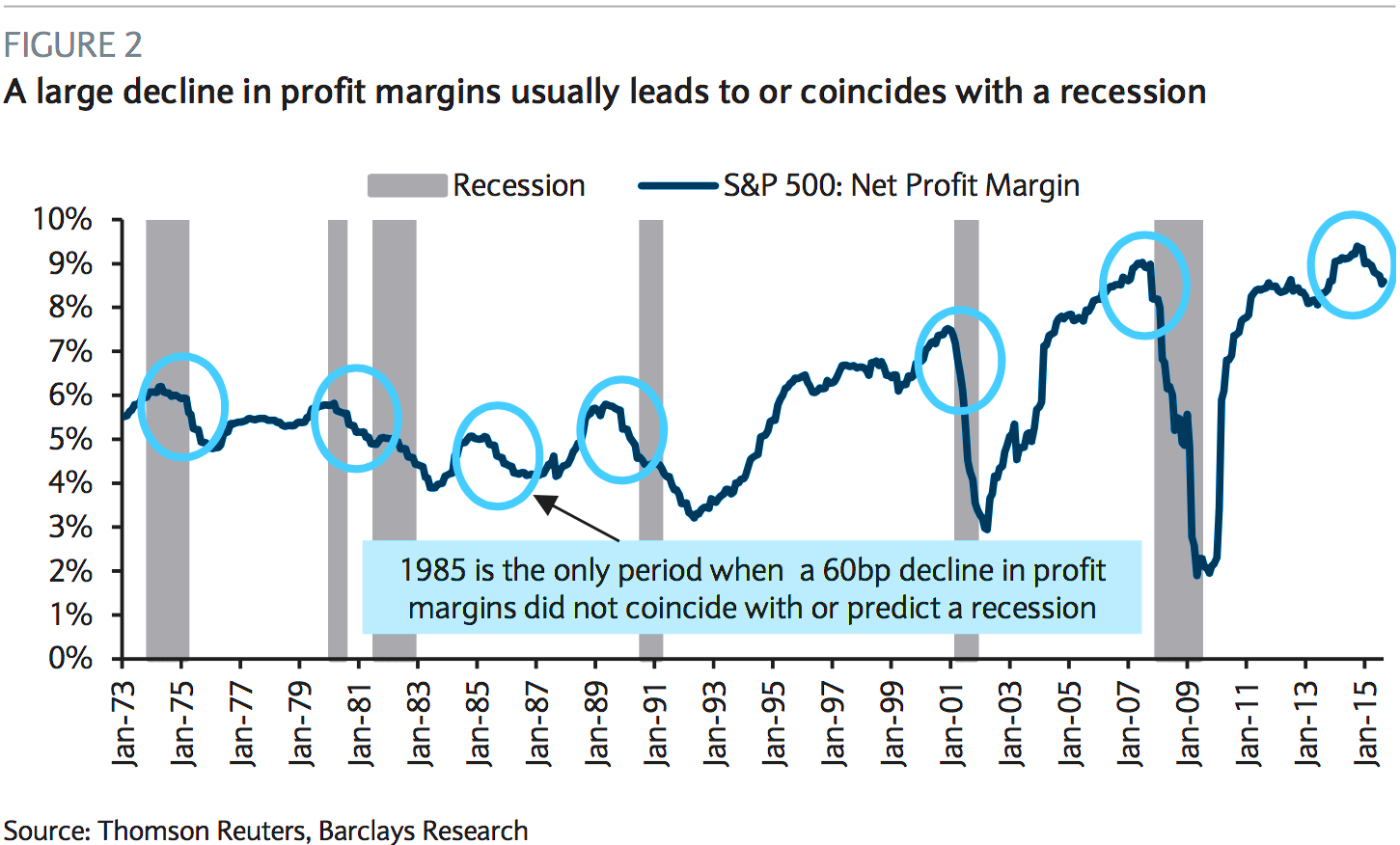
Thomson Research / Barclays Research’s take on the same theme echoes Grantham:

“The link between profit margins and recessions is strong,” Barclays’ Jonathan Glionna writes in a new note to clients. “We analyze the link between profit margins and recessions for the last seven business cycles, dating back to 1973. The results are not encouraging for the economy or the market. In every period except one, a 0.6% decline in margins in 12 months coincided with a recession.”

barclays-margin

Buffett Weighs in

Even Warren Buffett gets in on the act (from 1999):

“In my opinion, you have to be wildly optimistic to believe that corporate profits as a percent of GDP can, for any sustained period, hold much above 6%.”

warren-buffett-477

With the Illuminati chorusing as one on the perils of elevated rates of corporate profits, one would be foolish to take a contrarian view, perhaps.  And yet, that claim of Grantham’s (“probably the most mean-reverting series in finance”) poses a challenge worthy of some analysis.  Let’s take a look.

The Predictive Value of Corporate Profit Margins

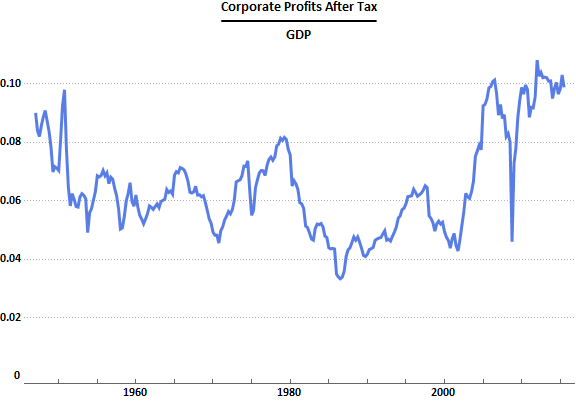
First, let’s reproduce the St Louis Fed chart:

CPGDP
Corporate Profit Margins

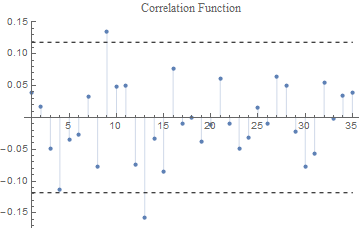
A plot of the series autocorrelations strongly suggests that the series is not at all mean-reverting, but non-stationary, integrated order 1:

CPGDPACF
Autocorrelations


Next, we conduct an exhaustive evaluation of a wide range of time series models, including seasonal and non-seasonal ARIMA and GARCH:

ModelFit ModelFitResults

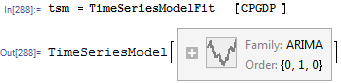
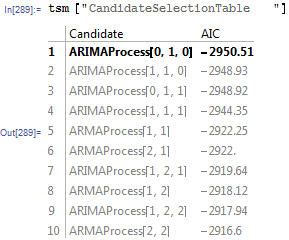
The best fitting model (using the AIC criterion) is a simple ARMA(0,1,0) model, integrated order 1, as anticipated.  The series is apparently difference-stationary, with no mean-reversion characteristics at all.  Diagnostic tests indicate no significant patterning in the model residuals:

ModelACF
Residual Autocorrelations
LjungPlot
Ljung-Box Test Probabilities

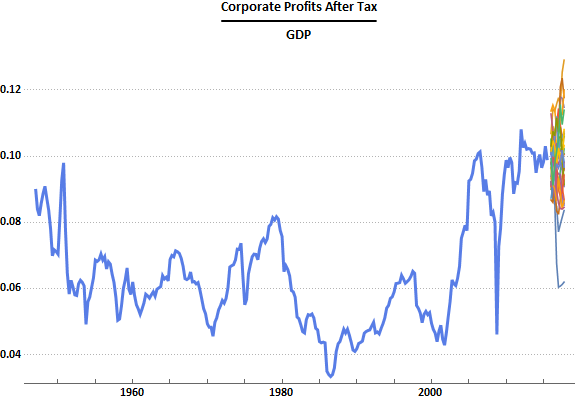
Using the model to forecast a range of possible values of the Corporate Profit to GDP ratio over the next 8 quarters suggests a very wide range, from as low as 6% to as high as 13%!

Forecast


CONCLUSION

The opinion of investment celebrities like Grantham and Buffett to the contrary, there really isn’t any evidence in the data to support the suggestion that corporate profit margins are mean reverting, even though common-sense economics suggests they should be.

The best-available econometric model produces a very wide range of forecasts of corporate profit rates over the next two years, some even higher than they are today.

If a recession is just around the corner,  corporate profit margins aren’t going to call it for us.

Alpha Extraction and Trading Under Different Market Regimes

Market Noise and Alpha Signals

One of the perennial problems in designing trading systems is noise in the data, which can often drown out an alpha signal.  This is turn creates difficulties for a trading system that relies on reading the signal, resulting in greater uncertainty about the trading outcome (i.e. greater volatility in system performance).  According to academic research, a great deal of market noise is caused by trading itself.  There is apparently not much that can be done about that problem:  sure, you can trade after hours or overnight, but the benefit of lower signal contamination from noise traders is offset by the disadvantage of poor liquidity.  Hence the thrust of most of the analysis in this area lies in the direction of trying to amplify the signal, often using techniques borrowed from signal processing and related engineering disciplines.

There is, however, one trick that I wanted to share with readers that is worth considering.  It allows you to trade during normal market hours, when liquidity is greatest, but at the same time limits the impact of market noise.

SSALGOTRADING AD

Quantifying Market Noise

How do you measure market noise?  One simple approach is to start by measuring market volatility, making the not-unreasonable assumption that higher levels of volatility are associated with greater amounts of random movement (i.e noise). Conversely, when markets are relatively calm, a greater proportion of the variation is caused by alpha factors.  During the latter periods, there is a greater information content in market data – the signal:noise ratio is larger and hence the alpha signal can be quantified and captured more accurately.

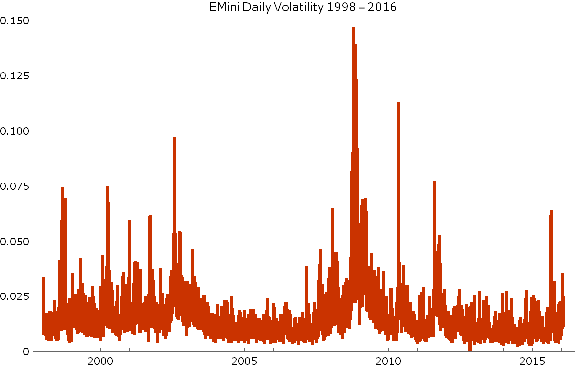
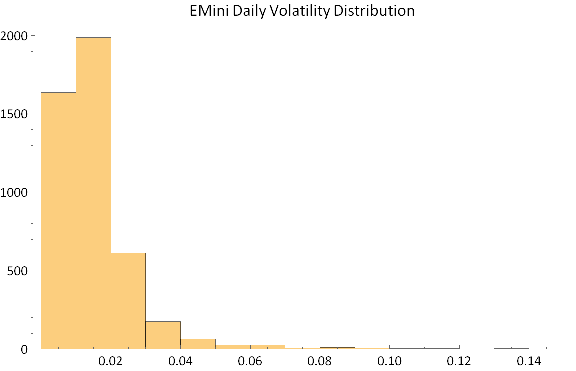
For a market like the E-Mini futures, the variation in daily volatility is considerable, as illustrated in the chart below.  The median daily volatility is 1.2%, while the maximum value (in 2008) was 14.7%!
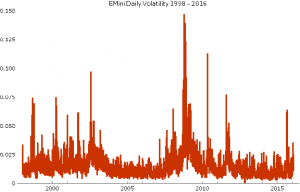
Fig1

The extremely long tail of the distribution stands out clearly in the following histogram plot.
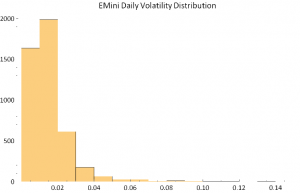
Fig 2

Obviously there are times when the noise in the process is going to drown out almost any alpha signal. What if we could avoid such periods?

Noise Reduction and Model Fitting

Let’s divide our data into two subsets of equal size, comprising days on which volatility was lower, or higher, than the median value.  Then let’s go ahead and use our alpha signal(s) to fit a trading model, using only data drawn from the lower volatility segment.

This is actually a little tricky to achieve in practice:  most software packages for time series analysis or charting are geared towards data occurring at equally spaced points in time.  One useful trick here is to replace the actual date and time values of the observations with sequential date and time values, in order to fool the software into accepting the data, since there are no longer any gaps in the timestamps.  Of course, the dates on our time series plot or chart will be incorrect. But that doesn’t matter:  as long as we know what the correct timestamps are.

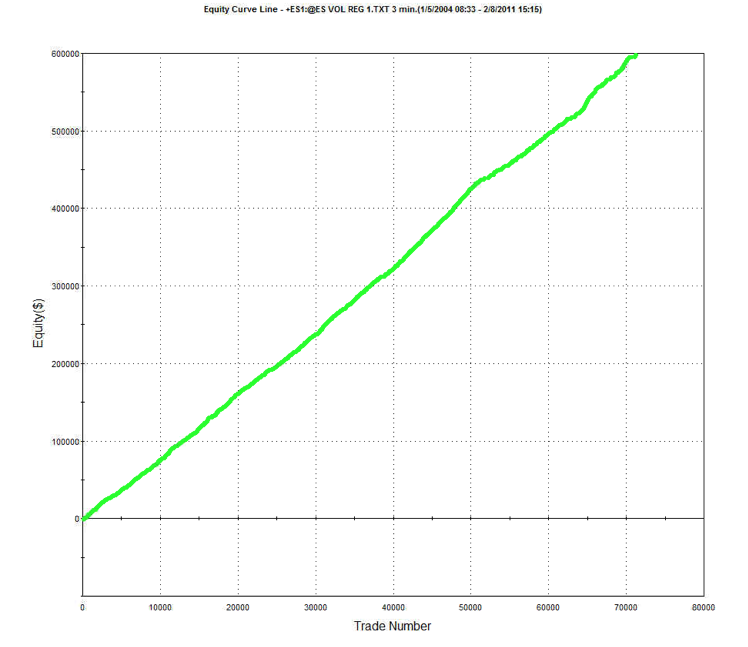
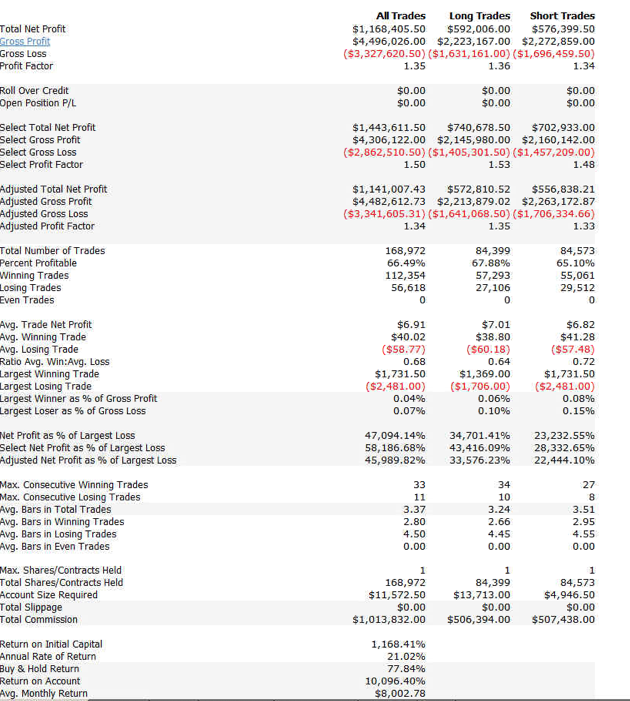
An example of such a system is illustrated below.  The model was fitted  to  3-Min bar data in EMini futures, but only on days with market volatility below the median value, in the period from 2004 to 2015.  The strategy equity curve is exceptionally smooth, as might be expected, and the performance characteristics of the strategy are highly attractive, with a 27% annual rate of return, profit factor of 1.58 and Sharpe Ratio approaching double-digits.
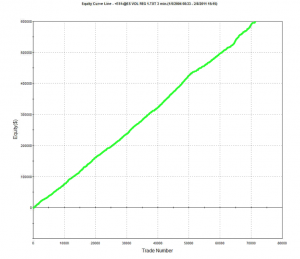
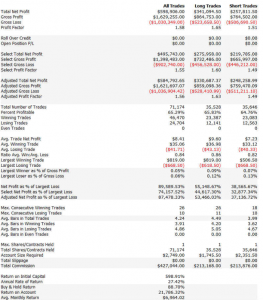
Fig 3

Fig 4

Dealing with the Noisy Trading Days

Let’s say you have developed a trading system that works well on quiet days.  What next?  There are a couple of ways to go:

(i) Deploy the model only on quiet trading days; stay out of the market on volatile days; or

(ii) Develop a separate trading system to handle volatile market conditions.

Which approach is better?  It is likely that the system you develop for trading quiet days will outperform any system you manage to develop for volatile market conditions.  So, arguably, you should simply trade your best model when volatility is muted and avoid trading at other times.  Any other solution may reduce the overall risk-adjusted return.  But that isn’t guaranteed to be the case – and, in fact, I will give an example of systems that, when combined, will in practice yield a higher information ratio than any of the component systems.

Deploying the Trading Systems

The astute reader is likely to have noticed that I have “cheated” by using forward information in the model development process.  In building a trading system based only on data drawn from low-volatility days, I have assumed that I can somehow know in advance whether the market is going to be volatile or not, on any given day.  Of course, I don’t know for sure whether the upcoming session is going to be volatile and hence whether to deploy my trading system, or stand aside.  So is this just a purely theoretical exercise?  No, it’s not, for the following reasons.

The first reason is that, unlike the underlying asset market, the market volatility process is, by comparison, highly predictable.  This is due to a phenomenon known as “long memory”, i.e. very slow decay in the serial autocorrelations of the volatility process.  What that means is that the history of the volatility process contains useful information about its likely future behavior.  [There are several posts on this topic in this blog – just search for “long memory”].  So, in principle, one can develop an effective system to forecast market volatility in advance and hence make an informed decision about whether or not to deploy a specific model.

But let’s say you are unpersuaded by this argument and take the view that market volatility is intrinsically unpredictable.  Does that make this approach impractical?  Not at all.  You have a couple of options:

You can test the model built for quiet days on all the market data, including volatile days.  It may perform acceptably well across both market regimes.

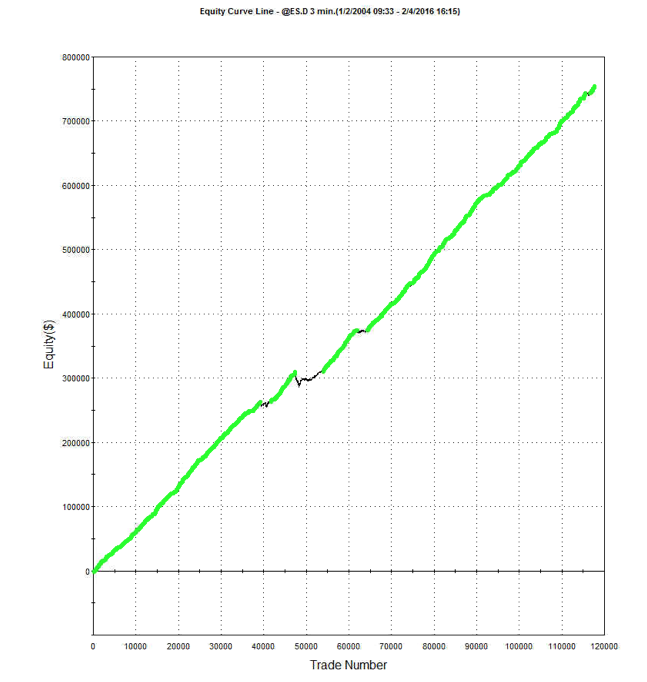
For example, here are the results of a backtest of the model described above on all the market data, including volatile and quiet periods, from 2004-2015.  While the performance characteristics are not quite as good, overall the strategy remains very attractive.
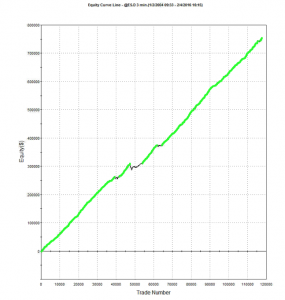
Fig 5

Fig 6


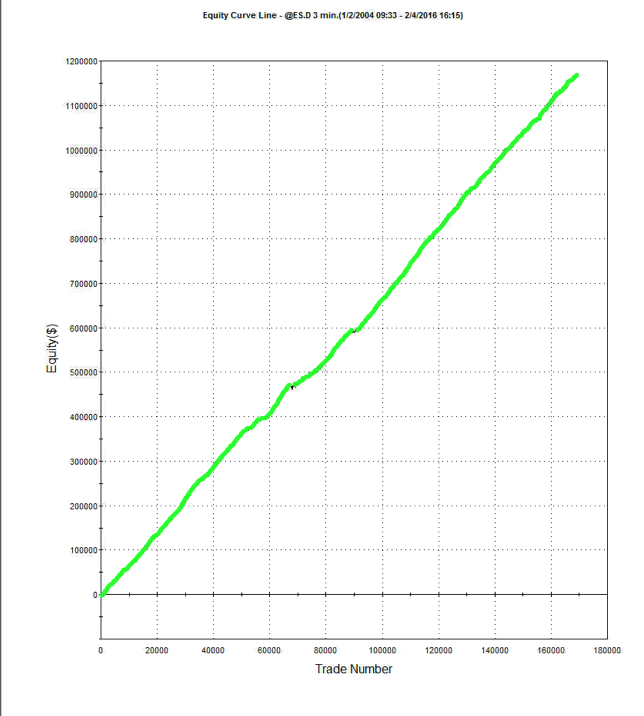
Another approach is to develop a second model for volatile days and deploy both low- and high-volatility regime models simultaneously.  The trading systems will interact (if you allow them to) in a highly nonlinear and unpredictable way.  It might turn out badly – but on the other hand, it might not!  Here, for instance, is the result of combining low- and high-volatility models simultaneously for the Emini futures and running them in parallel.  The result is an improvement (relative to the low volatility model alone), not only in the annual rate of return (21% vs 17.8%), but also in the risk-adjusted performance, profit factor and average trade.
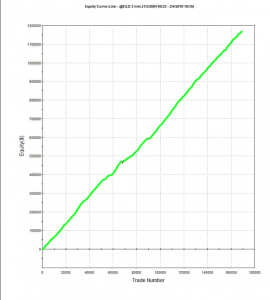
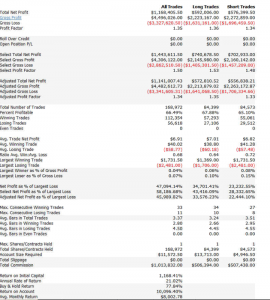
Fig 7

Fig 8


CONCLUSION

Separating the data into multiple subsets representing different market regimes allows the system developer to amplify the signal:noise ratio, increasing the effectiveness of his alpha factors. Potentially, this allows important features of the underlying market dynamics to be captured in the model more easily, which can lead to improved trading performance.

Models developed for different market regimes can be tested across all market conditions and deployed on an everyday basis if shown to be sufficiently robust.  Alternatively, a meta-strategy can be developed to forecast the market regime and select the appropriate trading system accordingly.

Finally, it is possible to achieve acceptable, or even very good results, by deploying several different models simultaneously and allowing them to interact, as the market moves from regime to regime.


 

Enhancing Mutual Fund Returns With Market Timing

Summary

In this article, I will apply market timing techniques to several popular mutual funds.

The market timing approach produces annual rates of return that are 3% to 7% higher, with lower risk, than an equivalent buy and hold mutual fund investment.

Investors could in some cases have earned more than double the return achieved by holding a mutual fund investment over a 10-year period.

Hedging strategies that use market timing signals are able to sidestep market corrections, volatile conditions and the ensuing equity drawdowns.

Hedged portfolios typically employ around 12% less capital than the equivalent buy and hold strategy.

Background to the Market Timing Approach

In an earlier article, I discussed how to use marketing timing techniques to hedge an equity portfolio correlated to the broad market. I showed how, by using signals produced by a trading system modeled on the CBOE VIX index, we can smooth out volatility in an equity portfolio consisting of holdings in the SPDR S&P 500 ETF (NYSEARCA:SPY). An investor will typically reduce their equity holdings by a modest amount, say 20%, or step out of the market altogether during periods when the VIX index is forecast to rise, returning to the market when the VIX is likely to fall. An investment strategy based on this approach would have avoided most of the 2000-03 correction, as well as much of the market turmoil of 2008-09.

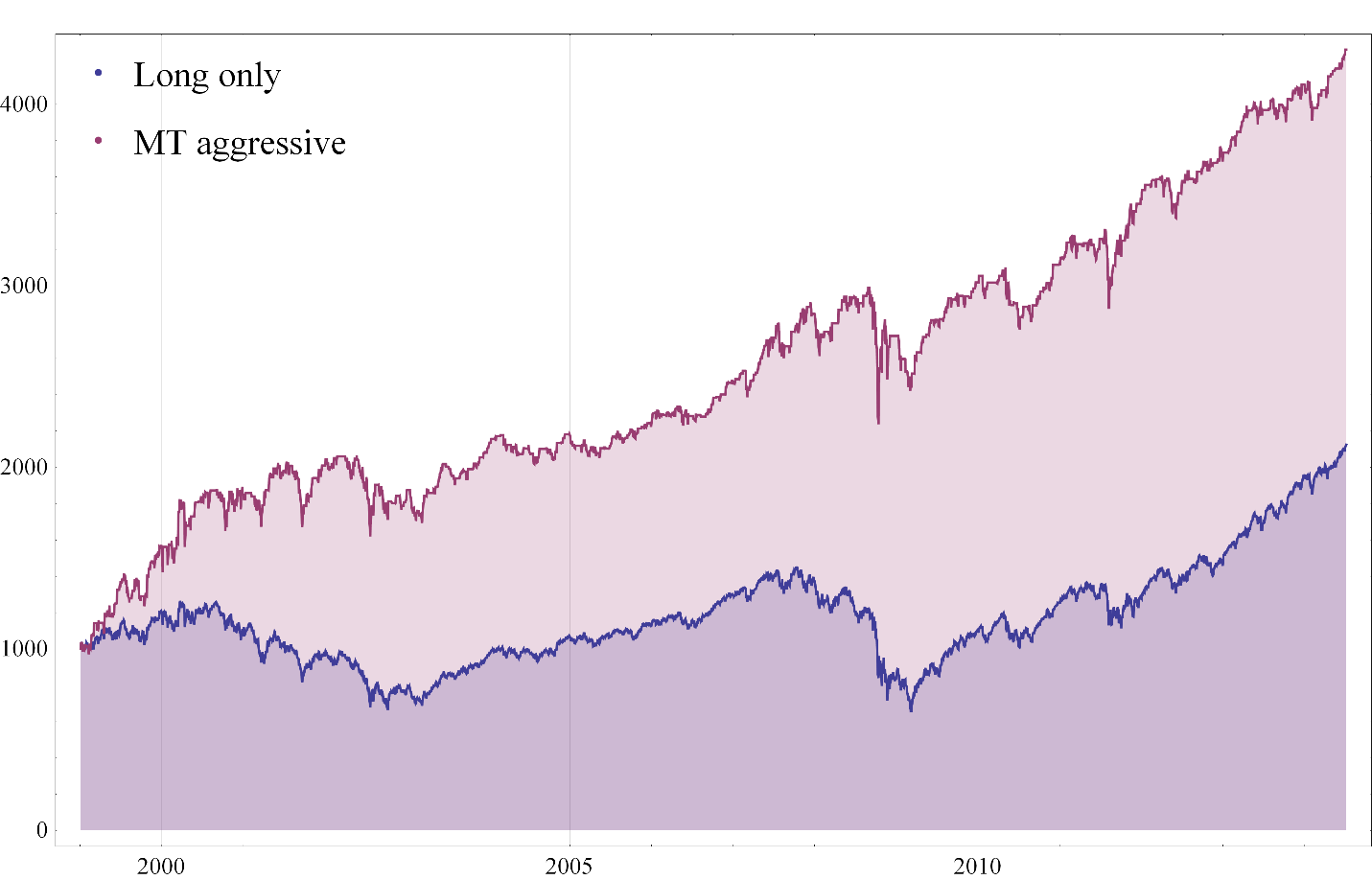
A more levered version of the hedging strategy, which I termed the MT aggressive portfolio, uses the VIX index signals to go to cash during high volatility periods, and then double the original equity portfolio holdings (using standard Reg-T leverage) during benign market conditions, as signaled by the model. The MT aggressive approach would have yielded net returns almost three times greater than that of a buy and hold portfolio in the SPY ETF, over the period from 1999-2014. Even though this version of the strategy makes use of leverage, the average holding in the portfolio would have been slightly lower than in the buy and hold portfolio because, in a majority of days, the strategy would have been 100% in cash. The result is illustrated in the chart in Fig. 1, which is reproduced below.

Fig. 1: Value of $1,000 – Long-Only Vs. MT Aggressive Portfolio

Source: Yahoo Finance.

Note that this approach does not entail shorting any stock. And for investors who prefer to buy and hold, I would make the point that the MT aggressive approach would have enabled you to buy almost three times as much stock in dollar terms by mid-2014 than would be the case if you had simply owned the SPY portfolio over the entire period.

SSALGOTRADING AD

Market Timing and Mutual Funds

With that background, we turn our attention to how we can use market timing techniques to improve returns from equity mutual funds. The funds selected for analysis are the Vanguard 500 Index Admiral (MUTF:VFIAX), Fidelity Spartan 500 Index Advtg (MUTF:FUSVX) and BlackRock S&P 500 Stock K (MUTF:WFSPX). This group of popular mutual funds is a representative sample of available funds that offer broad equity market exposure, with a high degree of correlation to the S&P 500 index. In what follows, we will focus attention on the MT aggressive approach, although other more conservative hedging strategies are equally valid.

We consider performance over the 10-year period from 2005, as at least one of the funds opened late in 2004. In each case, the MT aggressive portfolio is created by exiting the current mutual fund position and going 100% to cash, whenever the VIX model issues a buy signal in the VIX index. Conversely, we double our original mutual fund investment when the model issues a sell signal in the VIX index. In calculating returns, we make an allowance for trading costs of $3 cents per share for all transactions.

Returns for each of the mutual funds, as well as for the SPY ETF and the corresponding MT aggressive hedge strategies, are illustrated in the charts in Fig. 2. The broad pattern is similar in each case – we see significant outperformance of the MT aggressive portfolios relative to their ETF or mutual fund benchmarks. Furthermore, in most cases the hedge strategy tends to exhibit lower volatility, with less prolonged drawdowns during critical periods such as 2000/03 and 2008/09.

Fig. 2 – Value of $1,000: Mutual Fund Vs. MT Aggressive Portfolio January 2005 – June 2014

Source: Yahoo Finance.

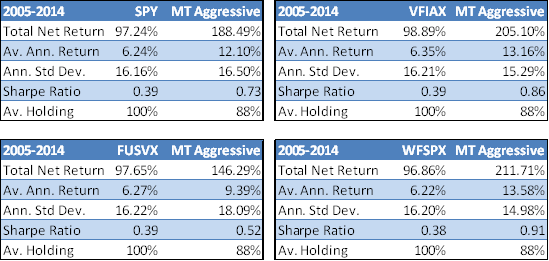
Looking at the performance numbers in more detail, we can see from the tables shown in Fig. 3 that the MT aggressive strategies outperformed their mutual fund buy and hold benchmarks by a substantial margin. In the case of VFIAX and WFSPX, the hedge strategies produce a total net return more than double that of the corresponding mutual fund. With one exception, FUSVX, annual volatility of the MT aggressive portfolio was similar to, or lower than, that of the corresponding mutual fund, confirming our reading of the charts in Fig. 2. As a consequence, the MT aggressive strategies have higher Sharpe Ratios than any of the mutual funds. The improvement in risk adjusted returns is significant – more than double in the case of two of the funds, and about 40% higher in the case of the third.

Finally, we note that the MT aggressive strategies have an average holding that is around 12% lower than the equivalent long-only fund. That’s because of the periods in which investment proceeds are held in cash.

Fig. 3: Mutual Fund and MT Aggressive Portfolio Performance January 2005 – June 2014

Mutual Fund vs. MT Aggressive Portfolio Performance

Source: Yahoo Finance.

Conclusion

The aim of market timing is to smooth out the returns by hedging, and preferably avoiding altogether periods of market turmoil. In other words, the objective is to achieve the same, or better, rates of return, with lower volatility and drawdowns. We have demonstrated that this can be done, not only when the underlying investment is in an ETF such as SPY, but also where we hold an investment in one of several popular equity mutual funds. Over a 10-year period the hedge strategies produced consistently higher returns, with lower volatility and drawdown, while putting less capital at risk than their counterpart buy and hold mutual fund investments.