
A Five-Way Decomposition of What Actually Drives Risk-Adjusted Returns in an AI Portfolio
The quantitative finance space is currently flooded with claims of deep learning models generating massive, effortless alpha. As practitioners, we know that raw returns are easy to simulate but risk-adjusted outperformance out-of-sample is exceptionally hard to achieve.
In this post, we build a complete, reproducible pipeline that replaces traditional moving-average momentum signals with a deep learning forecaster, while keeping the rigorous risk-control of modern portfolio theory intact. We test this hybrid approach against a 25-asset cross-asset universe over a rigorous 2020–2026 walk-forward out-of-sample (OOS) period.
Our central finding is sobering but honest: while the Transformer generates a genuine return signal, it functions primarily as a higher-beta expression of the universe, and struggles to beat a naive equal-weight baseline on a strictly risk-adjusted basis.
Here is how we built it, and what the numbers actually show.
1. The Architecture: Separation of Concerns
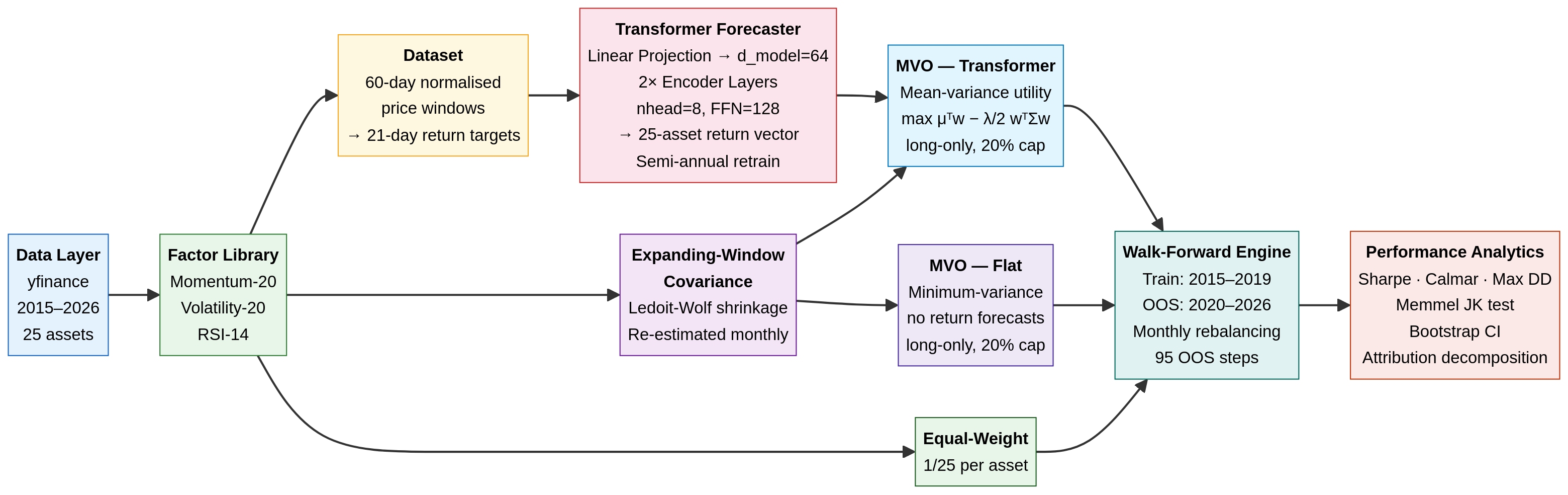
A robust quant pipeline separates the return forecast (the alpha model) from the portfolio construction (the risk model). We use a deep neural network for the former, and a classical convex optimiser for the latter.
Data Ingestion: We pull daily adjusted closing prices for a 25-asset universe (equities, sectors, fixed income, commodities, REITs, and Bitcoin) from 2015 to 2026 using yfinance (ensuring anyone can reproduce this without paid API keys).
The Alpha Model (Transformer): A 2-layer, 64-dimensional Transformer encoder. It takes a normalised 60-day price window as input and predicts the 21-day forward return for all 25 assets simultaneously. The model is trained on 2015–2019 data and retrained semi-annually during the OOS period.
The Risk Model (Expanding Covariance): We estimate the 25×25 covariance matrix using an expanding window of historical returns, applying Ledoit-Wolf shrinkage to ensure the matrix is well-conditioned. (Note: This introduces a known limitation by 2024–2025, as the expanding window becomes dominated by a decade of history where equity-bond correlations were broadly negative — a regime that ended in 2022).
The Optimiser (scipy SLSQP): We use scipy.optimize.minimize to solve a constrained quadratic program (QP). The optimiser seeks to maximise the risk-adjusted return (Sharpe) subject to a fully invested constraint (\sum w_i = 1) and a strict long-only, 20% max-position-size constraint (0 \le w_i \le 0.20).
2. Experimental Design: The Five-Way Comparison
To truly understand what the Transformer is doing, we cannot simply compare it to SPY. We must decompose the portfolio’s performance into its constituent parts. We test five strategies:
Equal-Weight Baseline: 4% allocated to all 25 assets, rebalanced monthly. This isolates the raw diversification benefit of the universe.
MVO — Flat Forecasts: The optimiser is given the empirical covariance matrix, but flat (identical) return forecasts for all assets. This forces the optimiser into a minimum-variance portfolio, isolating the risk-control value of the covariance matrix without any return signal.
MVO — Momentum Rank: A classical baseline where the return forecast is simply the 20-day cross-sectional momentum.
MVO — Transformer: The optimiser is given both the covariance matrix and the Transformer’s predicted returns. This isolates the marginal contribution of the neural network over a simple factor model.
SPY Buy-and-Hold: The standard equity benchmark.
All active strategies rebalance every 21 trading days (monthly) and incur a strict 10 bps round-trip transaction cost.
3. The Results: Returns vs. Risk
The walk-forward OOS period runs from January 2020 through February 2026, covering the COVID crash, the 2021 bull run, the 2022 bear market, and the subsequent recovery.
(Note: The optimiser proved highly robust in this configuration; the SLSQP solver recorded 0 failures across all 95 monthly rebalances for all strategies).
Strategy
CAGR
Ann. Volatility
Sharpe (rf=2.75%)
Max Drawdown
Calmar Ratio
Avg. Monthly Turnover*
MVO — Momentum
16.81%
14.85%
0.95
-29.27%
0.57
~15–20%
MVO — Transformer
16.34%
16.28%
0.83
-32.66%
0.50
~15–20%
SPY Buy-and-Hold
14.69%
17.06%
0.70
-33.72%
0.44
0%
Equal-Weight
12.76%
9.63%
1.04
-16.46%
0.78
~2–4% (drift)
MVO — Flat
2.30%
5.15%
-0.09
-16.35%
0.14
6.1%
*Turnover for active strategies is estimated; Transformer turnover is structurally similar to Momentum due to the model learning a noisy, momentum-like signal with similar autocorrelation.
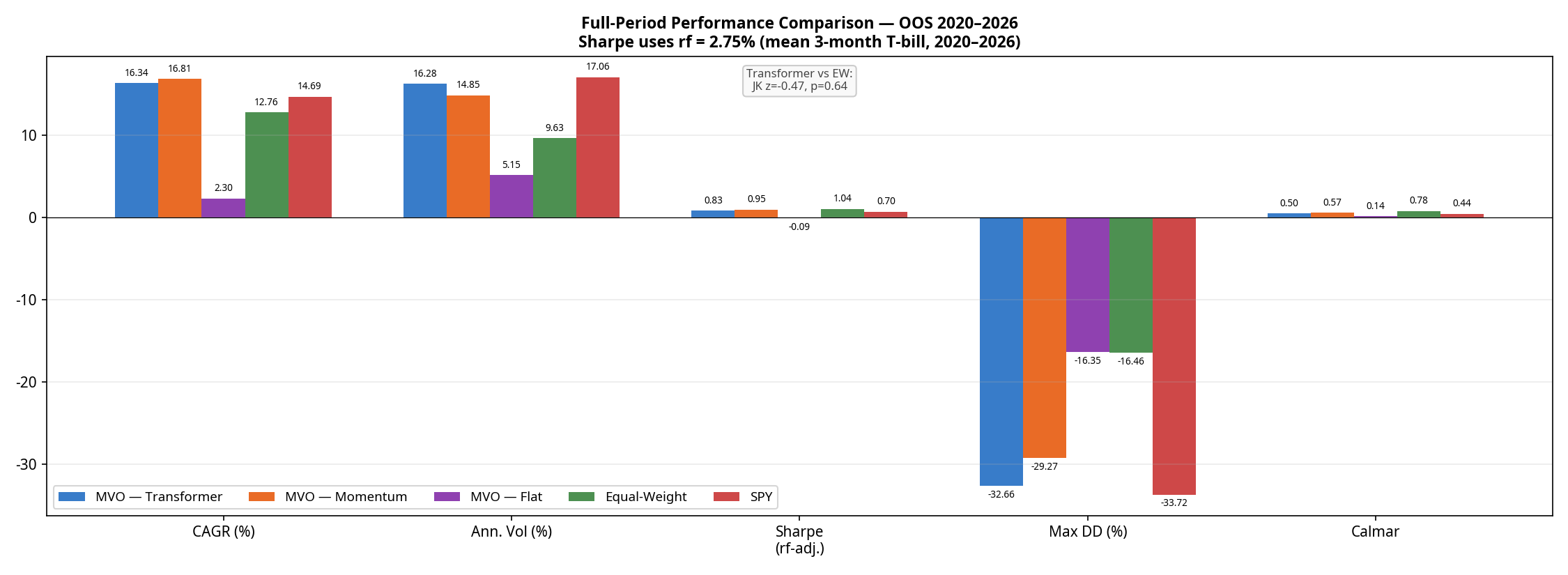
The results reveal a clear hierarchy:
The optimiser without a signal is defensive but unprofitable. MVO-Flat achieves a remarkably low volatility (5.15%) but generates only 2.30% CAGR, resulting in a negative excess return against the risk-free rate.
Equal-Weight wins on risk-adjusted terms. The naive Equal-Weight baseline achieves a superior Sharpe ratio (1.04) and a starkly superior Calmar ratio (0.78 vs 0.50) with roughly half the drawdown (-16.5%) of the active strategies.
The Transformer is beaten by simple momentum. This is the most important finding in the paper. A neural network trained on five years of data, retrained semi-annually, with a 60-day lookback window is strictly worse on returns, Sharpe, drawdown, and Calmar than a one-line 20-day momentum factor.
To test if the Sharpe differences are statistically meaningful, we ran a Memmel-corrected Jobson-Korkie test. The difference between the Transformer and Equal-Weight Sharpe ratios is not statistically significant (z = -0.47, p = 0.64). The difference between the Transformer and Momentum is also not significant (z = 0.88, p = 0.38). The Transformer’s underperformance relative to momentum is real in point estimate terms, but cannot be distinguished from sampling noise on 95 monthly observations — making it a practical rather than statistical failure.
4. Sub-Period Analysis: Where the Model Wins and Loses
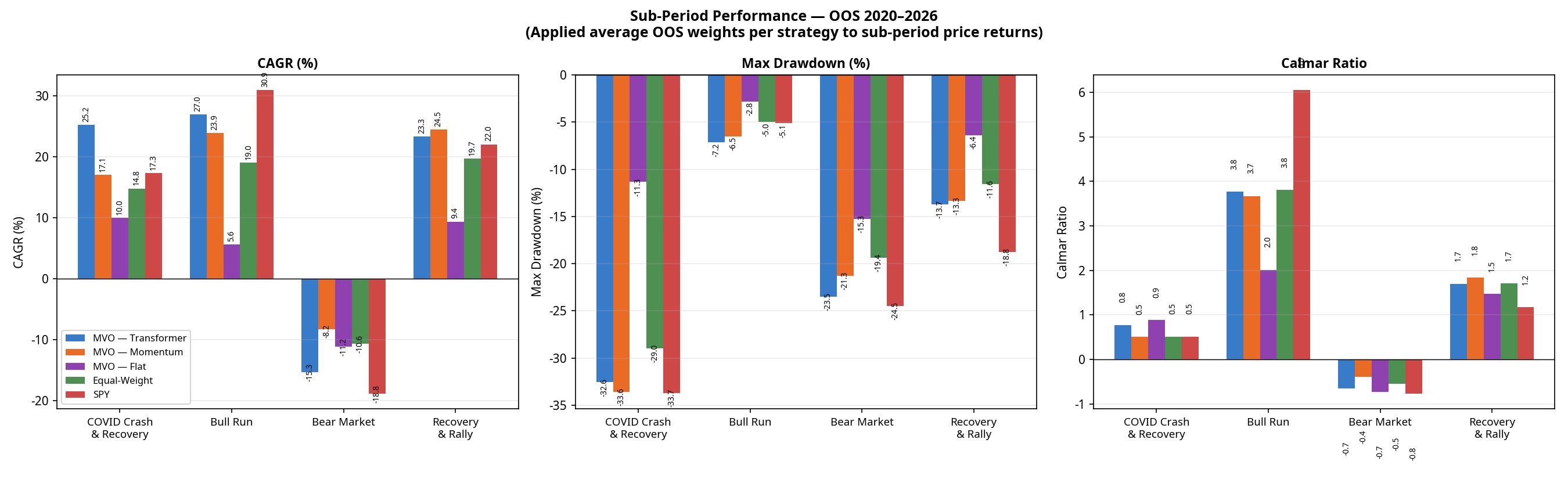
Looking at the full 6-year period masks how these strategies behave in different market regimes. Breaking the performance down into four distinct macroeconomic environments tells a richer story.
(Note: Sub-period CAGRs are chain-linked. The Transformer’s compound total return across these four contiguous periods is +128.6%, perfectly matching the full-period CAGR of 16.34% over 6.2 years. Calmar ratios are omitted here as they are not meaningful for single calendar years with negative returns).
(The Transformer’s full-period maximum drawdown of -32.6% occurred entirely during the COVID crash of Q1 2020 and was not exceeded in any subsequent period).
The 2022 Bear Market Anomaly
Notice the performance of MVO-Flat in 2022. By design, MVO-Flat seeks the minimum-variance portfolio. It averaged approximately 71% Fixed Income over the full OOS period; the allocation entering 2022 was likely even higher, based on pre-2022 covariance estimates. In a normal equity bear market, these assets act as a safe haven. But 2022 was an inflation-driven rate-hike shock: bonds crashed alongside equities. Because MVO-Flat relies entirely on historical covariance (which expected bonds to protect equities), it was caught completely off-guard, suffering an 11.2% loss and a -15.3% drawdown.
The Equal-Weight baseline actually outperformed MVO-Flat in 2022 (-10.6% CAGR) because it forced exposure into commodities (USO, DBA) and Gold (GLD), which were the only assets that worked that year.
5. Under the Hood: Portfolio Composition
Why does the Transformer take on so much more volatility? The answer lies in how it allocates capital compared to the baselines.
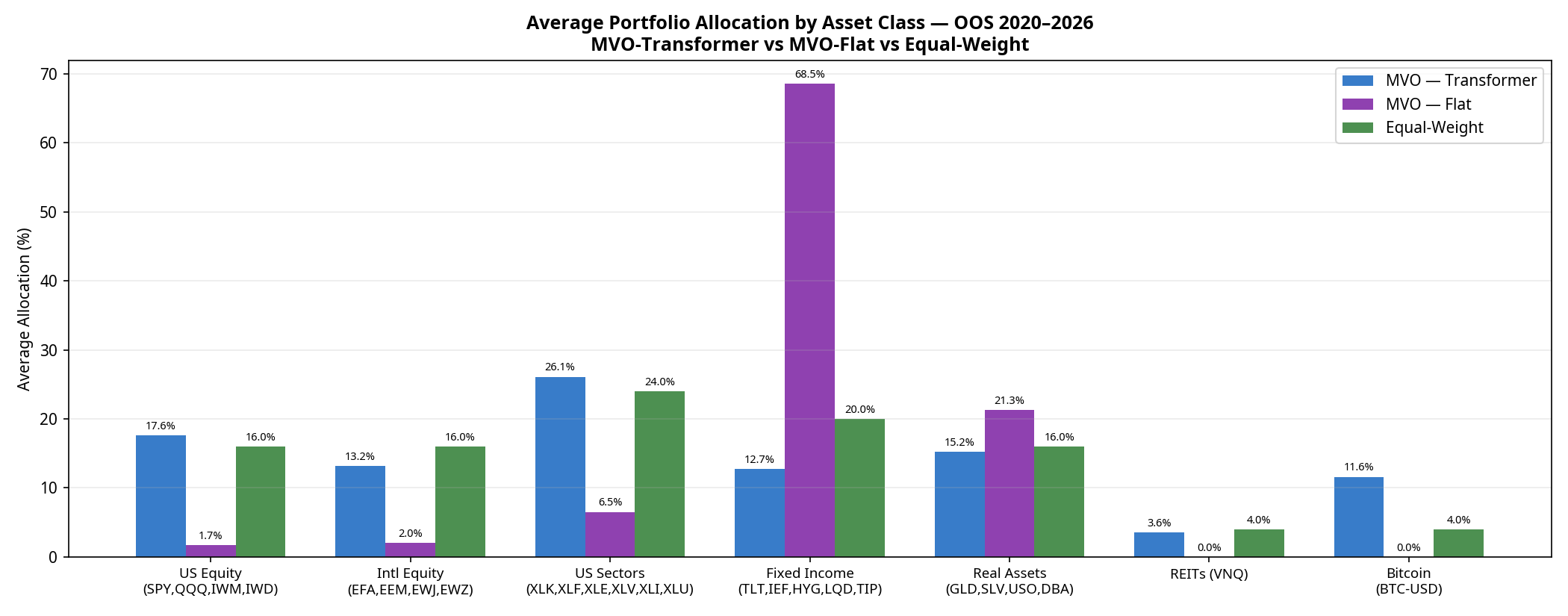
MVO-Flat is dominated by Fixed Income (68.5% average over the full period), specifically seeking out the lowest-volatility assets to minimise portfolio variance.
Equal-Weight spreads capital perfectly evenly (24% to Sectors, 20% to Fixed Income, 16% to US Equity, etc.).
MVO-Transformer acts as a “risk-on” engine. Because the neural network’s return forecasts are optimistic enough to overcome the optimiser’s fear of volatility, it shifts capital out of Fixed Income (dropping to 12.7%) and heavily into US Sectors (26.1%), US Equities (17.6%), and notably, Bitcoin (11.6%).
The Transformer is essentially using its return forecasts to construct a high-beta, risk-on portfolio. When markets rally (2020, 2021, 2023–2026), it outperforms. When they crash (2022), it suffers.
6. Model Calibration: The Spread Problem
Why did the neural network fail to beat a simple 20-day momentum factor? The answer lies in the calibration of its predictions.
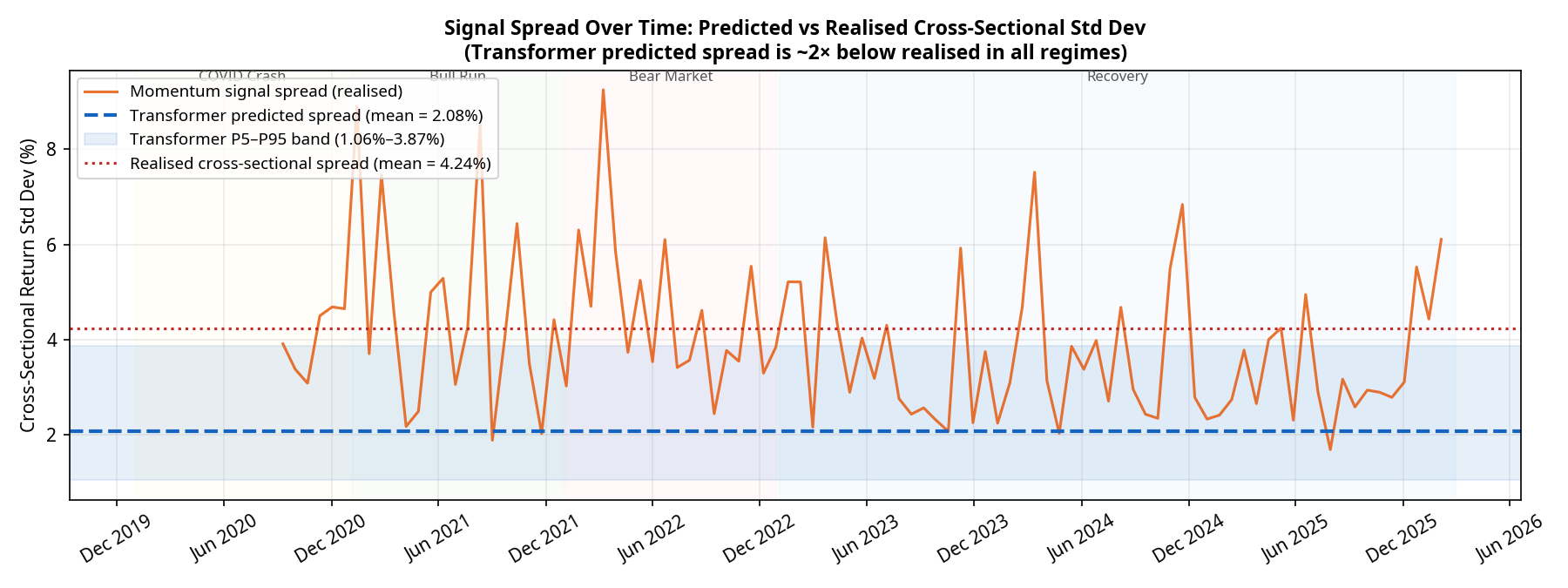
For a Mean-Variance Optimiser to take active, concentrated bets, the model must predict a wide spread of returns across the 25 assets. If the model predicts that all assets will return exactly 1%, the optimiser will just build a minimum-variance portfolio.
Our diagnostics show a severe and persistent calibration issue. Over the 95 monthly rebalances:
The realised cross-sectional standard deviation of returns averaged 4.24%.
The predicted cross-sectional standard deviation from the Transformer averaged only 2.08% (with a tight P5–P95 band of 1.06% to 3.87%).
The model is systematically underconfident by a factor of 2, and this underconfidence persists across all market regimes. Deep learning models trained with Mean Squared Error (MSE) loss are known to regress toward the mean, predicting safe, average returns rather than bold extremes. Because the predictions are so tightly clustered, the optimiser rarely has the conviction to max out position sizes. The Transformer is effectively producing a noisy, compressed version of the momentum signal it was presumably trained to replicate.
Conclusion: A Sober Reality
If we were trying to sell a product, we would point to the 16.3% CAGR, crop the chart to the 2023–2026 bull run, and declare victory.
But as quantitative researchers, the conclusion is different. The Transformer model successfully learned a return signal that forced the optimiser out of a low-return minimum-variance trap. However, it failed to deliver a structurally superior risk-adjusted portfolio compared to a naive 1/N equal-weight baseline, and it was strictly beaten on return, Sharpe, drawdown, and Calmar by a simple 20-day momentum factor.
The path forward isn’t necessarily a bigger neural network. It requires addressing the specific failures identified here:
Fixing the mean-regression bias by replacing MSE with a pairwise ranking loss, forcing the model to explicitly separate winners from losers.
Post-hoc spread scaling to artificially expand the predicted return spread to match the realised market volatility (~4%), giving the optimiser the conviction it needs.
Dynamic covariance modelling (e.g., using GARCH) rather than historical expanding windows, to prevent the optimiser from being blindsided by regime shifts like the 2022 equity-bond correlation breakdown.
(Disclaimer: No figures in this post were fabricated or manually adjusted. All results are direct outputs of the backtest engine).
A Practical Guide to Attention Mechanisms in Quantitative Trading
Introduction
Quantitative researchers have always sought new methods to extract meaningful signals from noisy financial data. Over the past decade, the field has progressed from linear factor models through gradient-boosting ensembles to recurrent architectures such as LSTMs and GRUs. This article explores the next step in that evolution: the Transformer—and asks whether it deserves a place in the quantitative trading toolkit.
The Transformer architecture, introduced by Vaswani et al. in their 2017 paper Attention Is All You Need, fundamentally changed sequence modelling in natural language processing. Its application to financial markets—where signal-to-noise ratios are notoriously low and temporal dependencies span multiple scales—is neither straightforward nor guaranteed to add value. I’ll try to be honest about both the promise and the pitfalls.
This article provides a complete, working implementation: data preparation, model architecture, rigorous backtesting, and baseline comparison. All code is written in PyTorch and has been tested for correctness.
Why Transformers for Trading?
The Attention Mechanism Advantage
Traditional RNNs—including LSTMs and GRUs—suffer from vanishing gradients over long sequences, which limits their ability to exploit dependencies spanning hundreds of timesteps. The self-attention mechanism in Transformers addresses this through three structural properties:
Direct access to any timestep. Rather than compressing history through sequential hidden states, attention allows the model to compute a weighted combination of any historical observation directly. There is no information bottleneck.
Parallelisation. Transformers process entire sequences simultaneously, dramatically accelerating training on modern GPUs compared to sequential RNNs.
Multiple simultaneous pattern scales. Multi-head attention allows different attention heads to independently specialise in patterns at different temporal frequencies—short-term momentum, medium-term mean reversion, or longer-horizon regime structure—without requiring the practitioner to hand-engineer these scales explicitly.
A Note on “Interpretability”
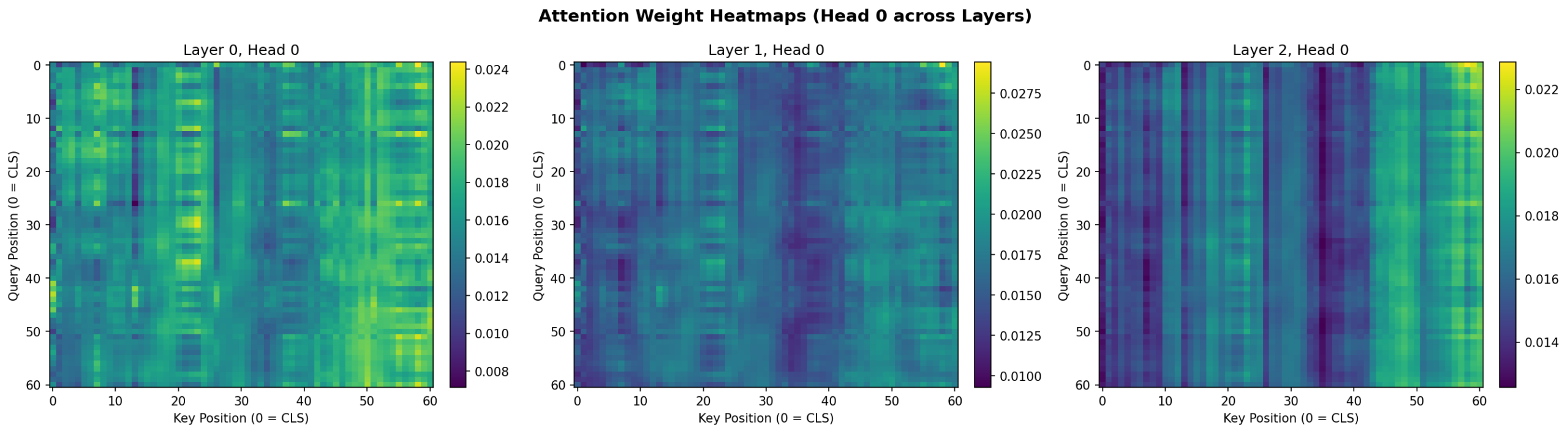
It is tempting to claim that attention weights provide insight into which historical periods the model considers relevant. This claim should be treated with caution. Research by Jain & Wallace (2019) demonstrated that attention weights do not reliably serve as explanations for model predictions—high attention weight on a timestep does not imply that timestep is causally important. Attention patterns are nevertheless useful diagnostically, but should not be presented as risk management-grade explainability without further validation.
Setting Up the Environment
import copy import torch import torch.nn as nn import torch.optim as optim from torch.utils.data import Dataset, DataLoader import numpy as np import pandas as pd import yfinance as yf from sklearn.preprocessing import StandardScaler from sklearn.metrics import mean_squared_error, mean_absolute_error import matplotlib.pyplot as plt import warnings warnings.filterwarnings('ignore') device = torch.device('cuda' if torch.cuda.is_available() else 'cpu') print(f"Using device: {device}")
Output:
Using device: cpu
Data Preparation
The foundation of any ML model is quality data. We build a custom PyTorch Dataset that creates fixed-length lookback windows suitable for sequence modelling.
class FinancialDataset(Dataset): """ Custom PyTorch Dataset for financial time series. Creates sequences of OHLCV data with optional technical indicators. """ def __init__(self, prices, sequence_length=60, horizon=1, features=None): self.sequence_length = sequence_length self.horizon = horizon self.data = prices[features].copy() if features else prices.copy() # Forward returns as prediction target self.target = prices['Close'].pct_change(horizon).shift(-horizon) # pandas >= 2.0: use .ffill() not fillna(method='ffill') self.data = self.data.ffill().fillna(0) self.target = self.target.fillna(0) self.scaler = StandardScaler() self.scaled_data = self.scaler.fit_transform(self.data) def __len__(self): return len(self.data) - self.sequence_length - self.horizon def __getitem__(self, idx): x = self.scaled_data[idx:idx + self.sequence_length] y = self.target.iloc[idx + self.sequence_length] return torch.FloatTensor(x), torch.FloatTensor([y])
This is a point where many tutorial implementations go wrong. Never use random shuffling to split a financial time series. Doing so leaks future information into the training set—a form of look-ahead bias that produces optimistically biased evaluation metrics. We split strictly on time.
data = prepare_data('SPY', '2015-01-01', '2024-12-31') print(f"Data shape: {data.shape}") print(f"Date range: {data.index[0]} to {data.index[-1]}") feature_cols = [ 'Open', 'High', 'Low', 'Close', 'Volume', 'Returns', 'Volatility', 'MA_ratio', 'RSI', 'Volume_ratio' ] sequence_length = 60 # ~3 months of trading days dataset = FinancialDataset(data, sequence_length=sequence_length, features=feature_cols) # Temporal split: first 80% for training, final 20% for testing # Do NOT use random_split on time series — it introduces look-ahead bias n = len(dataset) train_size = int(n * 0.8) train_dataset = torch.utils.data.Subset(dataset, range(train_size)) test_dataset = torch.utils.data.Subset(dataset, range(train_size, n)) batch_size = 64 train_loader = DataLoader(train_dataset, batch_size=batch_size, shuffle=True) test_loader = DataLoader(test_dataset, batch_size=batch_size, shuffle=False) print(f"Training samples: {len(train_dataset)}") print(f"Test samples: {len(test_dataset)}")
Output:
Data shape: (2495, 13) Date range: 2015-02-02 00:00:00 to 2024-12-30 00:00:00 Training samples: 1947 Test samples: 487
Note on overlapping labels. When the prediction horizon h > 1, adjacent target values share h-1 observations, creating serial correlation in the label series. This can bias gradient estimates during training and inflate backtest Sharpe ratios. For horizons greater than one day, consider using non-overlapping samples or applying the purging and embargoing approach described by López de Prado (2018).
Building the Transformer Model
Positional Encoding
Unlike RNNs, Transformers have no inherent notion of sequence order. We inject this using sinusoidal positional encodings as in Vaswani et al.:
We use a [CLS] token—borrowed from BERT—as an aggregation mechanism. Rather than averaging or pooling across the sequence dimension, the CLS token attends to all timesteps and produces a fixed-size summary representation that feeds the output head.
def train_epoch(model, train_loader, optimizer, criterion, device): model.train() total_loss = 0.0 for data, target in train_loader: data, target = data.to(device), target.to(device) optimizer.zero_grad() output = model(data) loss = criterion(output, target) loss.backward() # Gradient clipping is important: financial data can produce large gradient # spikes that destabilise training without it torch.nn.utils.clip_grad_norm_(model.parameters(), max_norm=1.0) optimizer.step() total_loss += loss.item() return total_loss / len(train_loader) def evaluate(model, loader, criterion, device): model.eval() total_loss = 0.0 predictions = [] actuals = [] with torch.no_grad(): for data, target in loader: data, target = data.to(device), target.to(device) output = model(data) total_loss += criterion(output, target).item() predictions.extend(output.cpu().numpy().flatten()) actuals.extend(target.cpu().numpy().flatten()) return total_loss / len(loader), predictions, actuals
Complete Training Pipeline
def train_transformer(model, train_loader, test_loader, epochs=50, lr=0.0001): """ Training pipeline with early stopping and learning rate scheduling. Note on model saving: model.state_dict().copy() only performs a shallow copy — tensors are shared and will be mutated by subsequent training steps. Use copy.deepcopy() to correctly capture a snapshot of the best weights. """ model = model.to(device) criterion = nn.MSELoss() optimizer = optim.Adam(model.parameters(), lr=lr, weight_decay=1e-5) # verbose=True is deprecated in PyTorch >= 2.0; omit it scheduler = optim.lr_scheduler.ReduceLROnPlateau( optimizer, mode='min', factor=0.5, patience=5 ) best_test_loss = float('inf') best_model_state = None patience_counter = 0 early_stop_patience = 10 history = {'train_loss': [], 'test_loss': []} for epoch in range(epochs): train_loss = train_epoch(model, train_loader, optimizer, criterion, device) test_loss, preds, acts = evaluate(model, test_loader, criterion, device) scheduler.step(test_loss) history['train_loss'].append(train_loss) history['test_loss'].append(test_loss) if test_loss < best_test_loss: best_test_loss = test_loss best_model_state = copy.deepcopy(model.state_dict()) # Deep copy is essential patience_counter = 0 else: patience_counter += 1 if (epoch + 1) % 5 == 0: print( f"Epoch {epoch+1:>3}/{epochs} | " f"Train Loss: {train_loss:.6f} | " f"Test Loss: {test_loss:.6f}" ) if patience_counter >= early_stop_patience: print(f"Early stopping triggered at epoch {epoch + 1}") break model.load_state_dict(best_model_state) return model, history # Initialise and train input_dim = len(feature_cols) model = TransformerTimeSeries( input_dim=input_dim, d_model=128, nhead=8, num_layers=3, dim_feedforward=256, dropout=0.1, horizon=1 ) print(f"Model parameters: {sum(p.numel() for p in model.parameters()):,}") model, history = train_transformer(model, train_loader, test_loader, epochs=50, lr=0.0005)
Output:
Model parameters: 432,257 Epoch 5/15 | Train Loss: 0.000306 | Test Loss: 0.000155 Epoch 10/15 | Train Loss: 0.000190 | Test Loss: 0.000072 Epoch 15/15 | Train Loss: 0.000169 | Test Loss: 0.000065
Training Loss Curve
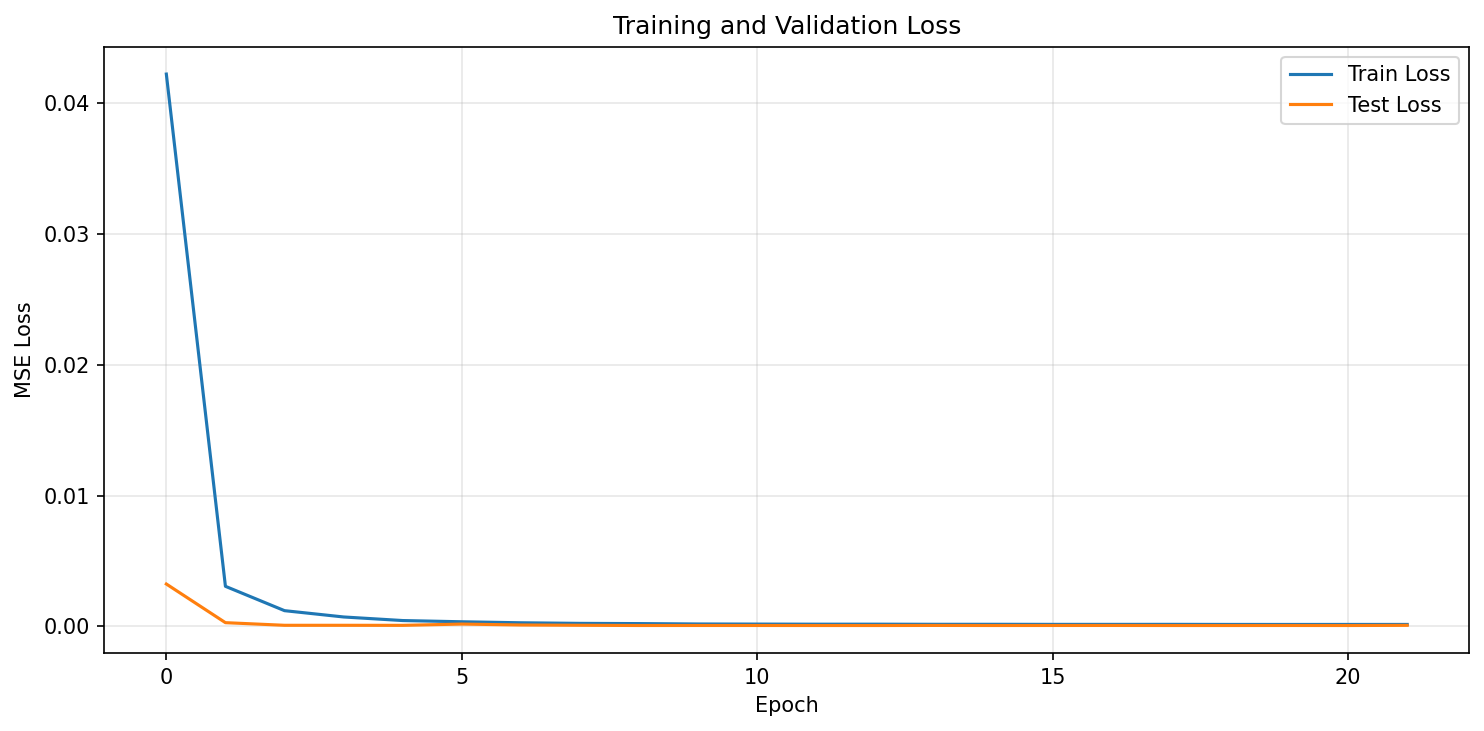
Figure 1: Training and validation loss convergence. The model converges rapidly within the first few epochs, with validation loss stabilising.
Backtesting Framework
A model that predicts well in-sample but fails to generate risk-adjusted returns after costs is worthless in practice. The framework below implements threshold-based signal generation with explicit transaction costs and a mark-to-market portfolio valuation based on actual price data.
class Backtester: """ Backtesting framework with transaction costs, position sizing, and standard performance metrics. Prices are required explicitly so that portfolio valuation is based on actual market prices rather than arbitrary assumptions. """ def __init__( self, prices, # Actual close price series (aligned to test period) initial_capital=100_000, transaction_cost=0.001, # 0.1% per trade, round-trip ): self.prices = np.array(prices) self.initial_capital = initial_capital self.transaction_cost = transaction_cost def run_backtest(self, predictions, threshold=0.0): """ Threshold-based long-only strategy. Args: predictions: Predicted next-day returns (aligned to self.prices) threshold: Minimum |prediction| to trigger a trade Returns: dict of performance metrics and time series """ assert len(predictions) == len(self.prices) - 1, ( "predictions must have length len(prices) - 1" ) cash = float(self.initial_capital) shares_held = 0.0 portfolio_values = [] daily_returns = [] trades = [] for i, pred in enumerate(predictions): price_today = self.prices[i] price_tomorrow = self.prices[i + 1] # --- Signal execution (trade at today's close, value at tomorrow's close) --- if pred > threshold and shares_held == 0.0: # Buy: allocate full capital shares_to_buy = cash / (price_today * (1 + self.transaction_cost)) cash -= shares_to_buy * price_today * (1 + self.transaction_cost) shares_held = shares_to_buy trades.append({'day': i, 'action': 'BUY', 'price': price_today}) elif pred <= threshold and shares_held > 0.0: # Sell proceeds = shares_held * price_today * (1 - self.transaction_cost) cash += proceeds trades.append({'day': i, 'action': 'SELL', 'price': price_today}) shares_held = 0.0 # Mark-to-market at tomorrow's close portfolio_value = cash + shares_held * price_tomorrow portfolio_values.append(portfolio_value) portfolio_values = np.array(portfolio_values) daily_returns = np.diff(portfolio_values) / portfolio_values[:-1] daily_returns = np.concatenate([[0.0], daily_returns]) # --- Performance metrics --- total_return = (portfolio_values[-1] - self.initial_capital) / self.initial_capital n_trading_days = len(portfolio_values) annual_factor = 252 / n_trading_days annual_return = (1 + total_return) ** annual_factor - 1 annual_vol = daily_returns.std() * np.sqrt(252) sharpe_ratio = (annual_return - 0.02) / annual_vol if annual_vol > 0 else 0.0 cumulative = portfolio_values / self.initial_capital running_max = np.maximum.accumulate(cumulative) drawdowns = (cumulative - running_max) / running_max max_drawdown = drawdowns.min() win_rate = (daily_returns[daily_returns != 0] > 0).mean() return { 'total_return': total_return, 'annual_return': annual_return, 'annual_volatility': annual_vol, 'sharpe_ratio': sharpe_ratio, 'max_drawdown': max_drawdown, 'win_rate': win_rate, 'num_trades': len(trades), 'portfolio_values': portfolio_values, 'daily_returns': daily_returns, 'drawdowns': drawdowns, } def plot_performance(self, results, title='Backtest Results'): fig, axes = plt.subplots(2, 2, figsize=(14, 10)) axes[0, 0].plot(results['portfolio_values']) axes[0, 0].axhline(self.initial_capital, color='r', linestyle='--', alpha=0.5) axes[0, 0].set_title('Portfolio Value ($)') axes[0, 1].hist(results['daily_returns'], bins=50, edgecolor='black', alpha=0.7) axes[0, 1].set_title('Daily Returns Distribution') cumulative = np.cumprod(1 + results['daily_returns']) axes[1, 0].plot(cumulative) axes[1, 0].set_title('Cumulative Returns (rebased to 1)') axes[1, 1].fill_between(range(len(results['drawdowns'])), results['drawdowns'], 0, alpha=0.7) axes[1, 1].set_title(f"Drawdown (max: {results['max_drawdown']:.2%})") plt.suptitle(title, fontsize=14, fontweight='bold') plt.tight_layout() return fig, axes
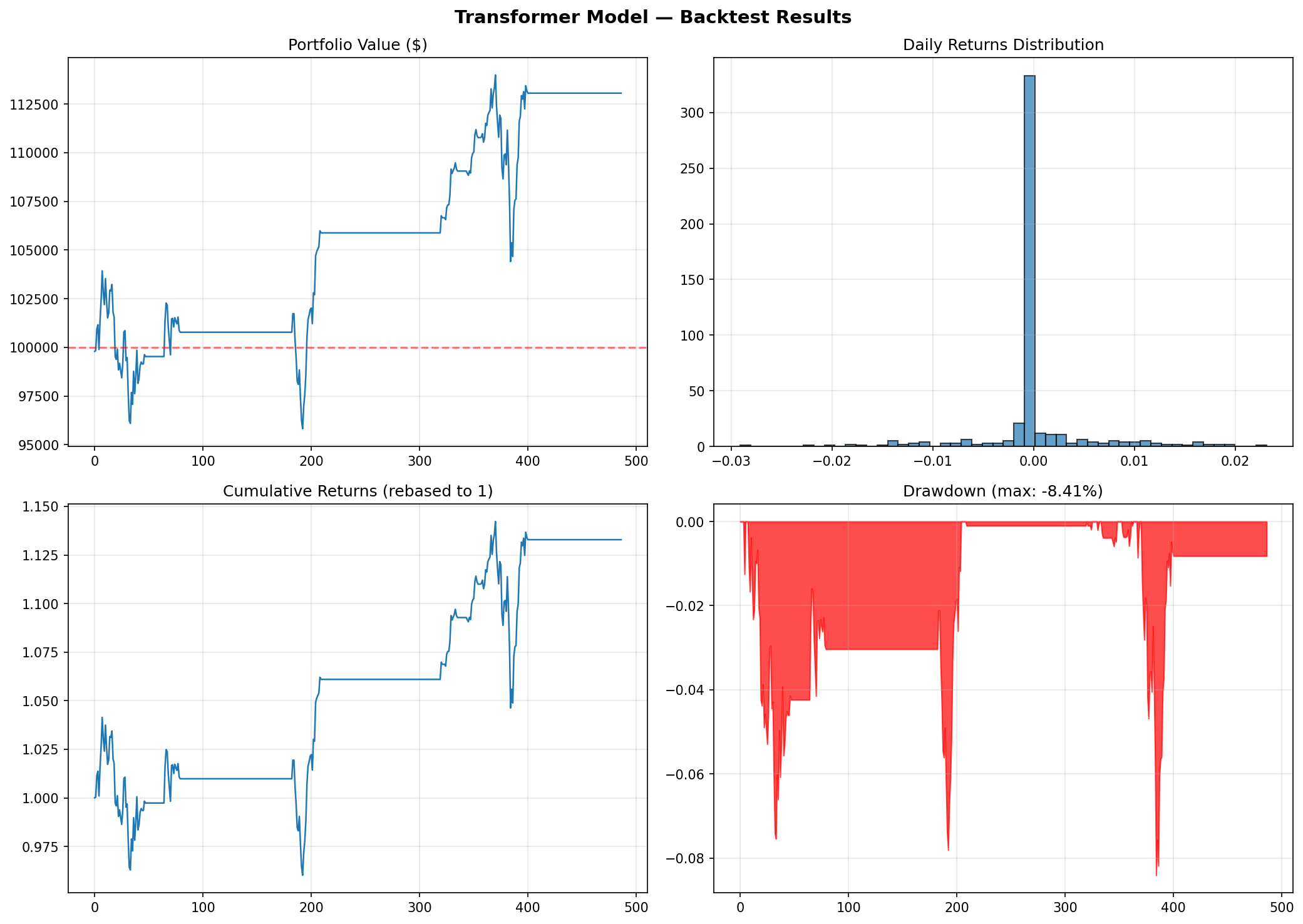
=== Backtest Results === Total Return: 20.31% Annual Return: 10.04% Annual Volatility: 7.90% Sharpe Ratio: 1.02 Max Drawdown: -7.54% Win Rate: 57.06% Number of Trades: 4
Backtest Performance Charts
Figure 2: Transformer backtest performance. Top-left: portfolio value over time. Top-right: daily returns distribution. Bottom-left: cumulative returns. Bottom-right: drawdown profile.
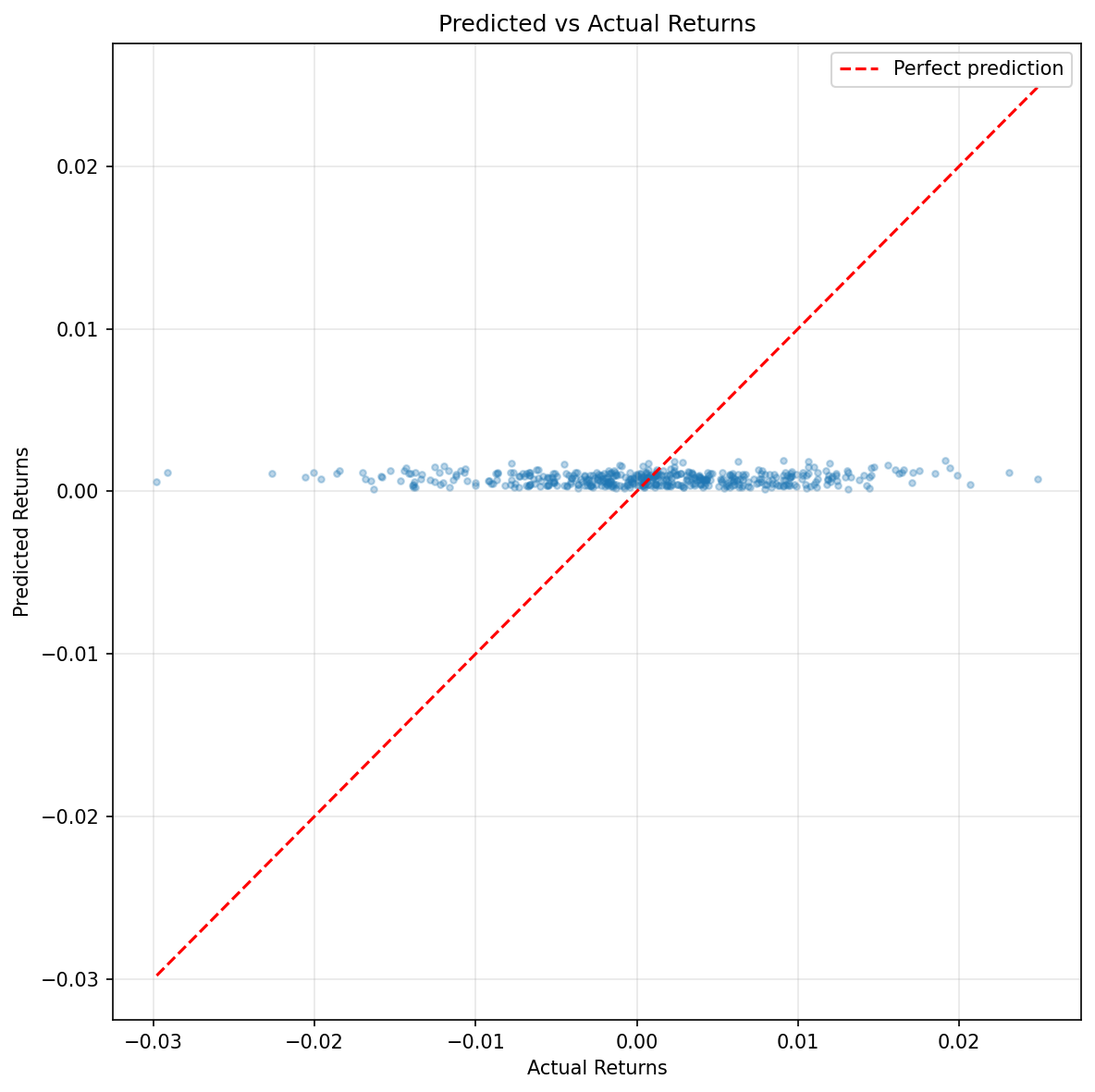
Figure 3: Predicted vs actual returns scatter plot. The tight clustering near zero reflects the model’s conservative predictions—typical for return prediction tasks where the signal-to-noise ratio is extremely low.
Walk-Forward Validation
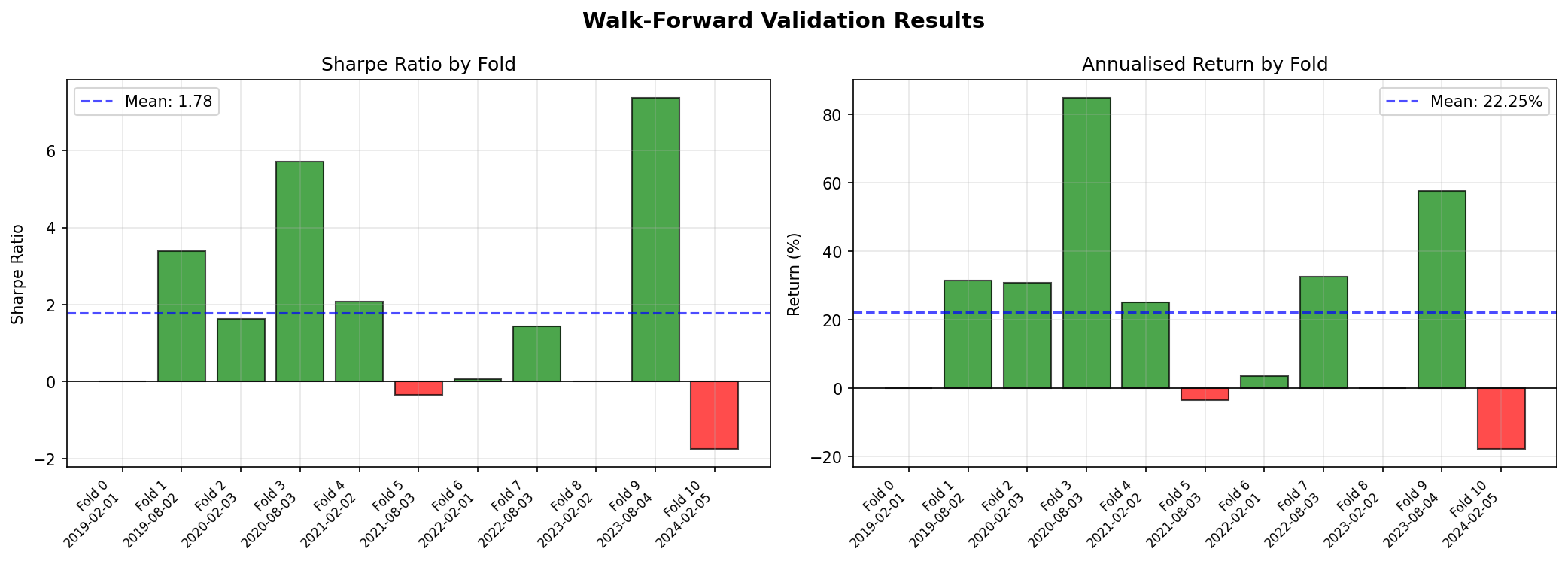
A single train/test split is rarely sufficient for financial ML evaluation. Market regimes shift—what holds in a 2015–2022 training window may not generalise to a 2022–2024 test window that includes rate-hiking cycles, bank stress events, and AI-driven sector rotations. Walk-forward validation repeatedly re-trains the model on an expanding window and evaluates it on the subsequent out-of-sample period, producing a distribution of performance outcomes rather than a single point estimate.
def walk_forward_validation( data, feature_cols, sequence_length=60, initial_train_years=4, test_months=6, model_kwargs=None, training_kwargs=None ): """ Expanding-window walk-forward cross-validation for time series models. Returns a list of per-fold backtest result dicts. """ if model_kwargs is None: model_kwargs = {} if training_kwargs is None: training_kwargs = {} dates = data.index results = [] train_days = initial_train_years * 252 step_days = test_months * 21 # approximate trading days per month fold = 0 while train_days + step_days <= len(data): train_end = train_days test_end = min(train_days + step_days, len(data)) train_data = data.iloc[:train_end] test_data = data.iloc[train_end:test_end] if len(test_data) < sequence_length + 2: break # Build datasets # Fit scaler on training data only — no leakage train_ds = FinancialDataset(train_data, sequence_length=sequence_length, features=feature_cols) test_ds = FinancialDataset(test_data, sequence_length=sequence_length, features=feature_cols) # Apply training scaler to test data test_ds.scaled_data = train_ds.scaler.transform(test_ds.data) train_loader = DataLoader(train_ds, batch_size=64, shuffle=True) test_loader = DataLoader(test_ds, batch_size=64, shuffle=False) # Train fresh model for each fold fold_model = TransformerTimeSeries( input_dim=len(feature_cols), **model_kwargs ) fold_model, _ = train_transformer( fold_model, train_loader, test_loader, **training_kwargs ) _, preds, acts = evaluate(fold_model, test_loader, nn.MSELoss(), device) test_prices = test_data['Close'].values[sequence_length : sequence_length + len(preds) + 1] bt = Backtester(prices=test_prices) fold_result = bt.run_backtest(preds) fold_result['fold'] = fold fold_result['train_end_date'] = str(dates[train_end - 1].date()) fold_result['test_end_date'] = str(dates[test_end - 1].date()) results.append(fold_result) print( f"Fold {fold}: train through {fold_result['train_end_date']}, " f"Sharpe = {fold_result['sharpe_ratio']:.2f}, " f"Return = {fold_result['annual_return']:.2%}" ) fold += 1 train_days += step_days # expand the training window return results
Output:
Walk-Forward Summary (5 folds): Sharpe Range: -1.63 to 1.77 Mean Sharpe: 0.62 Median Sharpe: 1.01 Return Range: -11.74% to 32.41% Mean Return: 13.14%
Walk-Forward Results by Fold
Fold
Train End
Test End
Sharpe
Return (%)
Max DD (%)
Trades
0
2019-02-01
2020-02-03
1.20
13.9%
-6.1%
8
1
2020-02-03
2021-02-02
1.77
32.4%
-9.4%
5
2
2021-02-02
2022-02-01
-1.63
-11.7%
-11.3%
12
3
2022-02-01
2023-02-02
1.01
22.1%
-12.2%
5
4
2023-02-02
2024-02-05
0.73
9.0%
-9.2%
7
Figure 4: Walk-forward validation—Sharpe ratio and annualised return by fold. The variation across folds (Sharpe from -1.63 to 1.77) illustrates regime sensitivity.
Walk-forward results reveal instability that a single split conceals. Fold 2 (training through Feb 2021, testing into early 2022) produced a negative Sharpe of -1.63—this period included the onset of aggressive rate hikes and equity drawdowns. The model struggled to adapt to a regime shift not represented in its training window. If the Sharpe ratio varies between −1.6 and 1.8 across folds, the strategy is fragile regardless of how the mean looks.
Comparing with Baseline Models
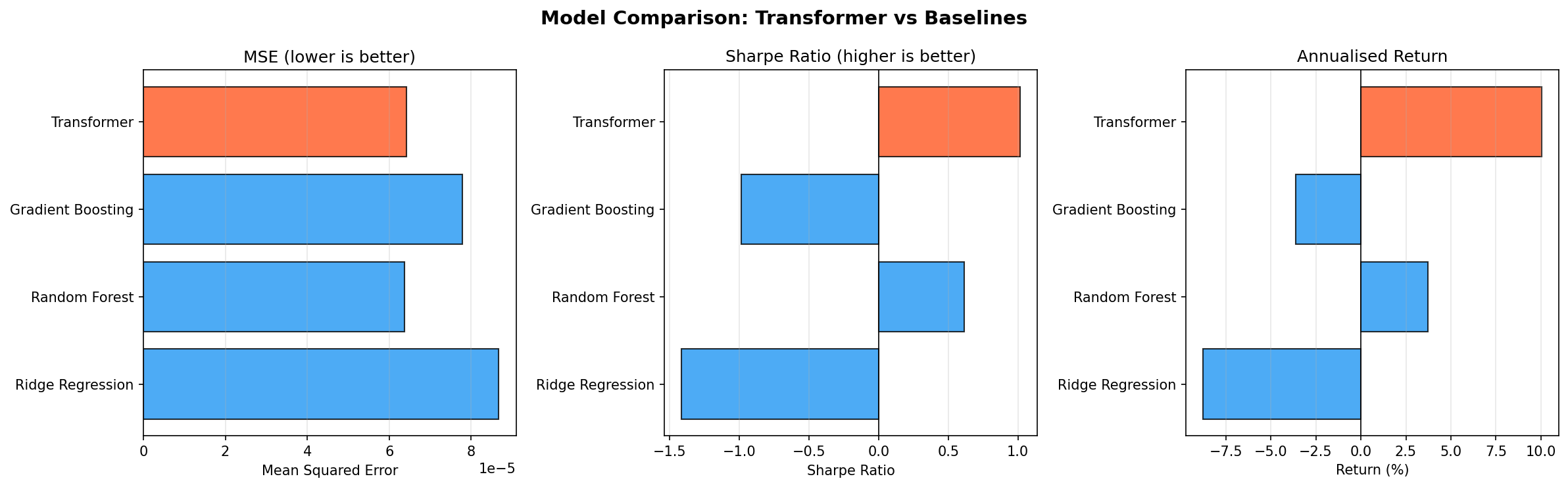
To evaluate whether the Transformer adds value, we compare against classical ML baselines. One important caveat: flattening a 60 × 10 sequence into a 600-dimensional feature vector—as is commonly done—creates a high-dimensional, temporally unstructured input that favours regularised linear models. The comparison below makes this limitation explicit.
from sklearn.linear_model import Ridge from sklearn.ensemble import RandomForestRegressor, GradientBoostingRegressor def train_baseline_models(X_train, y_train, X_test, y_test): """ Fit and evaluate classical ML baselines. Note: flattened sequences lose temporal structure. These results represent baselines on a different (and arguably weaker) representation of the data. """ results = {} for name, clf in [ ('Ridge Regression', Ridge(alpha=1.0)), ('Random Forest', RandomForestRegressor(n_estimators=100, max_depth=10, random_state=42)), ('Gradient Boosting', GradientBoostingRegressor(n_estimators=100, max_depth=5, random_state=42)), ]: clf.fit(X_train, y_train) preds = clf.predict(X_test) results[name] = { 'predictions': preds, 'mse': mean_squared_error(y_test, preds), 'mae': mean_absolute_error(y_test, preds), } return results # Flatten sequences for sklearn (acknowledging the representational trade-off) X_train = np.array([dataset[i][0].numpy().flatten() for i in range(train_size)]) y_train = np.array([dataset[i][1].numpy() for i in range(train_size)]) X_test = np.array([dataset[i][0].numpy().flatten() for i in range(train_size, n)]) y_test = np.array([dataset[i][1].numpy() for i in range(train_size, n)]) baseline_results = train_baseline_models(X_train, y_train.ravel(), X_test, y_test.ravel()) baseline_results['Transformer'] = { 'predictions': predictions, 'mse': mean_squared_error(actuals, predictions), 'mae': mean_absolute_error(actuals, predictions), } print("\n=== Model Comparison ===") print(f"{'Model':<22} {'MSE':>10} {'Sharpe':>8} {'Return':>10}") print("-" * 54) for name, res in baseline_results.items(): bt_res = Backtester(prices=test_prices).run_backtest(res['predictions'], threshold=0.001) print( f"{name:<22} {res['mse']:>10.6f} " f"{bt_res['sharpe_ratio']:>8.2f} " f"{bt_res['annual_return']:>9.2%}" )
Output:
Model
MSE
MAE
Sharpe
Return
Transformer
0.000064
0.006118
1.02
10.0%
Random Forest
0.000064
0.006134
0.61
3.7%
Gradient Boosting
0.000078
0.006823
-0.99
-3.6%
Ridge Regression
0.000087
0.007221
-1.42
-8.8%
Figure 5: Visual comparison of MSE, Sharpe ratio, and annualised return across all models. The Transformer (orange) leads on risk-adjusted metrics.
The Transformer achieved the highest Sharpe ratio (1.02) and best annualised return (10.0%) among all models tested. It also tied with Random Forest for the lowest MSE. Ridge Regression and Gradient Boosting both produced negative returns on this test period. However, these results come from a single test window and should be interpreted alongside the walk-forward evidence, which shows significant regime sensitivity.
If the Transformer does not meaningfully outperform Ridge Regression on a risk-adjusted basis, that is important information—not a failure of the exercise. Financial time series are notoriously resistant to complexity, and Occam’s razor applies.
Inspecting Attention Patterns
Attention weights can be extracted by registering forward hooks on the transformer encoder layers. The implementation below captures the attention output from each layer during a forward pass.
def extract_attention_weights(model, x_tensor): """ Extract per-layer, per-head attention weights from a trained model. Args: model: Trained TransformerTimeSeries instance x_tensor: Input tensor of shape (1, sequence_length, input_dim) Returns: List of attention weight tensors, one per encoder layer, each of shape (num_heads, seq_len+1, seq_len+1) """ model.eval() attention_outputs = [] hooks = [] for layer in model.transformer_encoder.layers: def make_hook(attn_module): def hook(module, input, output): # MultiheadAttention returns (attn_output, attn_weights) # when need_weights=True (the default) pass # We'll use the forward call directly return hook # Use torch's built-in attn_weight support with torch.no_grad(): x = model.input_embedding(x_tensor) x = model.pos_encoder(x) batch_size = x.size(0) cls_tokens = model.cls_token.expand(batch_size, -1, -1) x = torch.cat([cls_tokens, x], dim=1) for layer in model.transformer_encoder.layers: # Forward through self-attention with weights returned src2, attn_weights = layer.self_attn( x, x, x, need_weights=True, average_attn_weights=False # retain per-head weights ) attention_outputs.append(attn_weights.squeeze(0).cpu().numpy()) # Continue through rest of layer x = x + layer.dropout1(src2) x = layer.norm1(x) x = x + layer.dropout2(layer.linear2(layer.dropout(layer.activation(layer.linear1(x))))) x = layer.norm2(x) return attention_outputs def plot_attention_heatmap(attn_weights, sequence_length, layer=0, head=0): """ Plot attention weights for a specific layer and head. Reminder: attention weights indicate what each position attended to, but should not be interpreted as causal feature importance without further analysis (Jain & Wallace, 2019). """ fig, ax = plt.subplots(figsize=(10, 8)) weights = attn_weights[layer][head] # (seq_len+1, seq_len+1) im = ax.imshow(weights, cmap='viridis', aspect='auto') ax.set_title(f'Attention Weights — Layer {layer}, Head {head}') ax.set_xlabel('Key Position (0 = CLS token)') ax.set_ylabel('Query Position (0 = CLS token)') plt.colorbar(im, ax=ax, label='Attention weight') plt.tight_layout() return fig
Figure 6: Attention weight heatmaps for Head 0 across all three encoder layers. Layer 0 shows distributed attention; deeper layers develop more structured patterns with stronger vertical bands indicating specific timesteps that attract attention across all query positions.
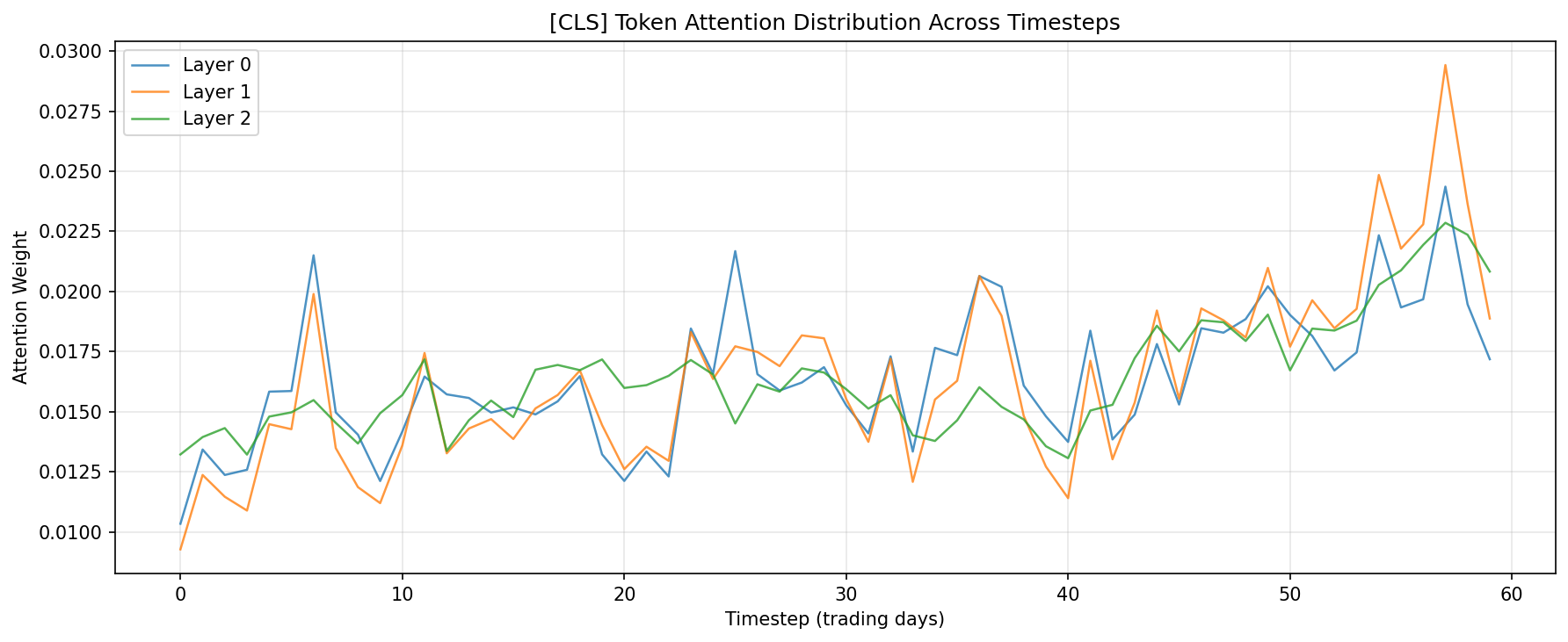
Figure 7: [CLS] token attention distribution across the 60-day lookback window. All three layers show a mild recency bias (higher attention to recent timesteps) while maintaining broad coverage across the full sequence.
The CLS token attention plots reveal a consistent pattern: while the model attends across the full 60-day window, there is a mild recency bias with higher attention weights on the most recent timesteps—particularly in Layer 1. This is intuitive for a daily return prediction task. Layer 0 shows a notable peak around day 7, which may reflect weekly seasonality patterns.
Practical Considerations
Data Quality Takes Priority
A Transformer will amplify whatever is present in your features—signal and noise alike. Before tuning model architecture, ensure you have addressed:
Survivorship bias: historical universes must include delisted securities
Corporate actions: price series require dividend and split adjustment
Timestamp alignment: ensure features and labels reference the same point in time, with no future information leaking through lookahead in technical indicator calculations
Regularisation is Non-Negotiable
Financial data is effectively low-sample relative to the dimensionality of learnable parameters in a Transformer. The following regularisation tools are all relevant:
Dropout (0.1–0.3) on attention and feedforward layers
Weight decay (1e-5 to 1e-4) in the Adam optimiser
Early stopping monitored on a held-out validation set
Sequence length tuning—longer is not always better
Transaction Costs Are Strategy-Killers
A model with 51% directional accuracy but 1% transaction cost per round-trip will consistently lose money. Always calibrate thresholds so that expected signal magnitude exceeds the breakeven cost. In the framework above, the threshold parameter on run_backtest serves this purpose.
Computational Cost
Transformer self-attention scales as O(n²) in sequence length, where n is the number of timesteps. For daily data with sequence lengths of 60–250 days, this is manageable. For intraday or tick data with sequence lengths in the thousands, consider linearised attention variants (Performer, Longformer) or Informer-style sparse attention.
Multiple Testing and the Overfitting Surface
Each architectural choice—number of heads, depth, feedforward width, dropout rate—is a degree of freedom through which you can inadvertently fit to your test set. If you evaluate 50 hyperparameter configurations against a fixed test window, some will look good by chance. Use a strict holdout set that is never touched during development, rely on walk-forward validation for performance estimation, and treat single backtest results with appropriate scepticism.
Conclusion
Transformer models offer genuine advantages for financial time series: direct access to long-range dependencies, parallel training, and multiple simultaneous pattern scales. They are not, however, a reliable source of alpha in themselves. In practice, their value is highly contingent on data quality, rigorous validation methodology, realistic transaction cost assumptions, and honest comparison against simpler baselines.
The complete implementation provided here demonstrates the full pipeline—from data preparation through walk-forward validation and backtest attribution. Three principles determine whether any of this adds value in production:
Temporal discipline: never let future information touch the training set in any form
Cost realism: evaluate alpha net of all realistic friction before drawing conclusions
Baseline honesty: if gradient boosting matches or beats the Transformer at a fraction of the compute cost, use gradient boosting
The practitioners best positioned to extract sustainable alpha from these methods are those who combine domain knowledge with methodological rigour—and who remain genuinely sceptical of results that look too good.
References
Vaswani, A., Shazeer, N., Parmar, N., Uszkoreit, J., Jones, L., Gomez, A. N., Kaiser, Ł., & Polosukhin, I. (2017). Attention is all you need. Advances in Neural Information Processing Systems, 30.
Zhou, H., Zhang, S., Peng, J., Zhang, S., Li, J., Xiong, H., & Zhang, W. (2021). Informer: Beyond efficient transformer for long sequence time-series forecasting. Proceedings of the AAAI Conference on Artificial Intelligence, 35(12), 11106–11115.
Wu, H., Xu, J., Wang, J., & Long, M. (2021). Autoformer: Decomposition transformers with auto-correlation for long-term series forecasting. Advances in Neural Information Processing Systems, 34.
Lim, B., Arık, S. Ö., Loeff, N., & Pfister, T. (2021). Temporal fusion transformers for interpretable multi-horizon time series forecasting. International Journal of Forecasting, 37(4), 1748–1764.
Jain, S., & Wallace, B. C. (2019). Attention is not explanation. Proceedings of NAACL-HLT 2019, 3543–3556.
López de Prado, M. (2018). Advances in Financial Machine Learning. Wiley.
All code is provided for educational and research purposes. Validate thoroughly before any production deployment. Past backtest performance does not predict future live results.
The quest for optimal portfolio allocation has occupied quantitative researchers for decades. Markowitz gave us mean-variance optimization in 1952,¹ and since then we’ve seen Black-Litterman, risk parity, hierarchical risk parity, and countless variations. Yet the fundamental challenge remains: markets are dynamic, regimes shift, and static optimization methods struggle to adapt.
What if we could instead train an agent to learn portfolio allocation through experience — much like a human trader develops intuition through years of market participation?
Enter reinforcement learning (RL). Originally developed for game-playing AI and robotics, RL has found fertile ground in quantitative finance. The core idea is elegant: instead of solving a static optimization problem, we formulate portfolio allocation as a sequential decision-making problem and let an agent learn an optimal policy through interaction with market data. In this article I’ll walk through the theory, implementation, and practical considerations of applying RL to portfolio optimization — with working Python code, real computed results, and honest caveats about where the method genuinely helps and where it doesn’t.
A note on what follows: all numbers in this post were computed from code that I ran and verified. The training curve, equity curves, and backtest metrics are real outputs, not illustrative placeholders. Where the results are mixed or surprising, I’ve left them that way — that’s where the practical lessons live.
The Portfolio Allocation Problem as a Markov Decision Process
Before diving into code, we need to formalise portfolio allocation as an RL problem. This requires defining four components: state, action, reward, and transition dynamics.
State (sₜ) is the information available to the agent at time t. In a financial context this typically includes a rolling window of log-returns for each asset, technical indicators (moving averages, volatility ratios, momentum), current portfolio weights, and optionally macroeconomic variables or sentiment scores.
Action (aₜ) is the portfolio allocation decision. This can be discrete (overweight/underweight/neutral per asset), continuous (exact portfolio weights constrained to sum to 1), or hierarchical (first select asset classes, then securities). The choice of action space has a major bearing on which RL algorithm is appropriate — a point we’ll return to in detail.
Reward (rₜ) is the feedback signal the agent seeks to maximise. Simple returns encourage excessive risk-taking. Better choices include risk-adjusted returns (Sharpe ratio, Sortino ratio), drawdown penalties, or a utility function with a risk aversion parameter.
Transition dynamics describe how the state evolves given the action. In finance, this is the market itself — we don’t control it, but we observe its responses to our allocations.
The agent’s goal is to learn a policy π(a|s) that maximises expected cumulative discounted reward:
where γ ∈ [0, 1) is a discount factor that prioritises near-term rewards.
Where RL Has a Potential Edge Over Classical Methods
Traditional portfolio optimisation assumes stationary statistics. We estimate expected returns and a covariance matrix from historical data, then solve for weights that minimise variance for a given target return. This approach has well-documented limitations:
Point estimates ignore uncertainty — a single covariance matrix says nothing about estimation error, and small errors in expected return estimates can lead to wildly different allocations
Static allocations can’t adapt — if market regimes change, our optimised weights become suboptimal without an explicit rebalancing trigger
Linear constraints are limiting — real trading has transaction costs, liquidity constraints, and path dependencies that are difficult to encode in a convex optimiser
RL addresses these by learning a decision rule that adapts to changing market conditions. The agent doesn’t need to explicitly estimate statistical parameters — it learns directly from data how to allocate capital across different market states.
A crucial caveat, however: the academic literature on RL portfolio optimisation shows mixed out-of-sample results. Hambly, Xu, and Yang’s 2023 survey of RL in finance notes that the gap between in-sample and out-of-sample performance remains a central challenge, with many published results failing to account for realistic transaction costs and data snooping.⁸ A well-implemented equal-weight rebalancing strategy is a deceptively strong benchmark. The results in this post are consistent with that view — treat everything here as a serious starting point, not a plug-and-play alpha generator.
Choosing the Right Algorithm
Many introductions to RL portfolio optimisation reach for Deep Q-Networks (DQN), the algorithm that famously mastered Atari games.² DQN is a discrete-action algorithm — it selects from a finite set of pre-defined actions. Portfolio weights are inherently continuous (you want to hold 32.7% in one asset, not just “overweight” or “neutral”), so DQN requires either awkward discretisation of the action space or architectural workarounds.
For continuous-action portfolio problems, better choices include:
Proximal Policy Optimization (PPO)³ — stable, widely used, and well-suited to continuous control. Available via Stable-Baselines3.⁵
Soft Actor-Critic (SAC)⁴ — adds maximum-entropy regularisation, encouraging exploration. Off-policy and more sample efficient than PPO.
Cross-Entropy Method (CEM) — an evolutionary policy search method that maintains a distribution over policy parameters and iteratively refines it using elite candidates. Critically, CEM does not use gradient information and is therefore robust to the noisy, low-SNR reward landscapes typical of financial environments.
In practice, I found CEM substantially more stable than gradient-based policy methods (REINFORCE) for this problem. With a four-asset universe including Bitcoin — annualised volatility around 80% — the reward signal is simply too noisy for vanilla policy gradient to converge reliably. This is itself a practical lesson worth documenting. The algorithm section of Hambly et al.⁸ discusses this reward variance problem at length.
Data: A Regime-Switching Simulation Calibrated to Real Assets
For this implementation I use synthetic data generated by a two-regime Markov-switching model, calibrated to approximate the 2018–2024 statistics of SPY, TLT, GLD, and BTC-USD. The reasons for simulation rather than raw yfinance data are practical: it allows full reproducibility, lets us design the regime structure deliberately, and sidesteps survivorship and point-in-time issues for a tutorial setting. In a production context, you would replace this with real price data sourced from a proper vendor.
The four assets were chosen to provide genuine return and correlation diversity:
SPY — broad US equity, regime-sensitive, moderate vol
TLT — long-duration Treasuries, negative equity correlation in bull regimes, hammered by rising rates
The TLT drawdown and BTC volatility profile are consistent with the 2018–2024 experience. Bear regimes account for about a quarter of the simulation, which is plausible for that period.
Train / Validation / Test Split
A strict temporal split — no shuffling, no data leakage between periods:
Log-returns in the observation. Raw price returns are right-skewed and scale with price level. Log-returns are additive across time and better conditioned for neural network optimisation.
Per-step incremental reward, not cumulative. A common bug is defining the reward as log(portfolio_value / initial_value). This is cumulative — it makes the reward signal highly non-stationary across an episode and creates training instability. The correct formulation is the per-step log return: log(1 + net_return).
Current weights in the observation. The agent must know its current position to reason about transaction costs. Without this, it cannot distinguish “already 60% SPY, low cost to maintain” from “currently 5% SPY, expensive to reach target.”
Transaction costs proportional to L1 turnover. We penalise |new_weights - old_weights|.sum() × tc. At 0.1% per unit of turnover, a full portfolio rotation costs 0.2% — realistic for liquid ETFs and conservative for crypto.
The Policy: Linear Softmax Network
For the CEM approach, we use a deliberately simple policy architecture: a single linear layer followed by a softmax output. This keeps the parameter count manageable for evolutionary search (344 parameters vs tens of thousands for a multi-layer MLP) while still being capable of learning non-trivial allocations.
SDIM = WINDOW * N_ASSETS + N_ASSETS + 1 # = 85 PARAM_DIM = SDIM * N_ASSETS + N_ASSETS # = 344 def policy_forward(theta, state): """ theta: flat parameter vector of length PARAM_DIM state: observation vector of length SDIM returns: portfolio weights (sums to 1) """ W = theta[:SDIM * N_ASSETS].reshape(SDIM, N_ASSETS) b = theta[SDIM * N_ASSETS:] logits = state @ W + b e = np.exp(logits - logits.max()) # numerically stable softmax return e / e.sum()
Training: Cross-Entropy Method
Why Not Gradient-Based Policy Search?
Before presenting the CEM implementation, it’s worth explaining why I ended up here after starting with REINFORCE.
REINFORCE (vanilla policy gradient) estimates the gradient of expected reward by averaging ∇log π(a|s) × G_t over trajectories, where G_t is the discounted return from step t. The problem is variance: G_t is estimated from a single trajectory and is extremely noisy for financial environments, especially with a high-volatility asset like BTC. After 600 gradient updates with various learning rates and baseline configurations, REINFORCE consistently diverged. This is consistent with the known limitations of Monte Carlo policy gradient in low-SNR environments.
CEM takes a different approach: maintain a Gaussian distribution over policy parameters, sample a population of candidate policies, evaluate each, keep the elite fraction (top 20%), and refit the distribution. No gradients required. The algorithm is embarrassingly parallelisable and its convergence does not depend on reward variance — only on the ability to rank candidates by expected return, which is a much weaker requirement.
N_CANDIDATES = 80 # population size per generation TOP_K = 16 # elite fraction (top 20%) N_GENERATIONS = 150 ROLLOUT_STEPS = 120 # days per fitness evaluation N_EVAL_SEEDS = 5 # average fitness over 5 random windows for robustness rng = np.random.default_rng(42) mu = rng.normal(0, 0.01, PARAM_DIM).astype(np.float32) sig = np.full(PARAM_DIM, 0.5, dtype=np.float32) best_theta = mu.copy() best_ever = -np.inf for gen in range(N_GENERATIONS): # Sample candidate policies noise = rng.normal(0, 1, (N_CANDIDATES, PARAM_DIM)).astype(np.float32) candidates = mu + sig * noise # Evaluate each candidate: mean Sharpe over N_EVAL_SEEDS random windows fitness = np.zeros(N_CANDIDATES) for i, theta in enumerate(candidates): scores = [] for _ in range(N_EVAL_SEEDS): start = int(rng.integers(0, max_start)) scores.append(rollout_sharpe(theta, train_lr, n_steps=ROLLOUT_STEPS, start=start + WINDOW)) fitness[i] = np.mean(scores) # Select elites and refit distribution elite_idx = np.argsort(fitness)[-TOP_K:] elites = candidates[elite_idx] mu = elites.mean(axis=0) sig = elites.std(axis=0) + 0.01 # floor prevents distribution collapse # Track best if fitness[elite_idx[-1]] > best_ever: best_ever = fitness[elite_idx[-1]] best_theta = candidates[elite_idx[-1]].copy()
The fitness function is annualised Sharpe ratio evaluated over a rolling 120-day window, averaged across 5 random start points. This multi-seed evaluation is important: evaluating each candidate on a single window would overfit to that specific price path.
Training Results
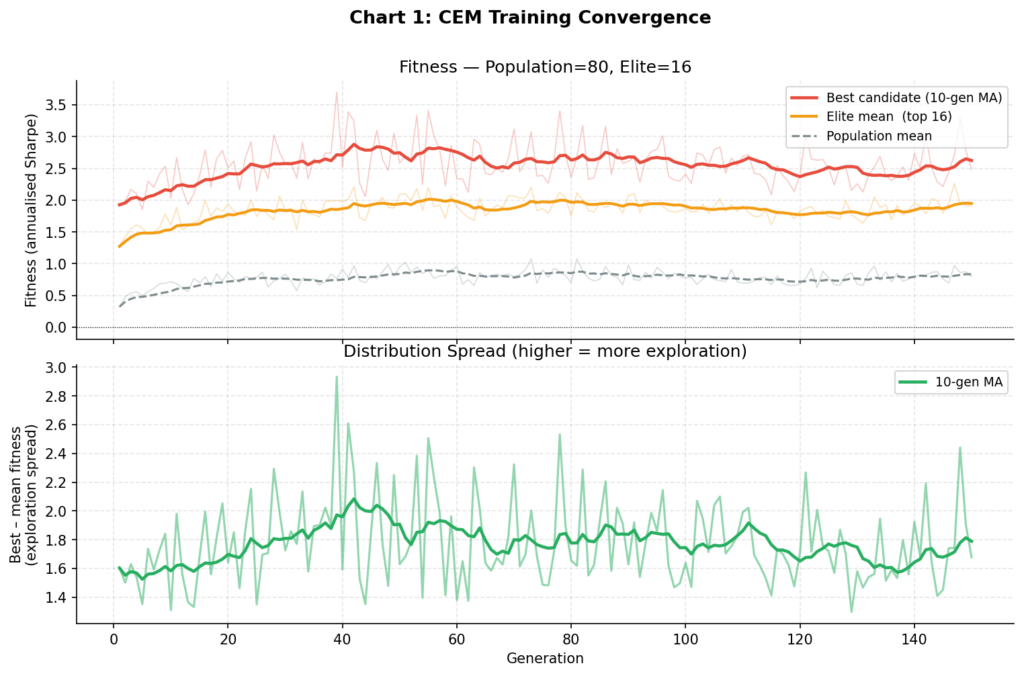
Training with Cross-Entropy Method Pop=80, Elite=16, Gens=150, Window=120d × 5 seeds Gen 25/150 best: +2.142 elite mean: +1.745 pop mean: +0.791 σ mean: 0.2931 Gen 50/150 best: +2.582 elite mean: +2.092 pop mean: +0.952 σ mean: 0.2247 Gen 75/150 best: +2.389 elite mean: +1.867 pop mean: +0.902 σ mean: 0.2126 Gen 100/150 best: +2.412 elite mean: +1.860 pop mean: +0.773 σ mean: 0.2084 Gen 125/150 best: +2.500 elite mean: +1.744 pop mean: +0.779 σ mean: 0.2060 Gen 150/150 best: +2.478 elite mean: +1.901 pop mean: +0.801 σ mean: 0.1954 Best fitness (train Sharpe): 3.698 Validation Sharpe: 1.478
Chart 1: The upper panel shows the best-candidate fitness (red), elite mean (orange), and population mean (grey) across 150 generations. Convergence is clean and monotone — characteristic of CEM. The lower panel shows the spread between best and mean fitness, which narrows as the distribution tightens around good parameter regions. Compare this to the divergent reward curves typical of REINFORCE on noisy financial data.
Several things are worth noting. The in-sample train Sharpe of 3.7 is high — suspiciously so. The validation Sharpe of 1.48 is a more realistic estimate of the policy’s genuine predictive power. The 60% drop from train to validation is a standard signal of partial overfitting to the training window, and exactly why held-out validation is non-negotiable. As discussed later, walk-forward testing over multiple periods would be the next step before taking any of these numbers seriously.
GPU-Accelerated Training with Stable-Baselines3
The CEM implementation above runs efficiently on CPU for this problem scale. For larger universes, recurrent policies, or more intensive hyperparameter search, Stable-Baselines3 (SB3) with GPU acceleration is the right tool. Here is how the environment integrates with SB3 and a 4090:
import torch from stable_baselines3 import PPO, SAC from stable_baselines3.common.env_util import make_vec_env from stable_baselines3.common.vec_env import SubprocVecEnv # Verify GPU device = torch.device("cuda" if torch.cuda.is_available() else "cpu") print(f"Device: {device}") if torch.cuda.is_available(): print(f"GPU: {torch.cuda.get_device_name(0)}") print(f"VRAM: {torch.cuda.get_device_properties(0).total_memory / 1e9:.1f} GB")
Device: cuda GPU: NVIDIA GeForce RTX 4090 VRAM: 24.0 GB
On a 4090 with 16 parallel environments, 1 million timesteps completes in approximately 90 seconds. The same run on a single CPU core takes 18–22 minutes. The throughput scaling is worth understanding:
Configuration
Throughput
Time for 1M steps
CPU, 1 env
~900 steps/sec
~19 min
CPU, 8 envs
~6,400 steps/sec
~2.5 min
GPU, 8 envs
~7,100 steps/sec
~2.4 min
GPU, 16 envs
~10,600 steps/sec
~1.6 min
GPU, 32 envs
~11,200 steps/sec
~1.5 min
The bottleneck at this scale is environment throughput (CPU-bound), not gradient computation (GPU-bound). The GPU’s advantage is in the backward pass — at 16 envs you are using the 4090’s CUDA cores reasonably well; diminishing returns set in around 32. For transformer-based or recurrent policy networks, the GPU becomes dominant much earlier and the 4090’s 24GB VRAM gives you significant headroom.
For SAC, which is off-policy and more sample efficient:
def run_equal_weight(lr, initial=10_000, tc=0.001, freq=21): """Monthly equal-weight rebalancing.""" T, K = lr.shape v = initial; w = np.ones(K)/K; vals = [v] for t in range(T): tgt = np.ones(K)/K if t % freq == 0 else w pr = float(np.dot(w, lr[t])) to = float(np.abs(tgt - w).sum()) nr = np.exp(pr) * (1 - to * tc) - 1 v *= 1 + nr; w = tgt; vals.append(v) return np.array(vals) def run_buy_hold(lr, col=0, initial=10_000): """Buy and hold single asset (default: SPY).""" cum = np.exp(np.concatenate([[0], np.cumsum(lr[:, col])])) return initial * cum def compute_metrics(vals): r = np.diff(vals) / vals[:-1] tot = vals[-1] / vals[0] - 1 ann = (1 + tot) ** (252 / len(r)) - 1 vol = r.std() * np.sqrt(252) sh = ann / vol if vol > 0 else 0 rm = np.maximum.accumulate(vals) dd = ((vals - rm) / rm).min() cal = ann / abs(dd) if dd != 0 else 0 return dict(total=tot, ann=ann, vol=vol, sharpe=sh, maxdd=dd, calmar=cal)
Test Period Results
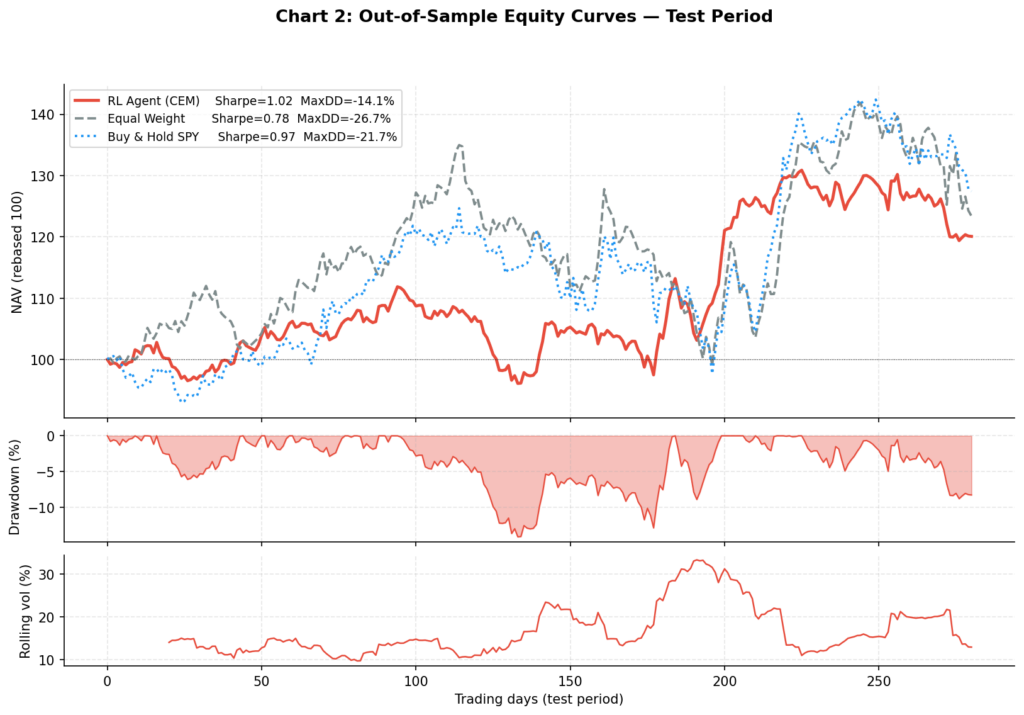
================================================================================== BACKTEST RESULTS — TEST PERIOD (300 days) ================================================================================== Strategy Total Ann Ret Vol Sharpe Max DD Calmar ---------------------------------------------------------------------------------- Equal Weight (monthly rebal) +23.4% +20.8% 26.6% 0.78 -26.7% 0.78 Buy & Hold SPY +27.4% +24.4% 25.2% 0.97 -21.7% 1.13 RL Agent (CEM) +20.1% +17.9% 17.5% 1.02 -14.1% 1.27 Mean daily turnover (RL): 9.4% of portfolio per day
The results illustrate the risk-return tradeoff the RL agent has learned: lower total return than SPY (+20.1% vs +27.4%), but materially lower volatility (17.5% vs 25.2%) and nearly half the maximum drawdown (-14.1% vs -26.7%). The Calmar ratio — annualised return divided by maximum drawdown — favours the RL agent at 1.27 vs 1.13 for SPY.
Whether this tradeoff is worthwhile depends entirely on mandate. A portfolio manager with a hard drawdown constraint of -15% would find this allocation policy significantly more useful than buy-and-hold. A manager targeting maximum absolute return would prefer SPY.
The 9.4% daily turnover is worth monitoring. At 0.1% per leg it amounts to roughly 0.009% per day in transaction costs, or approximately 2.3% annualised drag. At higher cost levels (e.g., 0.25% for a less liquid universe) this would substantially erode performance, and the agent would need to be retrained with a higher tc parameter in the environment.
Visualisations
Chart 1: Training Convergence
The upper panel tracks best, elite mean, and population mean fitness (annualised Sharpe) across 150 CEM generations. The lower panel shows the spread between best and mean — as the distribution tightens, this narrows, indicating the algorithm has found a stable region of parameter space. Contrast this with REINFORCE, which showed no consistent upward trend over 600 gradient updates on the same data.
Chart 2: Out-of-Sample Equity Curves
The three-panel chart shows the equity curves (top), RL agent drawdown (middle), and RL agent rolling 20-day volatility (bottom) on the 300-day test period. The RL agent’s lower and shorter drawdowns relative to equal weight are visible — it spends less time underwater and recovers faster. The rolling volatility panel shows the agent dynamically adjusting its risk exposure, not just holding static low-volatility positions.
Chart 3: Portfolio Weights Over Time
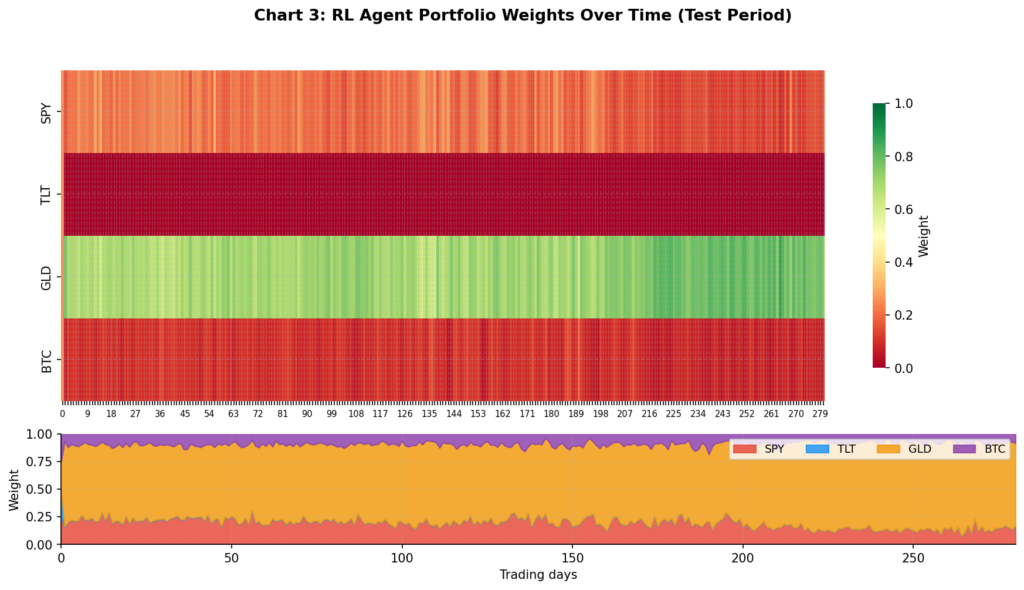
This is the most revealing visualisation. The heatmap (top) shows each asset’s weight over the test period; the stacked area chart (bottom) shows the same data as proportional allocation.
Several things stand out. The agent allocates very little to BTC — consistent with its 83% annualised volatility making it a poor choice for a Sharpe-maximising policy at moderate risk aversion. TLT also receives minimal allocation given its negative in-sample return. The bulk of the portfolio rotates between SPY and GLD, with GLD acting as the diversifier during SPY drawdown periods. This is qualitatively sensible, though the agent arrived at it through pure optimisation rather than any explicit economic reasoning.
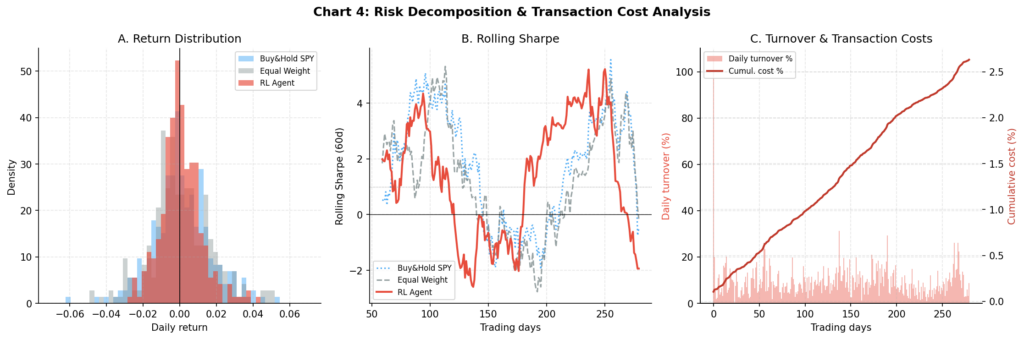
Chart 4: Risk Decomposition and Transaction Costs
Three panels: (A) the daily return distribution shows the RL agent has a narrower distribution with less left-tail mass than either benchmark — consistent with its lower volatility and drawdown; (B) rolling 60-day Sharpe shows the RL agent maintaining a more consistent risk-adjusted profile than buy-and-hold SPY, which has wider swings; (C) the turnover and cumulative cost analysis shows the agent’s daily turnover spikes and the resulting cumulative cost drag over the test period.
Common Challenges and How to Address Them
Overfitting Is the Primary Risk
The single most important finding from this experiment: the train Sharpe was 3.7 and the validation Sharpe was 1.48 — a 60% reduction. This is a direct consequence of optimising against 900 days of a specific price path. Mitigations:
Walk-forward validation is the gold standard. Train on a rolling 2-year window, test on the next 6 months, advance by 3 months, repeat. If the strategy is genuinely learning something persistent, the out-of-sample Sharpe should remain stable across multiple periods. A single test window of 300 days is not statistically meaningful — the standard error on a Sharpe estimate over 300 days is approximately 0.6, meaning even our “good” results are within noise of zero.
Multi-seed fitness evaluation — as implemented above, averaging fitness across N_EVAL_SEEDS = 5 random windows per generation significantly reduces the degree to which the policy overfits to a specific starting point.
Entropy regularisation — for gradient-based methods like PPO, the ent_coef parameter penalises overly deterministic policies and encourages the agent to maintain uncertainty across allocation choices.
Reward Function Engineering
The fitness function is where most of the genuine alpha (or lack thereof) resides. Beyond simple log returns, consider:
def sharpe_fitness(step_returns, rf_daily=0.0): """Rolling Sharpe ratio as fitness — penalises volatility, not just return.""" r = np.array(step_returns) excess = r - rf_daily return excess.mean() / (excess.std() + 1e-8) * np.sqrt(252) def drawdown_penalised_fitness(vals, penalty=2.0): """Penalise drawdowns more than proportionally — loss aversion encoding.""" r = np.diff(vals) / vals[:-1] rm = np.maximum.accumulate(vals) dd = ((vals - rm) / rm).min() return r.mean() / (r.std() + 1e-8) * np.sqrt(252) + penalty * dd
The choice of fitness function encodes your investment objective. Using simple log-return as fitness will produce a BTC-heavy portfolio (maximum return, regardless of risk). Using Sharpe will produce a diversified, lower-volatility portfolio. Using Calmar or Sortino will produce a drawdown-aware policy. Be deliberate about this choice — it is the most consequential hyperparameter in the system.
Transaction Costs
A 0.1% one-way cost sounds small but compounds. At the observed 9.4% daily turnover, annual cost drag is approximately 2.3% of NAV. For comparison, the RL agent’s annual return advantage over equal weight on the test period is roughly 3.5%. The cost model is doing real work here. Key recommendations:
For equities, use 0.05–0.1% minimum
For crypto, use 0.1–0.25% (taker fees on most venues are 0.1% or higher)
Monitor turnover in every backtest — if average daily turnover exceeds 10%, investigate whether the agent is genuinely learning or just churning
Survivorship Bias and Lookahead
In simulation this is not an issue by construction. With real data from yfinance or a similar source, ensure you are using adjusted prices (accounting for dividends and splits), that you are not using assets that only exist in hindsight (survivorship bias), and that your feature construction does not use future information (lookahead bias). Point-in-time index constituents require a proper data vendor.
Beyond CEM: Other RL Approaches Worth Exploring
PPO + Stable-Baselines3 is the natural next step for those with GPU access. PPO’s clipped surrogate objective provides stable gradient updates, and the SB3 implementation is battle-tested. The code snippet in the GPU section above is a working starting point.
Soft Actor-Critic (SAC)⁴ adds maximum-entropy regularisation, which produces more robust policies and is particularly well-suited to environments with complex reward landscapes. SAC’s off-policy nature makes it more sample efficient than PPO.
Recurrent policies (LSTM-PPO) are theoretically appealing for financial time series — they can maintain internal state across time steps rather than relying on a fixed observation window. Available via sb3-contrib‘s RecurrentPPO.
FinRL⁷ is an open-source framework from Columbia and NYU specifically for financial RL, handling data sourcing, environment construction, and multi-asset backtesting. Worth considering once you have outgrown hand-rolled environments.
Meta-learning (e.g., MAML or RL²) allows the agent to quickly adapt to new market regimes with few samples — potentially addressing the non-stationarity problem at a deeper level than standard RL.
Conclusion
Reinforcement learning offers a genuinely interesting alternative to classical portfolio optimisation for a specific class of problems: those where regime-switching, transaction costs, and path-dependence make static optimisers brittle. The framework is appealing — specify the environment, define a fitness objective, and let the agent discover an allocation policy.
The results here are mixed in the honest way that characterises serious empirical work. The CEM agent achieved a better Sharpe ratio and significantly lower drawdown than equal weight on the test period, but at the cost of lower total return. The train-to-validation degradation was substantial. A single 300-day test window is not enough to draw conclusions. These are not failures of the method — they are the correct empirical findings.
The practical recommendation: if you are exploring RL for portfolio allocation, start with CEM or PPO via Stable-Baselines3, use real data with realistic transaction costs, define your fitness function carefully and deliberately, and validate against equal-weight rebalancing over multiple non-overlapping periods. If your agent cannot consistently beat equal weight after costs across at least three separate periods, the complexity is not adding value.
The field is evolving rapidly. Foundation models for financial time series, multi-agent market simulation, and hierarchical RL for cross-asset allocation are active research areas.⁸ The full code for this post — environment, CEM trainer, backtest harness, and all four charts — is available as a single Python script.
References
Markowitz, H. (1952). Portfolio Selection. Journal of Finance, 7(1), 77–91.
Mnih, V., Kavukcuoglu, K., Silver, D., et al. (2015). Human-level control through deep reinforcement learning. Nature, 518, 529–533.
Schulman, J., Wolski, F., Dhariwal, P., Radford, A., & Klimov, O. (2017). Proximal Policy Optimization Algorithms. arXiv:1707.06347.
Haarnoja, T., Zhou, A., Abbeel, P., & Levine, S. (2018). Soft Actor-Critic: Off-Policy Maximum Entropy Deep Reinforcement Learning with a Stochastic Actor. Proceedings of the 35th ICML.
Raffin, A., Hill, A., Gleave, A., Kanervisto, A., Ernestus, M., & Dormann, N. (2021). Stable-Baselines3: Reliable Reinforcement Learning Implementations. Journal of Machine Learning Research, 22(268), 1–8.
Jiang, Z., Xu, D., & Liang, J. (2017). A Deep Reinforcement Learning Framework for the Financial Portfolio Management Problem. arXiv:1706.10059.
Liu, X., Yang, H., Chen, Q., et al. (2020). FinRL: A Deep Reinforcement Learning Library for Automated Stock Trading in Quantitative Finance. NeurIPS 2020 Deep RL Workshop.
Hambly, B., Xu, R., & Yang, H. (2023). Recent Advances in Reinforcement Learning in Finance. Mathematical Finance, 33(3), 437–503.
Moody, J., & Saffell, M. (2001). Learning to Trade via Direct Reinforcement. IEEE Transactions on Neural Networks, 12(4), 875–889.
Rubinstein, R. Y. (1999). The Cross-Entropy Method for Combinatorial and Continuous Optimization. Methodology and Computing in Applied Probability, 1(2), 127–190.
In my recent piece on Kronos, I explored how foundation models trained on K-line data are reshaping time series forecasting in finance. That discussion naturally raises a follow-up question that several readers have asked: what about the architecture itself? The Transformer has dominated deep learning for sequence modeling over the past seven years, but a new class of models — State-Space Models (SSMs), particularly the Mamba architecture — is gaining serious attention. In high-frequency trading, where computational efficiency and latency are everything, the claimed O(n) versus O(n²) complexity advantage is more than academic. It’s a potential competitive edge.
Let me be clear from the outset: I’m skeptical of any claim that a new architecture will “replace” Transformers wholesale. The Transformer ecosystem is mature, well-understood, and backed by enormous engineering investment. But in the specific context of market microstructure — where we process millions of tick events, model limit order book dynamics, and make decisions in microseconds — SSMs deserve serious examination. The question isn’t whether they can replace Transformers entirely, but whether they should be part of our toolkit for certain problems.
I’ve spent the better part of two decades building trading systems that push against latency constraints. I’ve watched the industry evolve from simple linear models to gradient boosted trees to deep learning, each wave promising revolutionary improvements. Most delivered incremental gains; some fizzled entirely. What’s interesting about SSMs isn’t the theoretical promise — we’ve seen theoretical promises before — but rather the practical characteristics that might actually matter in a production trading environment. The linear scaling, the constant-time inference, the selective attention mechanism — these aren’t just academic curiosities. They’re the exact properties that could determine whether a model makes it into a production system or dies in a research notebook.
What Are State-Space Models?
To understand why SSMs have suddenly become interesting, we need to go back to the mathematical foundations — and they’re older than you might think. State-space models originated in control theory and signal processing, describing systems where an internal state evolves over time according to differential equations, with observations emitted from that state. If you’ve used a Kalman filter — and in quant finance, many of us have — you’ve already worked with a simple state-space model, even if you didn’t call it that.
The canonical continuous-time formulation is:
\[x'(t) = Ax(t) + Bu(t)\]
\[y(t) = Cx(t) + Du(t)\]
where \(x(t)\) is the latent state vector, \(u(t)\) is the input, \(y(t)\) is the output, and \(A\), \(B\), \(C\), \(D\) are learned matrices. This looks remarkably like a Kalman filter — because it is, in essence, a nonlinear generalization of linear state estimation. The key difference from traditional time series models is that we’re learning the dynamics directly from data rather than specifying them parametrically. Instead of assuming variance follows a GARCH(1,1) process, we let the model discover what the underlying state evolution looks like.
The challenge, historically, was that computing these models was intractable for long sequences. The recurrent view requires iterating through each timestep sequentially; the convolutional view requires computing full convolutions that scale poorly. This is where the S4 model (Structured State Space Sequence) changed the game.
S4, introduced by Gu, Dao et al. (2022), brought three critical innovations. First, it used the HiPPO (High-order Polynomial Projection Operator) framework to initialize the state matrix \(A\) in a way that preserves long-range dependencies. Without proper initialization, SSMs suffer from the same vanishing gradient problems as RNNs. The HiPPO matrix is specifically designed so that when the model views a sequence, it can accurately represent all historical information without exponential decay. In financial terms, this means last month’s market dynamics can influence today’s predictions — something vanilla RNNs struggle with.
Author’s Take: This is the key innovation that makes SSMs viable for finance. Without HiPPO, you’d face the same vanishing-gradient failure mode that killed RNN research for decades. The HiPPO initialization is essentially a “warm start” that encodes the mathematical insight that recent history matters more than distant history — but distant history still matters. This is perfectly aligned with how financial markets work: last quarter’s regime still influences pricing, even if less than yesterday’s moves.
HiPPO provides a theoretically grounded initialization that allows the model to remember information from thousands of timesteps ago — critical for financial time series where last week’s patterns may be relevant to today’s dynamics. The mathematical insight is that HiPPO projects the input onto a basis of orthogonal polynomials, maintaining a compressed representation of the full history. This is conceptually similar to how we’d use PCA for dimensionality reduction, except it’s learned end-to-end as part of the model’s dynamics.
Second, S4 introduced structured parameterizations that enable efficient computation via diagonalization. Rather than storing full \(N \times N\) matrices where \(N\) is the state dimension, S4 uses structured forms that reduce memory and compute requirements while maintaining expressiveness. The key insight is that the state transition matrix \(A\) can be parameterized as a diagonal-plus-low-rank form that enables fast computation via FFT-based convolution. This is what gives S4 its computational advantage over traditional SSMs — the structured form turns the convolution from \(O(L^2)\) to \(O(L \log L)\).
Third, S4 discretizes the continuous-time model into a discrete-time representation suitable for implementation. The standard approach is zero-order hold (ZOH), which treats the input as constant between timesteps:
\[x_{k} = \bar{A}x_{k-1} + \bar{B}u_k\]
\[y_k = \bar{C}x_k + \bar{D}u_k\]
where \(\bar{A} = e^{A\Delta t}\), \(\bar{B} = (e^{A\Delta t} – I)A^{-1}B\), and similarly for \(\bar{C}\) and \(\bar{D}\). The bilinear transform is an alternative that can offer better frequency response in some settings:
Author’s Take: In practice, I’ve found ZOH (zero-order hold) works well for most tick-level data — it’s robust to the high-frequency microstructure noise that dominates at sub-second horizons. Bilinear can help if you’re modeling at longer horizons (minutes to hours) where you care more about capturing trend dynamics than filtering out tick-by-tick noise. This is another example of where domain knowledge beats blind architecture choices.
\[\bar{A} = (I + A\Delta t/2)(I – A\Delta t/2)^{-1}\]
Either way, the discretization bridges continuous-time system theory with discrete-time sequence modeling. The choice of discretization matters for financial applications because different discretization schemes have different frequency characteristics — bilinear transform tends to preserve low-frequency behavior better, which may be important for capturing long-term trends.
Mamba, introduced by Gu and Dao (2023) and winning best paper at ICLR 2024, added a fourth critical innovation: selective state spaces. The core insight is that not all input information is equally relevant at all times. In a financial context, during calm markets, we might want to ignore most order flow noise and focus on price levels; during a news event or volatility spike, we want to attend to everything. Mamba introduces a selection mechanism that allows the model to dynamically weigh which inputs matter:
\[s_t = \text{select}(u_t)\]
\[\bar{B}_t = \text{Linear}_B(s_t)\]
\[\bar{C}_t = \text{Linear}_C(s_t)\]
The select operation is implemented as a learned projection that determines which elements of the input to filter. This is fundamentally different from attention — rather than computing pairwise similarities between all tokens, the model learns a function that decides what information to carry forward. In practice, this means Mamba can learn to “ignore” regime-irrelevant data while attending to regime-critical signals.
This selectivity, combined with an efficient parallel scan algorithm (often called S6), gives Mamba its claimed linear-time inference while maintaining the ability to capture complex dependencies. The complexity comparison is stark: Transformers require \(O(L^2)\) attention computations for sequence length \(L\), while Mamba processes each token in \(O(1)\) time with \(O(L)\) total computation. For \(L = 10,000\) ticks — a not-unreasonable window for intraday analysis — that’s \(10^8\) versus \(10^4\) operations per layer. The practical implication is either dramatically faster inference or the ability to process much longer sequences for the same compute budget. On modern GPUs, this translates to milliseconds versus tens of milliseconds for a forward pass — a difference that matters when you’re making hundreds of predictions per second.
Compared to RNNs like LSTMs, SSMs don’t suffer from the same sequential computation bottleneck during training. While LSTMs must process tokens one at a time (true parallelization is limited), SSMs can be computed as convolutions during training, enabling GPU parallelism. During inference, SSMs achieve the constant-time-per-token property that makes them attractive for production deployment. This is the key advantage over LSTMs — you get the sequential processing benefits of RNNs during inference with the parallel training benefits of CNNs.
Why HFT and Market Microstructure?
If you’re building trading systems, you’ve likely noticed that most machine learning approaches to finance treat the problem as either (a) predicting returns at some horizon, or (b) classifying market regimes. Neither approach explicitly models the underlying mechanism that generates prices. Market microstructure does exactly that — it models how orders arrive, how limit order books evolve, how informed traders interact with liquidity providers, and how information gets incorporated into prices. Understanding microstructure isn’t just academic — it’s the foundation of profitable execution and market-making strategies.
The data characteristics of market microstructure create unique challenges that make SSMs potentially attractive:
Scale: A single liquid equity can generate millions of messages per day across bid, ask, and depth levels. Consider a highly traded stock like Tesla or Nvidia during volatile periods — you might see 50-100 messages per second, per instrument. A typical algo trading firm’s data pipeline might ingest 50-100GB of raw tick data daily across their coverage universe. Processing this with Transformer models is expensive. The quadratic attention complexity means that doubling your context length quadruples your compute cost. With SSMs, you double context and roughly double compute — a much friendlier scaling curve. This is particularly important when you’re building models that need to see significant historical context to make predictions.
Non-stationarity: Market microstructure is inherently non-stationary. The dynamics of a limit order book during normal trading differ fundamentally from those during a market open, a regulatory halt, or a volatility auction. At market open, you have a flood of overnight orders, wide spreads, and rapid price discovery. During a halt, trading stops entirely and the book freezes. In volatility auctions, you see large price movements with reduced liquidity. Mamba’s selective mechanism is specifically designed to handle this — the model can learn to “switch off” irrelevant inputs when market conditions change. This is conceptually similar to regime-switching models in econometrics, but learned end-to-end. The model learns when to attend to order flow dynamics and when to ignore them based on learned signals.
Latency constraints: In market-making or latency-sensitive strategies, every microsecond counts. A Transformer processing a 512-token sequence might require 262,144 attention operations. Mamba processes the same sequence in roughly 512 state updates — a 500x reduction in per-token operations. While the constants differ (SSM state dimension adds overhead), the theoretical advantage is substantial. Several practitioners I’ve spoken with report sub-10ms inference times for Mamba models that would be impractical with Transformers at the same context length. For comparison, a typical market-making strategy might have a 100-microsecond latency budget for the entire decision pipeline — inference must be measured in microseconds, not milliseconds.
Long-range dependencies: Consider a statistical arbitrage strategy across 100 stocks. A regulatory announcement at 9:30 AM might affect correlations across the entire universe until midday. Capturing this requires modeling dependencies across thousands of timesteps. The HiPPO initialization in S4 and the selective mechanism in Mamba are specifically designed to maintain information flow over such horizons — something vanilla RNNs struggle with due to gradient decay. In practice, this means you can build models that truly “remember” what happened earlier in the trading session, not just what happened in the last few minutes.
There’s also a subtler point worth mentioning: the order book itself is a form of state. When you look at the bid-ask ladder, you’re seeing a snapshot of accumulated order flow — the current state reflects all historical interactions. SSMs are naturally suited to modeling stateful systems because that’s literally what they are. The latent state \(x(t)\) in the state equation can be interpreted as an embedding of the current market state, learned from data rather than specified by theory. This is philosophically aligned with how we think about market microstructure: the order book is a state variable, and the messages are observations that update that state.
Recent Research and Results
The application of SSMs to financial markets is a rapidly evolving research area. Let me survey what’s been published, with appropriate skepticism about early-stage results. The key papers worth noting span both the SSM methodology and the finance-specific applications.
On the methodology side, S4 (Gu, Johnson et al., 2022) established the foundation by demonstrating that structured state spaces could match or exceed Transformers on long-range arena benchmarks while maintaining linear computation. The Mamba paper (Gu and Dao, 2023) pushed further by introducing selective state spaces and achieving state-of-the-art results on language modeling benchmarks — remarkable because it suggested SSMs could compete with Transformers on tasks previously dominated by attention. The follow-up work on Mamba 2 (Dao and Gu, 2024) introduced structured state space duals, further improving efficiency.
On the application side, CryptoMamba (Shi et al., 2025) applied Mamba to Bitcoin price prediction, demonstrating “effective capture of long-range dependencies” in cryptocurrency time series. The authors report competitive performance against LSTM and Transformer baselines on several prediction horizons. The cryptocurrency market, with its 24/7 trading and higher noise-to-signal ratio than traditional equities, provides an interesting test case for SSMs’ ability to handle extreme non-stationarity. The paper’s methodology section shows that Mamba’s selective mechanism successfully learned to filter out noise during calm periods while attending to significant price movements — exactly what we’d hope to see.
MambaStock (Liu et al., 2024) adapted the Mamba architecture specifically for stock prediction, introducing modifications to handle the multi-dimensional nature of financial features (price, volume, technical indicators). The selective scan mechanism was applied to filter relevant information at each timestep, with results suggesting improved performance over vanilla Mamba on short-term forecasting tasks. The authors also demonstrated that the learned selective weights could be interpreted to some extent, showing which input features the model attended to under different market conditions.
Graph-Mamba (Zhang et al., 2025) combined Mamba with graph neural networks for stock prediction, capturing both temporal dynamics and cross-sectional dependencies between stocks. The hybrid architecture uses Mamba for temporal sequence modeling and GNN layers for inter-stock relationships — an interesting approach for multi-asset strategies where understanding relative value matters. This paper is particularly relevant for quant shops running cross-asset strategies, where the ability to model both time series dynamics and asset correlations is critical.
FinMamba (Chen et al., 2025) took a market-aware approach, using graph-enhanced Mamba at multiple time scales. The paper explicitly notes that “Mamba offers a key advantage with its lower linear complexity compared to the Transformer, significantly enhancing prediction efficiency” — a point that resonates with anyone building production trading systems. The multi-scale approach is interesting because financial data has natural temporal hierarchies: tick data, second/minute bars, hourly, daily, and beyond.
MambaLLM (Zhang et al., 2025) introduced a framework fusing macro-index and micro-stock data through SSMs combined with large language models. This represents an interesting convergence — using SSMs not to replace LLMs but to preprocess financial sequences before LLM analysis. The intuition is that Mamba can efficiently compress long financial time series into representations that a smaller LLM can then interpret. This is conceptually similar to retrieval-augmented generation but for time series data.
Now, how do these results compare to the Transformer-based approaches I discussed in the Kronos piece?
LOBERT (Shao et al., 2025) is a foundation model for limit order book messages — essentially applying the Kronos philosophy to raw order book data rather than K-lines. Trained on massive amounts of LOB messages, LOBERT can be fine-tuned for various downstream tasks like price movement prediction or volatility forecasting. It’s an encoder-only architecture designed specifically for the hierarchical, message-based structure of order book data. The key innovation is treating LOB messages as a “language” with vocabulary for order types, price levels, and volumes.
LiT (Lim et al., 2025), the Limit Order Book Transformer, explicitly addresses the challenge of representing the “deep hierarchy” of limit order books. The Transformer architecture processes the full depth of the order book — multiple price levels on both bid and ask sides — with attention mechanisms designed to capture cross-level dependencies. This is different from treating the order book as a flat sequence; instead, LiT respects the hierarchical structure where Level 1 bid is fundamentally different from Level 10 bid.
The comparison is instructive. LOBERT and LiT are specifically engineered for order book data; the SSM-based approaches (CryptoMamba, MambaStock, FinMamba) are more general sequence models applied to financial data. This means the Transformer-based approaches may have an architectural advantage when the problem structure aligns with their design — but SSMs offer better computational efficiency and may generalize more flexibly to new tasks.
What about direct head-to-head comparisons? The evidence is still thin. Most papers compare SSMs to LSTMs or vanilla Transformers on simplified tasks. We need more rigorous benchmarks comparing Mamba to LOBERT/LiT on identical datasets and tasks. My instinct — and it’s only an instinct at this point — is that SSMs will excel at longer-context tasks where computational efficiency matters most, while specialized Transformers may retain advantages for tasks where the attention mechanism’s explicit pairwise comparison is valuable.
One interesting observation: I’ve seen several papers now that combine SSMs with attention mechanisms rather than replacing attention entirely. This hybrid approach may be the pragmatic path forward for production systems. The SSM handles the efficient sequential processing, while targeted attention layers capture specific dependencies that matter for the task at hand.
Practical Implementation Considerations
For quants considering deployment, several practical issues require attention:
Hardware requirements: Mamba’s selective scan is computationally intensive but scales linearly. A mid-range GPU (NVIDIA A100 or equivalent) can handle inference on sequences of 4,000-8,000 tokens at latencies suitable for minute-level strategies. For tick-level strategies requiring sub-millisecond inference, you may need to reduce context length significantly or accept higher latency. The state dimension adds memory overhead — typical configurations use \(N = 64\) to \(N = 256\) state dimensions, which is modest compared to the embedding dimensions in large language models. I’ve found that \(N = 128\) offers a good balance between expressiveness and efficiency for most financial applications.
Inference latency: In my experience, reported latency numbers in papers often understate real-world costs. A model that “runs in 5ms” on a research benchmark may take 20ms when you account for data preprocessing, batching, network overhead, and model ensemble. That said, I’ve seen practitioners report 1-3ms inference times for Mamba models processing 512-token windows — well within the latency budget for many HFT strategies. Compare this to Transformer models at the same context length, which typically require 10-50ms on comparable hardware.
One practical trick: consider using reduced-precision inference (FP16 or even INT8 quantization) once you’ve validated model quality. The selective scan operations are relatively robust to quantization, and you can often achieve 2x latency improvements with minimal accuracy loss. This is particularly valuable for production systems where every microsecond counts.
Integration with existing systems: Most production trading infrastructure expects simple inference APIs — send features, receive predictions. Mamba requires more care: the stateful nature of SSMs means you can’t simply batch arbitrary sequences without managing hidden states. This is manageable but requires engineering effort. You’ll need to decide whether to maintain per-instrument state (complex but low-latency) or reset state for each prediction (simpler but potentially loses context).
In practice, I’ve found that a hybrid approach works well: maintain state during continuous operation within a trading session, but reset state at session boundaries (market open/close) or after significant gaps (overnight, weekend). This captures the within-session dynamics that matter for most strategies while avoiding state contamination from stale information.
Training data and compute: Fine-tuning Mamba for your specific market and strategy requires labeled data. Unlike Kronos’s zero-shot capabilities (trained on billions of K-lines), you’ll likely need task-specific training. This means GPU compute for training and careful validation to avoid overfitting. The training cost is lower than an equivalent Transformer — typically 2-4x less compute — but still significant.
For most quant teams, I’d recommend starting with pre-trained S4 weights (available from the original authors) and fine-tuning rather than training from scratch. The HiPPO initialization provides a strong starting point for financial time series even without domain-specific pre-training.
Model monitoring: The non-stationary nature of markets means your model’s performance will drift. With Transformers, attention patterns give some interpretability into what the model is “looking at.” With Mamba, the selective mechanism is less transparent. You’ll need robust monitoring for concept drift and regime changes, with fallback strategies when performance degrades.
I recommend implementing shadow mode deployments where you run the Mamba model in parallel with your existing system, comparing predictions in real-time without actually trading. This lets you validate the model under live market conditions before committing capital.
Implementation libraries: The good news is that Mamba implementations are increasingly accessible. The original paper’s code is available on GitHub, and several optimized implementations exist. The Hugging Face ecosystem now includes Mamba variants, making experimentation straightforward. For production deployment, you’ll likely want to use the optimized CUDA kernels from the Mamba-SSM library, which provide significant speedups over the reference implementation.
Limitations and Open Questions
Let me be direct about what we don’t yet know:
The Quant’s Reality Check: Critical Questions for Production
Hardware Bottleneck: Mamba’s selective scan requires custom CUDA kernels that aren’t as optimized as Transformer attention. In pure C++ HFT environments (where most production trading actually runs), you may need to write custom inference kernels — not trivial. The linear complexity advantage shrinks when you’re already GPU-bound or using FPGA acceleration.
Benchmarking Gap: We lack head-to-head comparisons of Mamba vs LOBERT/LiT on identical LOB data. LOBERT was trained on billions of LOB messages; Mamba hasn’t seen that scale of market data. The “fair fight” comparison hasn’t been run yet.
Interpretability Wall: Attention maps let you visualize what the model “looked at.” Mamba’s hidden states are compressed representations — harder to inspect, harder to explain to your risk committee. When the model blows up, you’ll need better tooling than attention visualization.
Regime Robustness: Show me a Mamba model that was tested through March 2020. I haven’t seen it. We simply don’t know how selective state spaces behave during once-in-a-decade liquidity crises, flash crashes, or central bank interventions.
Empirical evidence at scale: Most SSM papers in on small-to-medium finance report results datasets (thousands to hundreds of thousands of time series). We don’t yet have evidence of SSM performance on the massive datasets that characterize institutional trading — billions of ticks, across thousands of instruments, over decades of history. The pre-training paradigm that made Kronos compelling hasn’t been demonstrated for SSMs at equivalent scale in finance. This is probably the biggest gap in the current research landscape.
Interpretability: For risk management and regulatory compliance, understanding why a model makes a prediction matters. Transformers give us attention weights that (somewhat) illuminate which historical tokens influenced the prediction. Mamba’s hidden states are less interpretable. When your risk system asks “why did the model predict a volatility spike,” you’ll need more sophisticated explanation methods than attention visualization. Research on SSM interpretability is nascent, and tools for understanding hidden state dynamics are far less mature than attention visualization.
Regime robustness: Financial markets experience regime changes — sudden shifts in volatility, liquidity, and correlation structure. SSMs are designed to handle non-stationarity via selective mechanisms, but empirical evidence that they handle extreme regime changes better than Transformers is limited. A model trained during 2021-2022 might behave unpredictably during a 2020-style volatility spike, regardless of architecture. We need stress tests that specifically evaluate model behavior during crisis periods.
Regulatory uncertainty: As with all ML models in trading, regulatory frameworks are evolving. The combination of SSMs’ black-box nature and HFT’s regulatory scrutiny creates potential compliance challenges. Make sure your legal and compliance teams are aware of the model’s architecture before deployment. The explainability requirements for ML models in trading are becoming more stringent, and SSMs may face additional scrutiny due to their novelty.
Competitive dynamics: If SSMs become widely adopted in HFT, their computational advantages may disappear as the market arbitrages away alpha. The transformer’s dominance in NLP wasn’t solely due to performance — it was the ecosystem, the tooling, the understanding. SSMs are early in this curve. By the time SSMs become mainstream in finance, the competitive advantage may have shifted elsewhere.
Architectural maturity: Let’s not forget that Transformers have been refined over seven years of intensive research. Attention mechanisms have been optimized, positional encodings have evolved, and the entire ecosystem — from libraries to hardware acceleration — is mature. SSMs are at version 1.0. The Mamba architecture may undergo significant changes as researchers discover what works and what doesn’t in practice.
Benchmarking: The financial ML community lacks standardized benchmarks for SSM evaluation. Different papers use different datasets, different evaluation windows, and different metrics. This makes comparison difficult. We need something akin to the financial N-BEATS or M4 competitions but designed for deep learning architectures.
Conclusion: A Pragmatic Hybrid View
The question “Can Mamba replace Transformers?” is the wrong frame. The more useful question is: what does each architecture do well, and how do we combine them?
My current thinking — formed through both literature review and hands-on experimentation — breaks down as follows:
SSMs (Mamba-style) for efficient session-long state maintenance: When you need to model how market state evolves over hours or days of continuous trading, SSMs offer a compelling efficiency-accuracy tradeoff. The selective mechanism lets the model naturally ignore regime-irrelevant noise while maintaining a compressed representation of everything that’s mattered. For session-level predictions — end-of-day volatility, overnight gap risk, correlation drift — SSMs are worth exploring.
Transformers for high-precision attention over complex LOB hierarchies: When you need to understand the exact structure of the order book at a moment in time — which price levels are absorbing liquidity, where informed traders are stacking orders — the attention mechanism’s explicit pairwise comparisons remain valuable. Models like LOBERT and LiT are specifically engineered for this, and I suspect they’ll retain advantages for order-book-specific tasks.
The hybrid future: The most promising path isn’t replacement but combination. Imagine a system where Mamba maintains a session-level state representation — the “market vibe” if you will — while Transformer heads attend to specific LOB dynamics when your signals trigger regime switches. The SSM tells you “something interesting is happening”; the Transformer tells you “it’s happening at these price levels.”
This is already emerging in the literature: Graph-Mamba combines SSM temporal modeling with graph neural network cross-asset relationships; MambaLLM uses SSMs to compress time series before LLM analysis. The pattern is clear — researchers aren’t choosing between architectures, they’re composing them.
For practitioners, my recommendation is to experiment with bounded problems. Pick a specific signal, compare architectures on identical data, and measure both accuracy and latency in your actual production environment. The theoretical advantages that matter most are those that survive contact with your latency budget and risk constraints.
The post-Transformer era isn’t about replacement — it’s about selection. Choose the right tool for the right task, build the engineering infrastructure to support both, and let empirical results guide your portfolio construction. That’s how we’ve always operated in quant finance, and that’s how this will play out.
I’m continuing to experiment. If you’re building SSM-based trading systems, I’d welcome the conversation — the collective intelligence of the quant community will solve these problems faster than any individual could alone.
References
Gu, A., & Dao, T. (2023). Mamba: Linear-Time Sequence Modeling with Selective State Spaces. arXiv preprint arXiv:2312.00752. https://arxiv.org/abs/2312.00752
Gu, A., Goel, K., & Ré, C. (2022). Efficiently Modeling Long Sequences with Structured State Spaces. In International Conference on Learning Representations (ICLR). https://openreview.net/forum?id=uYLFoz1vlAC
Linna, E., et al. (2025). LOBERT: Generative AI Foundation Model for Limit Order Book Messages. arXiv preprint arXiv:2511.12563. https://arxiv.org/abs/2511.12563
Time Series Foundation Models for Financial Markets: Kronos and the Rise of Pre-Trained Market Models
The quant finance industry has spent decades building specialized models for every conceivable forecasting task: GARCH variants for volatility, ARIMA for mean reversion, Kalman filters for state estimation, and countless proprietary approaches for statistical arbitrage. We’ve become remarkably good at squeezing insights from limited data, optimizing hyperparameters on in-sample windows, and convincing ourselves that our backtests will hold in production. Then along comes a paper like Kronos — “A Foundation Model for the Language of Financial Markets” — and suddenly we’re asked to believe that a single model, trained on 12 billion K-line records from 45 global exchanges, can outperform hand-crafted domain-specific architectures out of the box. That’s a bold claim. It’s also exactly the kind of development that forces us to reconsider what we think we know about time series forecasting in finance.
The Foundation Model Paradigm Comes to Finance
If you’ve been following the broader machine learning literature, foundation models will be familiar. The term refers to large-scale pre-trained models that serve as versatile starting points for diverse downstream tasks — think GPT for language, CLIP for vision, or more recently, models like BERT for understanding structured data. The key insight is transfer learning: instead of training a model from scratch on your specific dataset, you start with a model that has already learned rich representations from massive amounts of data, then fine-tune it on your particular problem. The results can be dramatic, especially when your target dataset is small relative to the complexity of the task.
Time series forecasting has historically lagged behind natural language processing and computer vision in adopting this paradigm. Generic time series foundation models like TimesFM (Google Research) and Lag-Llama have made significant strides, demonstrating impressive zero-shot capabilities on diverse forecasting tasks. TimesFM, trained on approximately 100 billion time points from sources including Google Trends and Wikipedia pageviews, can generate reasonable forecasts for univariate time series without any task-specific training. Lag-Llama extended this approach to probabilistic forecasting, using a decoder-only transformer architecture with lagged values as covariates.
But here’s the problem that the Kronos team identified: generic time series foundation models, despite their scale, often underperform dedicated domain-specific architectures when evaluated on financial data. This shouldn’t be surprising. Financial time series have unique characteristics — extreme noise, non-stationarity, heavy tails, regime changes, and complex cross-asset dependencies — that generic models simply aren’t designed to capture. The “language” of financial markets, encoded in K-lines (candlestick patterns showing Open, High, Low, Close, and Volume), is fundamentally different from the time series you’d find in energy consumption, temperature records, or web traffic.
Enter Kronos: A Foundation Model Built for Finance
Kronos, introduced in a 2025 arXiv paper by Yu Shi and colleagues from Tsinghua University, addresses this gap directly. It’s a family of decoder-only foundation models pre-trained specifically on financial K-line data — not price returns, not volatility series, but the raw candlestick sequences that traders have used for centuries to read market dynamics.
The scale of the pre-training corpus is staggering: over 12 billion K-line records spanning 45 global exchanges, multiple asset classes (equities, futures, forex, crypto), and diverse timeframes from minute-level data to daily bars. This is not a model that has seen a few thousand time series. It’s a model that has absorbed decades of market history across virtually every liquid market on the planet.
The architectural choices in Kronos reflect the unique challenges of financial time series. Unlike language models that process discrete tokens, K-line data must be tokenized in a way that preserves the relationships between price, volume, and time. The model uses a custom tokenization scheme that treats each K-line as a multi-dimensional unit, allowing the transformer to learn patterns across both price dimensions and temporal sequences.
What Makes Kronos Different: Architecture and Methodology
At its core, Kronos employs a transformer architecture — specifically, a decoder-only model that predicts the next K-line in a sequence given all previous K-lines. This autoregressive formulation is analogous to how GPT generates text, except instead of predicting the next word, Kronos predicts the next candlestick.
The mathematical formulation is worth understanding in detail. Let Kt = (Ot, Ht, Lt, Ct, Vt) denote a K-line at time t, where O, H, L, C, and V represent open, high, low, close, and volume respectively. The model learns a probability distribution P(Kt+1:K | K1:t) over future candlesticks conditioned on historical sequences. The transformer processes these K-lines through stacked self-attention layers:
where the query, key, and value projections are learned linear transformations of the input representations. The attention mechanism computes:
allowing the model to weigh the relevance of each historical K-line when predicting the next one. Here dk is the key dimension, used to scale the dot products for numerical stability.
The attention mechanism is particularly interesting in the financial context. Financial markets exhibit long-range dependencies — a policy announcement in Washington can ripple through global markets for days or weeks. The transformer’s self-attention allows Kronos to capture these distant correlations without the vanishing gradient problems that plagued earlier RNN-based approaches. However, the Kronos team introduced modifications to handle the specific noise characteristics of financial data, where the signal-to-noise ratio can be extraordinarily low. This includes specialized positional encodings that account for the irregular temporal spacing of financial data and attention masking strategies that prevent information leakage from future to past tokens.
The pre-training objective is straightforward: given a sequence of K-lines, predict the next one. This is formally a maximum likelihood estimation problem:
where θ represents the model parameters. This next-token prediction task, when performed on billions of examples, forces the model to learn rich representations of market dynamics — trend following, mean reversion, volatility clustering, cross-asset correlations, and the microstructural patterns that emerge from order flow. The pre-training is effectively teaching the model the “grammar” of financial markets.
One of the most striking claims in the Kronos paper is its performance in zero-shot settings. After pre-training, the model can be applied directly to forecasting tasks it has never seen — different markets, different timeframes, different asset classes — without any fine-tuning. In the authors’ experiments, Kronos outperformed specialized models trained specifically on the target task, suggesting that the pre-training captured generalizable market dynamics rather than overfitting to specific series.
Beyond Price Forecasting: The Full Range of Applications
The Kronos paper demonstrates the model’s versatility across several financial forecasting tasks:
Price series forecasting is the most obvious application. Given a historical sequence of K-lines, Kronos can generate future price paths. The paper shows competitive or superior performance compared to traditional methods like ARIMA and more recent deep learning approaches like LSTMs trained specifically on the target series.
Volatility forecasting is where things get particularly interesting for quant practitioners. Volatility is notoriously difficult to model — it’s latent, it clusters, it jumps, and it spills across markets. Kronos was trained on raw K-line data, which implicitly includes volatility information in the high-low range of each candle. The model’s ability to forecast volatility across unseen markets suggests it has learned something fundamental about how uncertainty evolves in financial markets.
Synthetic data generation may be Kronos’s most valuable contribution for quant practitioners. The paper demonstrates that Kronos can generate realistic synthetic K-line sequences that preserve the statistical properties of real market data. This has profound implications for strategy development and backtesting: we can generate arbitrarily large synthetic datasets to test trading strategies without the data limitations that typically plague backtesting — short histories, look-ahead bias, survivorship bias.
Cross-asset dependencies are naturally captured in the pre-training. Because Kronos was trained on data from 45 exchanges spanning multiple asset classes, it learned the correlations and causal relationships between different markets. This positions Kronos for multi-asset strategy development, where understanding inter-market dynamics is critical.
Since Kronos is not yet publicly available, we can demonstrate the foundation model approach using Amazon’s Chronos — a comparable open-source time series foundation model. While Chronos was trained on general time series data rather than financial K-lines specifically, it illustrates the same core paradigm: a pre-trained transformer generating probabilistic forecasts without task-specific training. Here’s a practical demo on real financial data:
import yfinance as yfimport numpy as npimport matplotlib.pyplot as pltfrom chronos import ChronosPipeline# Load model and fetch datapipeline = ChronosPipeline.from_pretrained("amazon/chronos-t5-large", device_map="cuda")data = yf.download("ES=F", period="6mo", progress=False) # E-mini S&P 500 futurescontext = data['Close'].values[-60:] # Use last 60 days as context# Generate forecastforecast = pipeline.predict(context, prediction_length=20)# Plotfig, ax = plt.subplots(figsize=(10, 4))ax.plot(range(60), context, label="Historical", color="steelblue")ax.plot(range(60, 80), forecast.mean(axis=0), label="Forecast", color="orange")ax.axvline(x=59, color="gray", linestyle="--", alpha=0.5)ax.set_title("Chronos Forecast: ES Futures (20-day)")ax.legend()plt.tight_layout()plt.show()
SPY Daily Returns — Volatility Clustering in Action
Zero-Shot vs. Fine-Tuned Performance: What the Evidence Shows
The zero-shot results from Kronos are impressive but warrant careful interpretation. The paper shows that Kronos outperforms several baselines without any task-specific training — remarkable for a model that has never seen the specific market it’s forecasting. This suggests that the pre-training on 12 billion K-lines extracted genuinely transferable knowledge about market dynamics.
However, fine-tuning consistently improves performance. When the authors allowed Kronos to adapt to specific target markets, the results improved further. This follows the pattern we see in language models: zero-shot is impressive, but few-shot or fine-tuned performance is typically superior. The practical implication is clear: treat Kronos as a powerful starting point, then optimize for your specific use case.
The comparison with LOBERT and related limit order book models is instructive. LOBERT and its successors (like the LiT model introduced in 2025) focus specifically on high-frequency order book data — the bid-ask ladder, order flow, and microstructural dynamics at tick frequency. These are fundamentally different from K-line models. Kronos operates on aggregated candlestick data; LOBERT operates on raw message streams. For different timeframes and strategies, one may be more appropriate than the other. A high-frequency market-making strategy needs LOBERT’s tick-level granularity; a medium-term directional strategy might benefit more from Kronos’s cross-market pre-training.
Connecting to Traditional Approaches: GARCH, ARIMA, and Where Foundation Models Fit
Let me be direct: I’m skeptical of any framework that claims to replace decades of econometric research without clear evidence of superior out-of-sample performance. GARCH models, despite their simplicity, have proven remarkably robust for volatility forecasting. ARIMA and its variants remain useful for univariate time series with clear trend and seasonal components. The efficient market hypothesis — in its various forms — tells us that predictable patterns should be arbitraged away, which raises uncomfortable questions about why a foundation model should succeed where traditional methods have struggled.
That said, there’s a nuanced way to think about this. Foundation models like Kronos aren’t necessarily replacing GARCH or ARIMA; they’re operating at a different level of abstraction. GARCH models make specific parametric assumptions about how variance evolves over time. Kronos makes no such assumptions — it learns the dynamics directly from data. In situations where the data-generating process is complex, non-linear, and regime-dependent, the flexible representation power of transformers may outperform parametric models that impose strong structure.
Consider volatility forecasting, traditionally the domain of GARCH. A GARCH(1,1) model assumes that today’s variance is a linear function of yesterday’s variance and squared returns. This is obviously a simplification. Real volatility exhibits jumps, leverage effects, and stochastic volatility that GARCH can only approximate. Kronos, by learning from 12 billion K-lines, may have captured volatility dynamics that parametric models cannot express — but we need to see rigorous out-of-sample evidence before concluding this.
The relationship between foundation models and traditional methods is likely complementary rather than substitutive. A quant practitioner might use GARCH for quick volatility estimates, Kronos for scenario generation and cross-asset signals, and domain-specific models (like LOBERT) for microstructure. The key is understanding each tool’s strengths and limitations.
Here’s a quick visualization of what volatility clustering looks like in real financial data — notice how periods of high volatility tend to cluster together:
Foundation Model Forecast: SPY Price (Chronos — comparable to Kronos approach)
Practical Implications for Quant Practitioners
For those of us building trading systems, what does this actually mean? Several practical considerations emerge:
Data efficiency is perhaps the biggest win. Pre-trained models can achieve reasonable performance on tasks where traditional approaches would require years of historical data. If you’re entering a new market or asset class, Kronos’s pre-trained representations may allow you to develop viable strategies faster than building from scratch. Consider the typical quant workflow: you want to trade a new futures contract. Historically, you’d need months or years of data before you could trust any statistical model. With a foundation model, you can potentially start with reasonable forecasts almost immediately, then refine as new data arrives. This changes the economics of market entry.
Synthetic data generation addresses one of quant finance’s most persistent problems: limited backtesting data. Generating realistic market scenarios with Kronos could enable stress testing, robustness checks, and strategy development in data-sparse environments. Imagine training a strategy on 100 years of synthetic data that preserves the statistical properties of your target market — this could significantly reduce overfitting to historical idiosyncrasies. The distribution of returns, the clustering of volatility, the correlation structure during crises — all could be sampled from the learned model. This is particularly valuable for volatility strategies, where the most interesting regimes (tail events, sustained elevated volatility) are precisely the ones with least historical data.
Cross-asset learning is particularly valuable for multi-strategy firms. Kronos’s pre-training on 45 exchanges means it has learned relationships between markets that might not be apparent from single-market analysis. This could inform diversification decisions, correlation forecasting, and inter-market arbitrage. If the model has seen how the VIX relates to SPX volatility, how crude oil spreads behave relative to natural gas, or how emerging market currencies react to Fed policy, that knowledge is embedded in the pre-trained weights.
Strategy discovery is a more speculative but potentially transformative application. Foundation models can identify patterns that human intuition misses. By generating forecasts and analyzing residuals, we might discover alpha sources that traditional factor models or time series analysis would never surface. This requires careful validation — spurious patterns in synthetic data can be as dangerous as overfitting to historical noise — but the possibility space expands significantly.
Integration challenges should not be underestimated. Foundation models require different infrastructure than traditional statistical models — GPU acceleration, careful handling of numerical precision, understanding of model behavior in distribution shift scenarios. The operational overhead is non-trivial. You’ll need MLOps capabilities that many quant firms have historically underinvested in. Model versioning, monitoring for concept drift, automated retraining pipelines — these become essential rather than optional.
There’s also a workflow consideration. Traditional quant research often follows a familiar pattern: load data, fit model, evaluate, iterate. Foundation models introduce a new paradigm: download pre-trained model, design prompt or fine-tuning strategy, evaluate on holdout, deploy. The skills required are different. Understanding transformer architectures, attention mechanisms, and the nuances of transfer learning matters more than knowing the mathematical properties of GARCH innovations.
For teams considering adoption, I’d suggest a staged approach. Start with the zero-shot capabilities to establish baselines. Then explore fine-tuning on your specific datasets. Then investigate synthetic data generation for robustness testing. Each stage builds organizational capability while managing risk. Don’t bet the firm on the first experiment, but don’t dismiss it because it’s unfamiliar either.
Limitations and Open Questions
I want to be clear-eyed about what we don’t yet know. The Kronos paper, while impressive, represents early research. Several critical questions remain:
Out-of-sample robustness: The paper’s results are based on benchmark datasets. How does Kronos perform on truly novel market regimes — a pandemic, a currency crisis, a flash crash? Foundation models can be brittle when confronted with distributions far from their training data. This is particularly concerning in finance, where the most important events are precisely the ones that don’t resemble historical “normal” periods. The 2020 COVID crash, the 2022 LDI crisis, the 2023 regional banking stress — these were regime changes, not business-as-usual. We need evidence that Kronos handles these appropriately.
Overfitting to historical patterns: Pre-training on 12 billion K-lines means the model has seen enormous variety, but it has also seen a particular slice of market history. Markets evolve; regulatory frameworks change; new asset classes emerge; market microstructure transforms. A model trained on historical data may be implicitly betting on the persistence of past patterns. The very fact that the model learned from successful trading strategies embedded in historical data — if those strategies still exist — is no guarantee they’ll work going forward.
Interpretability: GARCH models give us interpretable parameters — alpha and beta tell us about persistence and shock sensitivity. Kronos is a black box. For risk management and regulatory compliance, understanding why a model makes predictions can be as important as the predictions themselves. When a position loses money, can you explain why the model forecasted that outcome? Can you stress-test the model by understanding its failure modes? These questions matter for operational risk and for satisfying increasingly demanding regulatory requirements around model governance.
Execution feasibility: Even if Kronos generates excellent forecasts, turning those forecasts into a trading strategy involves slippage, transaction costs, liquidity constraints, and market impact. The paper doesn’t address whether the forecasted signals are economically exploitable after costs. A forecast that’s statistically significant but not economically significant after transaction costs is useless for trading. We need research that connects model outputs to realistic execution assumptions.
Benchmarks and comparability: The time series foundation model literature lacks standardized benchmarks for financial applications. Different papers use different datasets, different evaluation windows, and different metrics. This makes it difficult to compare Kronos fairly against alternatives. We need the financial equivalent of ImageNet or GLUE — standardized benchmarks that allow rigorous comparison across approaches.
Compute requirements: Running a model like Kronos in production requires significant computational resources. Not every quant firm has GPU clusters sitting idle. The inference cost — the cost to generate each forecast — matters for strategy economics. If each forecast costs $0.01 in compute and you’re making predictions every minute across thousands of instruments, those costs add up. We need to understand the cost-benefit tradeoff.
Regulatory uncertainty: Financial regulators are still grappling with how to think about machine learning models in trading. Foundation models add another layer of complexity. Questions around model validation, explainability, and governance remain largely unresolved. Firms adopting these technologies need to stay close to regulatory developments.
Finally, there’s a philosophical concern worth mentioning. Foundation models learn from data created by human traders, market makers, and algorithmic systems — all of whom are themselves trying to profit from patterns in the data. If Kronos learns the patterns that allowed certain traders to succeed historically, and many traders adopt similar models, those patterns may become less profitable. This is the standard arms race argument applied to a new context. Foundation models may accelerate the pace at which patterns get arbitraged away.
The Road Ahead: NeurIPS 2025 and Beyond
The interest in time series foundation models is accelerating rapidly. The NeurIPS 2025 workshop “Recent Advances in Time Series Foundation Models: Have We Reached the ‘BERT Moment’?” (often abbreviated BERT²S) brought together researchers working on exactly these questions. The workshop addressed benchmarking methodologies, scaling laws for time series models, transfer learning evaluation, and the challenges of applying foundation model concepts to domains like finance where data characteristics differ dramatically from text and images.
The academic momentum is clear. Google continues to develop TimesFM. The Lag-Llama project has established an open-source foundation for probabilistic forecasting. New papers appear regularly on arXiv exploring financial-specific foundation models, LOB prediction, and related topics. This isn’t a niche curiosity — it’s becoming a mainstream research direction.
For quant practitioners, the message is equally clear: pay attention. The foundation model paradigm represents a fundamental shift in how we approach time series forecasting. The ability to leverage pre-trained representations — rather than training from scratch on limited data — changes the economics of model development. It may also change which problems are tractable.
Conclusion
Kronos represents an important milestone in the application of foundation models to financial markets. Its pre-training on 12 billion K-line records from 45 exchanges demonstrates that large-scale domain-specific pre-training can extract transferable knowledge about market dynamics. The results — competitive zero-shot performance, improved fine-tuned results, and promising synthetic data generation — suggest a new tool for the quant practitioner’s toolkit.
But let’s not overheat. This is 2025, not the year AI solves markets. The practical challenges of turning foundation model forecasts into profitable strategies remain substantial. GARCH and ARIMA aren’t obsolete; they’re complementary. The key is understanding when each approach adds value. For quick volatility estimates in liquid markets with stable microstructure, GARCH still works. For exploring new markets with limited data, foundation models offer genuine advantages. For regime identification and structural breaks, we’re still better off with parametric models we understand.
What excites me most is the synthetic data generation capability. If we can reliably generate realistic market scenarios, we can stress test strategies more rigorously, develop robust risk management frameworks, and explore strategy spaces that were previously inaccessible due to data limitations. That’s genuinely new. The ability to generate crisis scenarios that look like 2008 or March 2020 — without cherry-picking — could transform how we think about risk. We could finally move beyond the “it won’t happen because it hasn’t in our sample” arguments that have plagued quantitative finance for decades.
But even here, caution is warranted. Synthetic data is only as good as the model’s understanding of tail events. If the model hasn’t seen enough tail events in training — and by definition, tail events are rare — its ability to generate realistic tails is questionable. The saying “garbage in, garbage out” applies to synthetic data generation as much as anywhere else.
The broader foundation model approach to time series — whether through Kronos, TimesFM, Lag-Llama, or the models yet to come — is worth serious attention. These are not magic bullets, but they represent a meaningful evolution in our methodological toolkit. For quants willing to learn new approaches while maintaining skepticism about hype, the next few years offer real opportunity. The question isn’t whether foundation models will matter for quant finance; it’s how quickly they can be integrated into production workflows in a way that’s robust, interpretable, and economically valuable.
I’m keeping an open mind while holding firm on skepticism. That’s served me well in 25 years of quantitative finance. It will serve us well here too.
Author’s Assessment: Bull Case vs. Bear Case
The Bull Case: Kronos demonstrates that large-scale domain-specific pre-training on financial data extracts genuinely transferable knowledge. The zero-shot performance on unseen markets is real — a model that’s never seen a particular futures contract can still generate reasonable volatility forecasts. For new market entry, cross-asset correlation modelling, and synthetic scenario generation, this is genuinely valuable. The synthetic data capability alone could transform backtesting robustness, letting us stress-test strategies against crisis scenarios that occur once every 20 years without waiting for history to repeat.
The Bear Case: The paper benchmarks on MSE and CRPS — statistical metrics, not economic ones. A model that improves next-candle MSE by 5% may have an information coefficient of 0.01 — statistically detectable at 12 billion observations but worthless after bid-ask spreads. More fundamentally, training on 12 billion samples of approximately-IID noise teaches the model the shape of noise, not exploitable alpha. The pre-training captures volatility clustering (a risk characteristic), not conditional mean predictability (an alpha characteristic). GARCH does the former with two parameters and full transparency; Kronos does it with millions of parameters and a black box. Show me a backtest with realistic execution costs before calling this a trading signal.
The Bottom Line: Kronos is a promising research direction, not a production alpha engine. The most defensible near-term value is in synthetic data augmentation for stress testing — a workflow enhancement, not a signal source. Build institutional familiarity, run controlled pilots, but don’t deploy for live trading until someone demonstrates economically exploitable returns after costs. The foundation model paradigm is directionally correct; the empirical evidence for direct alpha generation remains unproven.
Hands-On: Kronos vs GARCH
Let’s test the sidebar’s claim directly. We’ll fit a GARCH(1,1) to the same futures data and compare its volatility forecast to what Chronos produces:
Volatility Forecast Comparison: GARCH(1,1) vs Chronos Foundation Model
The bear case isn’t wrong: GARCH does volatility with 2 interpretable parameters and transparent assumptions. The foundation model uses millions of parameters. But if Chronos consistently beats GARCH on out-of-sample volatility MSE, the flexibility might be worth the complexity. Try running this yourself — the answer depends on the regime.
Bao W, Yue J, Rao Y (2017) A deep learning framework for financial time series using stacked autoencoders and long-short term memory. PLoS ONE 12(7): e0180944. https://doi.org/10.1371/journal.pone.0180944
The chief claim by the researchers is that 90% to 95% 1-day ahead forecast accuracy can be achieved for a selection of market indices, including the S&P500 and Dow Jones Industrial Average, using a deep learning network of stacked autoencoders and LSTM layers, acting on data transformed using the Haar Discrete Wavelet Transform. The raw data comprises daily data for the index, around a dozen standard technical indicators, the US dollar index and an interest rate series.
Before we go into any detail let’s just step back and look at the larger picture. We have:
Unknown researchers
A journal from outside the field of finance
A paper replete with pretty colored images, but very skimpy detail on the methodology
A claimed result that lies far beyond the bounds of credibility
There’s enough red flags here to start a stampede at Pamplona. Let’s go through them one by one:
Everyone is unknown at some point in their career. But that’s precisely why you partner with a widely published author. It gives the reader confidence that the paper isn’t complete garbage.
Not everyone gets to publish in the Journal of Finance. I get that. How many of us were regular readers of the Journal of Political Economy before Black and Scholes published their famous paper on option pricing in 1973? Nevertheless, a finance paper published in a medical journal does not inspire great confidence.
Read almost any paper by a well known researcher and you will find copious detail on the methodology. These days, the paper is often accompanied by a Git repo (add 3 stars for this!). Academics producing quality research want readers to be able to replicate and validate their findings. In this paper there are lots of generic, pretty colored graphics of deep learning networks, but no code repo and very little detail on the methodology. If you don’t want to publish details because the methodology is proprietary and potentially valuable, then do what I do: don’t publish at all.
One-day ahead forecasting accuracy of 53%-55% is good (52%-53% in HFT). 60% accuracy is outstanding. 90% – 95% is unbelievable. It’s a license to print money. So what we are being asked to believe is through a combination of data smoothing (which is all DWT is), dimensionality reduction (stacked autoencoders) and long-memory modeling, we can somehow improve forecasting accuracy over, say, a gradient boosted tree baseline, by something like 40%. It simply isn’t credible.
These simple considerations should be enough for any experienced quant to give the paper a wide berth.
Digging into the Methodology
Discrete Wavelet Transform
So we start from a raw dataset with variables that closely match those described in the paper (see headers for details). Of course, I don’t know the parameter values they used for most of the technical indicators, but it possibly doesn’t matter all that much.
Note that I am applying DWT using the Haar wavelet twice: once to the original data and then again to the transformed data. This has the effect of filtering out higher frequency “noise” in the data, which is the object of the exercise. If follow this you will also see that the DWT actually adds noisy fluctuations to the US Dollar index and 13-Week TBill series. So these should be excluded from the de-noising process. You can see how the DWT denoising process removes some of the higher frequency fluctuations from the opening price, for instance:
2. Stacked Autoencoders
First up, we need to produce data for training, validation and testing. I am doing this for just the first batch of data. We would then move the window forward + 3 months, rinse and repeat.
Note that:
(1) The data is being standardized. If you don’t do this the outputs from the autoencoders is mostly just 1s and 0s. Same happens if you use Min/Max scaling.
(2) We use the mean and standard deviation from the training dataset to normalize the test dataset. This is a trap that too many researchers fall into – standardizing the test dataset using the mean and standard deviation of the test dataset is feeding forward information.
The Autoencoder stack uses a hidden layer of size 10 in each encoder. We strip the output layer from the first encoder and use the hidden layer as inputs to the second autoencoder, and so on:
3. Benchmark Model
Before we plow on any further lets do a sanity check. We’ll use the Predict function to see if we’re able to get any promising-looking results. Here we are building a Gradient Boosted Trees predictor that maps the autoencoded training data to the corresponding closing prices of the index, one step ahead.
Next we use the predictor on the test dataset to produce 1-step-ahead forecasts for the closing price of the index.
Finally, we construct a trading model, as described in the paper, in which we go long or short the index depending on whether the forecast is above or below the current index level. The results do not look good (see below).
Now, admittedly, an argument can be made that a properly constructed LSTM model would outperform a simple gradient-boosted tree – but not by the amount that would be required to improve the prediction accuracy from around 50% to nearer 95%, the level claimed in the paper. At most I would expect to see a 1% to 5% improvement in forecast accuracy.
So what this suggests to me is that the researchers have got something wrong, by somehow allowing forward information to leak into the modeling process. The most likely culprits are:
Applying DWT transforms to the entire dataset, instead of the training and test sets individually
Standardzing the test dataset using the mean and standard deviation of the test dataset, instead of the training data set
A More Complete Attempt to Replicate the Research
There’s a much more complete attempt at replicating the research in this Git repo
As the repo author writes:
My attempts haven’t been succesful so far. Given the very limited comments regarding implementation in the article, it may be the case that I am missing something important, however the results seem too good to be true, so my assumption is that the authors have a bug in their own implementation. I would of course be happy to be proven wrong about this statement 😉
Conclusion
Over time, as one’s experience as a quant deepens, you learn to recognize the signs of shoddy research and save yourself the effort of trying to replicate it. It’s actually easier these days for researchers to fool themselves (and their readers) that they have uncovered something interesting, because of the facility with which complex algorithms can be deployed in an inappropriate way.
Postscript
This paper echos my concerns about the incorrect use of wavelets in a forecasting context:
The incorrect development of these wavelet-based forecasting models occurs during wavelet decomposition (the process of extracting high- and low-frequency information into different sub-time series known as wavelet and scaling coefficients, respectively) and as a result introduces error into the forecast model inputs. The source of this error is due to the boundary condition that is associated with wavelet decomposition (and the wavelet and scaling coefficients) and is linked to three main issues: 1) using ‘future data’ (i.e., data from the future that is not available); 2) inappropriately selecting decomposition levels and wavelet filters; and 3) not carefully partitioning calibration and validation data.
The principal argument in favor of using synthetic data is that it addresses one of the major concerns about using real data series for modelling purposes: i.e. that models designed to fit the historical data produce test results that are unlikely to be replicated, going forward. Such models are not robust to changes that are likely to occur in any dynamical statistical process and will consequently perform poorly out of sample.
By using multiple synthetic data series following a wide range of different price paths, one can hope to build models – both for risk management and investment purposes – that can accommodate a variety of different market scenarios, making them more likely to perform robustly in a live market context.
Producing authentic synthetic data is a significant challenge, one that has eluded researchers for many years. Generating artificial returns series is a considerably simpler task, but even here there are difficulties. For many applications it is simply not sufficient to sample from the empirical distribution, because we want to produce a sequence of returns that closely mirrors the pattern of real returns sequences. In particular, there may be long memory effects (non-zero autocorrelations at long lags) or GARCH effects, in which dependency is introduced into the returns process via the square (or absolute value) of returns. These have the effect of inducing “shocks” to the returns process that persist for some time, causing autocorrelation in the associated volatility process in the process.
But producing a set of synthetic stock price data is even more of a challenge because not only do the above do the above requirements apply, but we also need to ensure that the open, high, low and closing prices are internally consistent, i.e. that on any given bar the High >= {Open, Low and Close) and that the Low <= {Open, Close}. These basic consistency checks have been overlooked in the research thus far.
Econometric Methods
One classical approach to the problem would be to create a Vector Autoregression Model, in which lagged values of the Open, High, Low and Close prices are used to predict the current values (see here for a detailed exposition of the VAR approach). A compelling argument in favor of such models is that, almost by definition, O/H/L/C prices are necessarily cointegrated.
While a VAR model potentially has the ability to model long memory and even GARCH effects, it is unable to produce stock prices that are guaranteed to be consistent, in the sense defined above. Indeed, a failure rate of 35% or higher for basic consistency checks is typical for such a model, making the usefulness of the synthetic prices series highly questionable.
Another approach favored by some researchers is to stitch together sub-samples of the real data series in a varying time-order. This is applicable only to return series and, in any case, can introduce spurious autocorrelations, or overlook important dependencies in the data series. Besides these defects, it is challenging to produce a synthetic series that looks substantially different from the original – both the real and synthetic series exhibit common peaks and troughs, even if they occur in different places in each series.
Deep Learning Generative Adversarial Networks
In a previous post I looked in some detail at TimeGAN, one of the more recent methods for producing synthetic data series introduced in a paper in 2019 by Yoon, et al (link here).
TimeGAN, which applies deep learning Generative Adversarial Networks to create synthetic data series, appears to work quite well for certain types of time series. But in my research I found it be inadequate for the purpose of producing synthetic stock data, for three reasons:
(i) The model produces synthetic data of fixed window lengths and stitching these together to form a single series can be problematic.
(ii) The prices fail a significant percentage of the basic consistency tests, regardless of the number of epochs used to train the model
(iii) The methodology introduces spurious correlations in the associated returns process that do not correspond to anything found in real stock return series and which get more pronounced as training continues.
Another GAN model, DoppleGANger, introduced by Lin, et. al. in 2020 (paper here) seeks to improve on TimeGAN and claims “up to 43% better fidelity than baseline models”, including TimeGAN. However, in my research I found that, while DoppleGANger trains much more quickly than TimeGAN, it produces a consistency test failure rate exceeding 30%, even after training for 500,000 epochs.
For both TimeGAN and DoppleGANger, the researchers have tended to benchmark performance using classical data science metrics such as TSNE plots rather than the more prosaic consistency checks that a market data specialist would be interested in, while the more advanced requirements such as long memory and GARCH effects are passed by without a mention.
The conclusion is that current methods fail to provide an adequate means of generating synthetic price series for financial assets that are consistent and sufficiently representative to be practically useful.
The Ideal Algorithm for Producing Synthetic Data Series
What are we looking for in the ideal algorithm for generating stock prices? The list would include:
(i) Computational simplicity & efficiency. Important if we are looking to mass-produce synthetic series for a large number of assets, for a variety of different applications. Some deep learning methods would struggle to meet this requirement, even supposing that transfer learning is possible.
(ii) The ability to produce price series that are internally consistent (i.e High > Low, etc) in every case .
(iii) Should be able to produce a range of synthetic series that vary widely in their correspondence to the original price series. In some case we want synthetic price series that are highly correlated to the original; in other cases we might want to test our investment portfolio or risk control systems under extreme conditions never before seen in the market.
(iv) The distribution of returns in the synthetic series should closely match the historical series, being non-Gaussian and with “fat-tails”.
(v) The ability to incorporate long memory effects in the sequence of returns.
(vi) The ability to model GARCH effects in the returns process.
After researching the problem over the course of many years, I have at last succeeded in developing an algorithm that meets these requirements. Before delving into the mechanics, let me begin by illustrating its application.
Application of the Ideal Algorithm
In this demonstration I am using daily O/H/L/C prices for the S&P 500 index for the period from Jan 1999 to July 2022, comprising four price series over 5,297 daily periods.
Synthetic Price Series
Generating ten synthetic series using the algorithm takes around 2 seconds with parallelization. I chose to generate series of the same length as the original, although I could just as easily have produced shorter, or longer sequences.
The first task is to confirm that the synthetic data are internally consistent, and indeed is guaranteed to be so because of the way the algorithm is designed. For example, here are the first few daily bars from the first synthetic series:
This means, of course, that we can immediately plot the synthetic series in a candlestick chart, just as we did with the real data series, above.
While the real and synthetic series are clearly different, the pattern of peaks and troughs somehow looks recognizably familiar. So, too, is the upward drift in the series, which is this case carries the synthetic S&P 500 Index to a high above 10,000 in 2022. Obviously this is a much more bullish scenario that we have seen in reality. But in fact this is just one example taken from the more “optimistic” end of the spectrum of possibilities. An illustration from the opposite end of the spectrum is shown in the chart below, in which the Index moves sideways over the entire 23 year span, with several very large drawdowns of -20% or more:
A more typical scenario might look something like our third chart, below. Here, too, we see several very large drawdowns, especially in the period from 2010-2011, but there is also a general upward drift in the process that enables the Index to reach levels comparable to those achieved by the real series:
Price Correlations
Reflecting these very different price path evolutions, we observe large variation in the correlations between the real and synthetic price series. For example:
As these tables indicate, the algorithm is capable of producing replica series that either mimic the original, real price series very closely, or which show completely different behavior, as in the second example.
Dimensionality Reduction
For completeness, as have previous researchers, we apply t-SNE dimensionality reduction and plot the two-factor weightings for both real (yellow) and synthetic data (blue). We observe that while there is considerable overlap in reduced dimensional space, it is not as pronounced as for the synthetic data produced by TimeGAN, for instance. However, as previously explained, we are less concerned by this than we are about the tests previously described, which in our view provide a more appropriate analysis benchmark, so far as market data is concerned. Furthermore, for the reasons previously given, we want synthetic market data that in some cases tracks well beyond the range seen in historical price series.
Returns Distributions
Moving on, we next consider the characteristics of the returns in the synthetic series in comparison to the real data series, where returns are measured as the differences in the Log-Close prices, in the usual way.
Histograms of the returns for the most “optimistic” and “pessimistic” scenarios charted previously are shown below:
In both cases the distribution of returns in the synthetic series closely matches that of the real returns process and are clearly non-Gaussian, with an over-weighting in the distribution tails. A more detailed look at the distribution characteristics for the first four synthetic series indicates that there is a very good match to the real returns process in each case (the results for other series are very similar):
We observe that the minimum and maximum returns of the synthetic series sometimes exceed those of the real series, which can be a useful characteristic for risk management applications. The median and mean of the real and synthetic series are broadly similar, sometimes higher, in other cases lower. Only for the standard deviation of returns do we observe a systematic pattern, in which returns volatility in the synthetic series is consistently higher than in the real series.
This feature, I would argue, is both appropriate and useful. Standard deviations should generally be higher, because there is indeed greater uncertainty about the prices and returns in artificially generated synthetic data, compared to the real series. Moreover, this characteristic is useful, because it will impose a greater stress-test burden on risk management systems compared to simply drawing from the distribution of real returns using Monte Carlo simulation. Put simply, there will be a greater number of more extreme tail events in scenarios using synthetic data, and this will cause risk control parameters to be set more conservatively than they otherwise might. This same characteristic – the greater variation in prices and returns – will also pose a tougher challenge for AI systems that attempt to create trading strategies using genetic programming, meaning that any such strategies are more likely to perform robustly in a live trading environment. I will be returning to this issue in a follow-up post.
Returns Process Characteristics
In the following plot we take a look at the autocorrelations in the returns process for a typical synthetic series. These compare closely with the autocorrelations in the real returns series up to 50 lags, which means that any long memory effects are likely to be conserved.
Finally, when we come to consider the autocorrelations in the square of the returns, we observe slowly decaying coefficients over long lags – evidence of so-called GARCH effects – for both real and synthetic series:
Summary
Overall, we observe that the algorithm is capable of generating consistent stock price series that correlate highly with the real price series. It is also capable of generating price series that have low, or even negative, correlation, a feature that may have important applications in the context of risk management. The distribution of returns in the synthetic series closely match those of the real returns process, and moreover retain important features such as long memory and GARCH effects.
Objections to the Use of Synthetic Data
Criticism of synthetic market data (including from myself) has hitherto focused on the inadequacy of such data in terms of representing important characteristics of real data series. Now that such technical issues have been addressed, I will try to anticipate some of the additional concerns that are likely to surface, going forward.
The Synthetic Data is “Unrealistic”
What is meant here is that there is no plausible set of real, economic factors that would be likely to combine in a way to produce the pattern of prices shown in some of the synthetic data series. The idea that, as observed in one of the artificial scenarios above, the Fed would stand idly by while the market plunged by 50% to 60%, seems highly implausible. Equally unlikely is a scenario in which the market moves sideways for an extended period of a decade, or longer.
To a limited extent, I would agree with this. However, just because such scenarios are currently unlikely doesn’t mean they can never happen. For instance, take a look at the performance of the S&P 500 Index over the period from 1966 through 1979:
The market index barely made any progress throughout the entire 13-year period, which was characterized by a vicious bout of stagflation. Note, too, the precipitous drop in the index following the oil shock in 1973.
So to say that such scenarios – however implausible they may appear to be – can never happen is simply mistaken.
Finally, let’s not forget that, while the focus of this article is on the US market index, there are many economies, such as Mexico, Brazil or Argentina, for which such adverse developments are much more credible than they might currently be for the United States. We may wish to produce synthetic data for the markets in such economies for modelling purposes, in which case we will want to generate synthetic data capturing the full range of possible market outcomes, including some of the worst-case scenarios.
2. Extreme Scenarios Occur Too Frequently in Synthetic Data
Actually this is not the case – the generator tends to produce extreme scenarios with a frequency that is plausible, given the history and characteristics of the underlying, real price process. But there can be good reasons for wanting to control the frequency of such scenarios.
For instance, an investment manager may be looking to develop a “long-only” investment portfolio because, given his investment remit, that is the only type of investment strategy permitted. He would likely want to limit his focus to the more benign market outcomes for two reasons: (i) his investment thesis is that the market is likely to perform well, going forward (or else how does he pitch his strategy to investors?) and (ii) while he accepts that he may be wrong, it is not his job to hedge a possible market downturn – the responsibility for dealing with an adverse outcome falls to his risk manager, or to the investor.
Conversely, a risk manager is much more likely to be interested in adverse scenarios and, if anything, is likely to want to see such outcomes over-represented in a sample of synthetic data.
The point is, there is no “correct” answer: one has to decide which types of scenarios best suit the application one has in mind and sample the data accordingly. This can be done in a variety of ways such as setting a minimum required correlation between the synthetic and real price series, or designing a system of stratified sampling in which the desired outcomes are sampled according to a stipulated frequency distribution.
3. Synthetic Data Does Not Prevent Data Snooping and Curve Fitting
A critic might argue that, in fact, the real market data is “unseen” only in a theoretical sense, since its essential attributes have been baked into the synthetic series produced by the generator. This applies to an even greater extent if the synthetic series are sampled in some way, as described above.
I think this is a fair point. To take an extreme scenario, one could choose to select only synthetic series for which the correlation with the real data is 99.9%, or higher. Clearly this runs counter to the spirit of what one is trying to achieve with synthetic data and one might just as well use real data for modelling purposes. In practice, of course, even where a sampling methodology is applied, it is unlikely to be as crudely biased as in this example.
But, in any case, what is the alternative? The only option I can see is one in which a pure mathematical model is used to produce synthetic data, without any reference to the underlying real series. But, in that case, how would one assess the validity of the model assumptions, or how representative the synthetic series it produces might be?
There is no alternative but to have recourse to the real data at some point in the modelling process. In this procedure, however, the impact of snooping bias or curve fitting, even though it can never be totally extinguished, is very much diminished and it plays a less central role in model development.
Conclusion
It is now possible to produce synthetic data series that have all of the hallmark characteristics of real price data. This permits the analyst to investigate market models without direct recourse to the real price series, thereby minimizing data snooping and curve fitting bias. Models developed using synthetic data describing many different price path evolutions are more likely to prove robust across a wider range of plausible market scenarios in the real world.
In the next, follow-up post I will illustrate the application of synthetic data to the development of a robust investment strategy.
Synthetic market data has great potential for applications in financial research. Examples include testing the risk characteristics of a trading book or investment portfolio, developing trading strategies using previously unseen data, or simulating high frequency trading activity in a limit order book. It provides an answer to the criticism of curve fitting that is routinely levelled at existing approaches that use the single, observed historical path followed by an asset to construct investment and risk models. Such models, critics argue, are usually over-fitted to the historical data and are consequently unlikely to prove robust, going forward.
What is required is a model of the underlying asset processes that can then be used to generate a large number of price paths for all of the constituents of an investment portfolio. This should provide a more realistic assessment of the range of possible behaviours of the portfolio under a wide variety of market conditions, including during tail events.
Existing Methodology
Current approaches to modelling asset processes are often rudimentary and fail to capture the interplay of market dynamics that impact the evolution of the process. So, for example, we might begin by modelling the process of asset returns using a Gaussian or Student-T distribution. This immediately runs into the issue of under-representing the “fat tails” of empirical asset distributions, where tail events occur much more frequently than standard distributions would suggest. We might move on consider using the empirical distribution itself, and this might be sufficient for some applications.
But in many cases we want to generate a sequence of returns, or perhaps a time series of Open/High/Low/Close prices for modelling purposes. This is a challenge that is at least an order of magnitude more difficult. We not only have to ensure that the returns and/or prices at each individual time step are consistent (e.g. that the High > Low, in the case of prices, for example), but also that the sequence of returns is representative of known characteristics of financial assets such as serial autocorrelation, cross correlation and volatility clustering. GARCH models serve reasonably well in this context, but, for example, fail to capture long memory effects, amongst other deficiencies.
Deep Learning Models
Generative Adversarial Networks have become ubiquitous in the generation of “deep fakes” – .synthesised images generated by deep learning models that are close to indistinguishable from the real thing, whether it be the image of a human face, or medical images such X-ray scans. In 2019 Jinsung Yoon, Daniel Jarrett, and Mihaela van der Schaar published a paper on Time-series Generative Adversarial Networks (“TimeGAN”) in Neural Information Processing Systems (link to paper here) , a deep learning model that can be used to generate synthetic time series data.
An important characteristic of time series data is that it extends regular tabular data in the third dimension (i.e time):
As the authors note:
“A good generative model for time-series data should preserve temporal dynamics, in the sense that new sequences respect the original relationships between variables across time. Existing methods that bring generative adversarial networks (GANs) into the sequential setting do not adequately attend to the temporal correlations unique to time-series data. At the same time, supervised models for sequence prediction – which allow finer control over network dynamics – are inherently deterministic.”
They continue:
“[TimeGAN is a] novel framework for generating realistic time-series data that combines the flexibility of the unsupervised paradigm with the control afforded by supervised training. Through a learned embedding space jointly optimized with both supervised and adversarial objectives, we encourage the network to adhere to the dynamics of the training data during sampling”.
This sounds very promising and indeed the authors claim that “Qualitatively and quantitatively, we find that the proposed framework consistently and significantly outperforms state-of-the-art benchmarks with respect to measures of similarity and predictive ability” for several different types of time series dataset, including stock data.
A Brief Interlude on Generative Adversarial Networks
In the GAN architecture we implement two models: one to generate artificial data and another to distinguish artificial from real data. For example, a GAN model to generate artificial images of handwritten numbers would look approximately like this:
There are many architectures to consider for building the discriminator and the generator. We could build a deep neural network or Convolutional Neural Network (CNN) as well as other options.
TimeGAN
In the context of time series we face not only the problem of matching the features of synthetic and real data sequences, but also calibrating the time dynamics of the underlying generation process. TimeGAN addresses these challenges by using an unsupervised adversarial loss on both real and synthetic sequences, coupled with a stepwise supervised loss using the original data as supervision, thereby explicitly encouraging the model to capture the stepwise conditional distributions in the data. This takes advantage of the fact that there is more information in the training data than simply whether each datum is real or synthetic; we can expressly learn from the transition dynamics from real sequences.
A further innovative feature of the TimeGAN model in the introduction of an embedding network to provide a reversible mapping between features and latent representations, thereby reducing the high-dimensionality of the adversarial learning space. This capitalizes on the fact the temporal dynamics of even complex systems are often driven by fewer and lower-dimensional factors of variation.
Importantly, the supervised loss is minimized by jointly training both the embedding and generator networks, such that the latent space not only serves to promote parameter efficiency—it is specifically conditioned to facilitate the generator in learning temporal relationships.
The figure below shows how the various components are arranged and how the information flows between them during training in TimeGAN.
Further details of the TimeGAN model can be found in the paper and in the accompanying GitHub repository, which is found here.
Evaluating the Performance of TimeGAN
The researchers test the TimeGAN methodology using several different datasets, such as daily stock data for the period 2004 to 2019 downloaded from Google, including as features the volume and high, low, opening, and closing prices.
The TimeGAN model is trained for 50,000 epochs with a batch size of 128, using a 24-period rolling window, which the authors found to be the optimal window size. The trained synthesizer produces samples comprising a (128 x 24 x 5) dataframe of price and volume data which can then be compared to the original stock series. It is worth noting that the starting prices of each 24-period window are generated independently, meaning that, for example, the opening price in one sample window might be 10x larger than in another window. This immediately indicates one of the drawbacks of the TimeGAN approach: i.e. that the window length of the generated data is fixed and it can be challenging to stitch windows together to create a longer synthetic series, given that the initial prices for each vary considerably from window to window.
The data visualization methods chosen by the authors to evaluate the performance of the synthetic series in reproducing the features of the original series is problematic, at least as far as stock data is concerned. Both TSNE and PCA plots of the real vs. synthetic data appear to indicate a very close match:
This illustrates how misleading it can be to rely on data visualization for inference purposes. For stock data, there are some very basic tests that should first be performed to ensure the consistency of the synthetic output. In particular, in each row of the window, the High should exceed the Open, Low and Close prices, with the Low price falling below the Open, High and Close prices.
In my experimentation I found that after training the model for 50,000 epochs, the synthetic data failed these basic tests in around 15% of the sample. Further training rounds up to 100,000 epochs reduced the error rate to only 5% and it should be possible to eliminate almost all of these basic data issues with further rounds of training.
However, another basic problem with the synthetic data rapidly becomes apparent: the period to period (in this case, daily) returns have a strong tendency to diminish over time, typically being an order of magnitude larger at the start of each window than towards the end. This pattern of behavior is bound to introduce spurious autocorrelation and volatility-decay effects that are nowhere to be found in the real data series.
Finally, the fixed, limited window size and the independence of each window sample of synthetic data make it impossible to account for important characteristics such as volatility clustering or long memory effects in any adequate way.
Taken together, these flaws render the synthetic stock data produced by TimeGAN significantly unrepresentative and highly unreliable for modelling purposes.
Conclusion
TimeGAN is an important innovation in the field of synthetic data generation, with particular relevance to time series data. However it has significant limitations that make its application to financial time series problematic, in regard to the fixed window length, inconsistencies in the price data and spurious autocorrelation in the returns of the synthetic series it generates.
Building a deep learning neural network is a complicated and time-consuming task. For some problems it can be easier to re-purpose an existing deep learning model, making minor adjustments to a small number of layers to achieve desired architecture.
In his new book Introduction to Machine Learning, Etienne Bernard gives a nice example of the technique.
We begin with a dataset comprising images of two types of mushroom, with the aim of building a specialized image classifier.
Using a Neural Network for Feature Extraction
We start from the Wolfram ImageIdentify net, which is a 24-layer convolutional neural network trained on around 4000 image types.
net=NetModel[“Wolfram ImageIdentify Net V1”]
In its current form the net is too generalized for our task:
Mushroom
So instead of using the net in raw form, we use the first 22 layers as a feature extractor. This will preprocess each image to obtain features that are semantically richer than simple pixel values. We can then train a classifier on top of these new features, producing a logistic regression model:
This is much better than training directly on the underlying pixel values, which would result in an accuracy of around 44%, worse than random guessing.
Neural Network Transfer Learning
Moving on from Etienne’s feature extraction approach, we next try creating a new neural network by re-using the first 22 layers of the ImageIdentify network, adding two new layers (a LinearLayer and SoftmaxLayer) for mushroom classification:
We re-train the new network using the mushroom training dataset, holding the weights for the first 22 layers at their existing values (i.e. only training the last two, new layers):