
The Swan of Deadwood

Spending 12-14 hours a day managing investors’ money doesn’t leave me a whole lot of time to sit around watching TV. And since I have probably less than 10% of the ad-tolerance of a typical American audience member, I inevitably turn to TiVo, Netflix, or similar, to watch a commercial-free show.  Which means that I am inevitably several years behind the cognoscenti of the au-courant. This has its pluses: I avoid a lot of drivel that way.

So it was that I recently tuned in to watch Deadwood, a masterpiece of modern drama written by the talented David Milch, of NYPD Blue fame.  The setting of the show is unpromising:  a mud-caked camp in South Dakota around the turn of the 19th century that appears to portend yet another formulaic Western featuring liquor, guns, gals and gold and not much else.  The first episode appeared at first to confirm my lowest expectations.  I struggled through the second. But by the third I was hooked.

SSALGOTRADING AD

What makes Deadwood such a triumph are its finely crafted plots and intricate sub-plots; the many varied and often complex characters, superbly played by Ian McShane (with outstanding performances by Brad Dourif, Powers Boothe, amongst an abundance of others, no less gifted); and, of course, the dialogue.

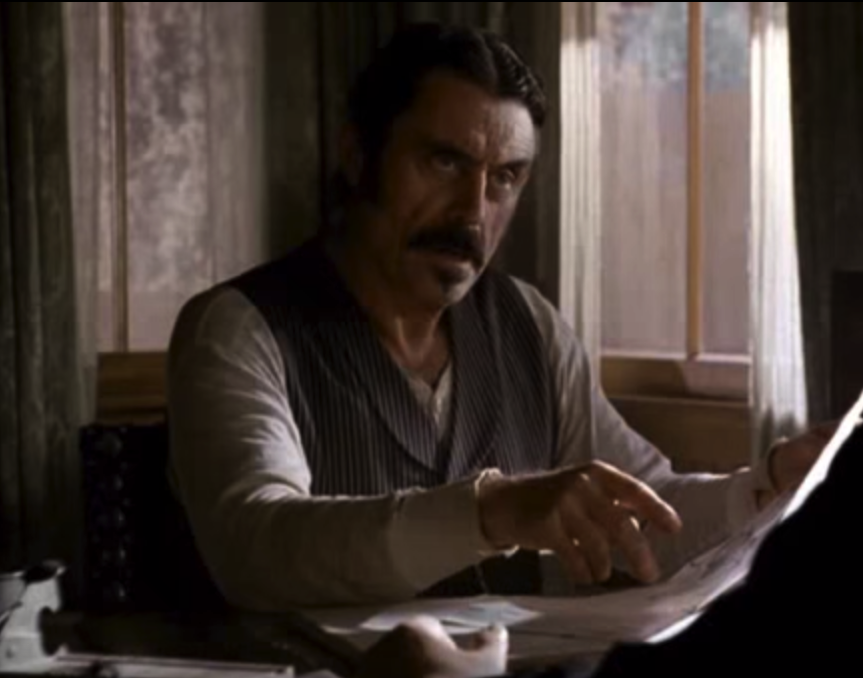
Yes, the dialogue:  hardly the crowning glory of the typical Hollywood Western.  And here, to make matters worse, almost every sentence uttered by many of the characters is replete with such shocking profanity that one is eventually numbed into accepting it as normal. But once you get past that, something strange and rather wonderful overtakes you: a sense of being carried along on a river of creative wordsmith-ing that at times eddies, bubbles, plunges and roars its way through scenes that are as comedic, dramatic and action-packed as any I have seen on film.  For those who have yet to enjoy the experience, I offer one small morsel:
 

deadwood1

https://www.youtube.com/watch?v=RdJ4TQ3TnNo


Milch as Shakespeare?

Around the start of Series 2 a rather strange idea occurred to me that, try as I might, I was increasingly unable to suppress as the show progressed:  that the writing – some of it at least – was almost Shakespearian in its ingenuity and, at times, lyrical complexity.

Convinced that I had taken leave of my senses I turned to Google and discovered, to my surprise, that there is a whole cottage industry of Deadwood fans who had made the same connection.  There is even – if you can imagine it – an online quiz that tests if you are able to identify the source of a number of quotes that might come from the show, or one of the Bard’s many plays.  I kid you not:
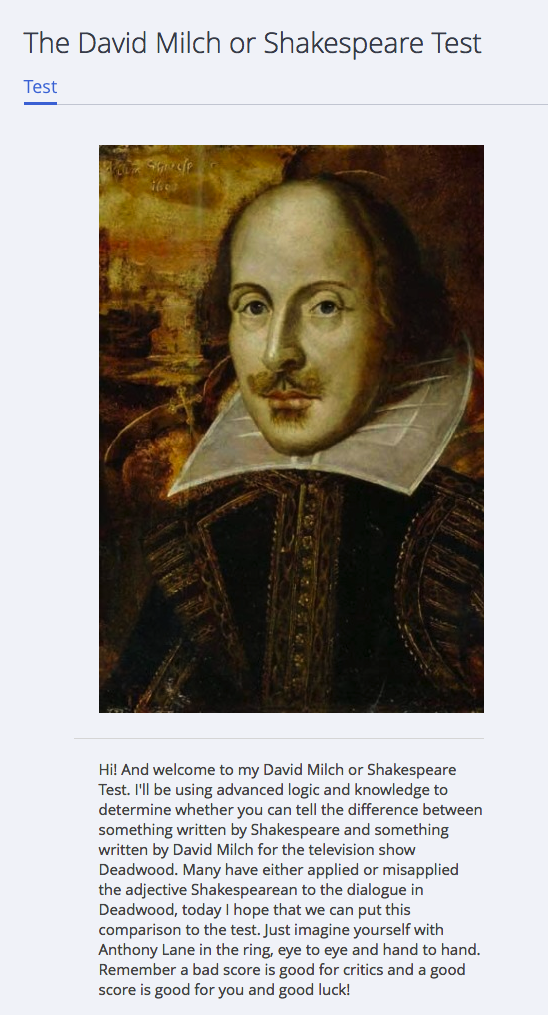
test

Intrigued, I took the test and scored around 85%.  Not too bad for a science graduate, although I expect most English majors would top 90%-95%.  That gave me an idea:  could one develop a machine learning algorithm to do the job?

Here’s how it went.

Milch or Shakespeare? – A Machine Learning Classification Algorithm

We start by downloading the text of a representative selection of Shakespeare’s plays, avoiding several of the better-known works from which many of the quotations derive:



ML1For testing purposes, let’s download a sample of classic works by other authors:

 

ML2

Let’s build an initial test classifier, as follows:

L3

ML4

It seems to work ok:

ML5

So far so good.  Let’s import the script for Deadwood series 1-3:

DeadWood =  Import[“……../Dropbox/Documents/Deadwood-Seasons-1-3-script.txt”];


Next, let’s import the quotations used in the online test:
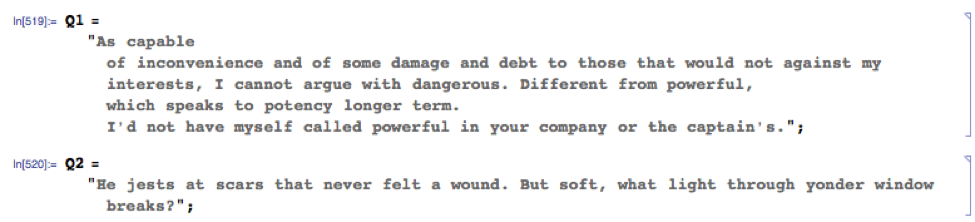
ML6

etc

We need to remove the relevant quotes from the Deadwood script file used to train the classifier, of course (otherwise it’s cheating!).  We will strip an additional 200 characters before the start of each quotation, and 500 characters after each quotation, just for good measure:

 

ML8

and so on….

ML9

Now we are ready to build our classifier:
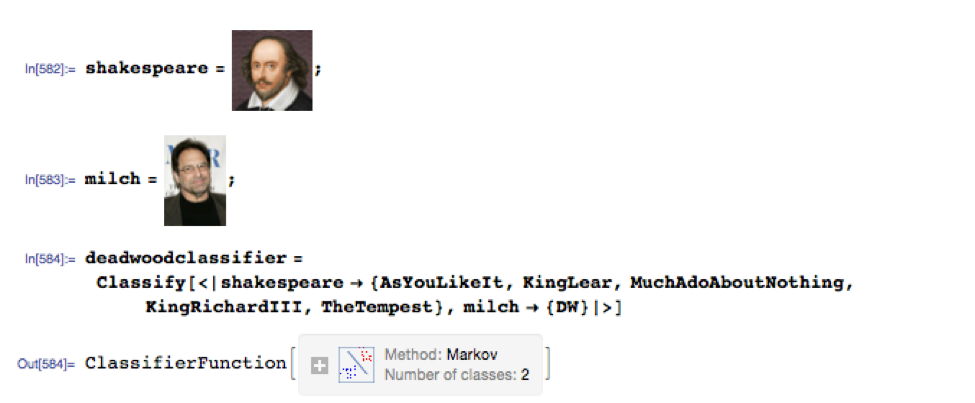
ML10


And we can obtain some information about the classifier, as follows:Classifier Info
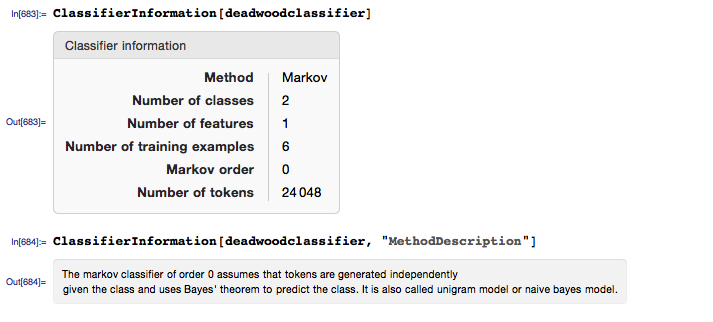
 

Let’s see how it performs:


ML11

Or, if you prefer tabular form:

ML12


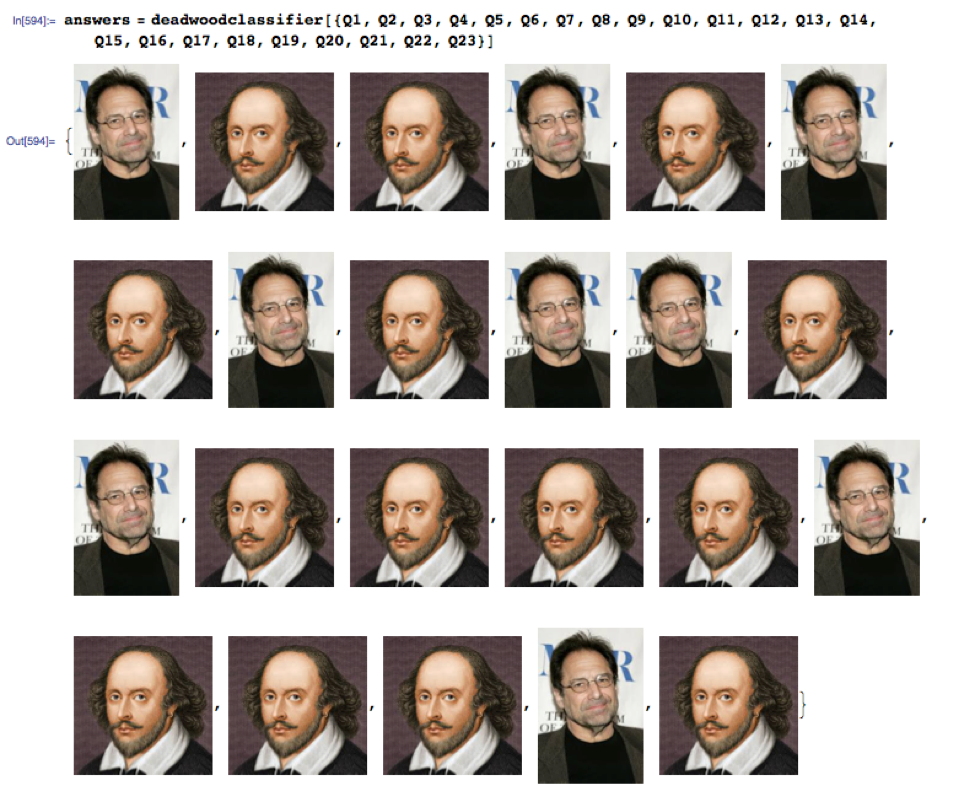
The machine learning model scored a total of 19 correct answers out of 23, or 82%.


Fooling the Machine

Let’s take a look as some of the questions the algorithm got wrong.

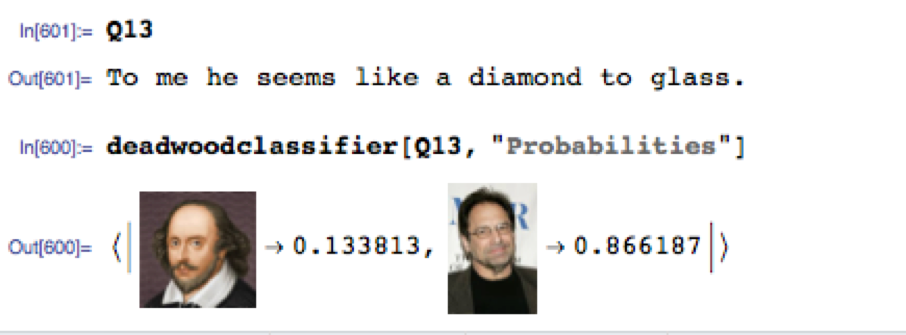
Quotation no. 13 is challenging, as it comes from Pericles, one of Shakespeare’s lesser-know plays and the idiom appears entirely modern.  The classifier assigns an 87% probability of Milch being the author (I got it wrong too).
 

L13


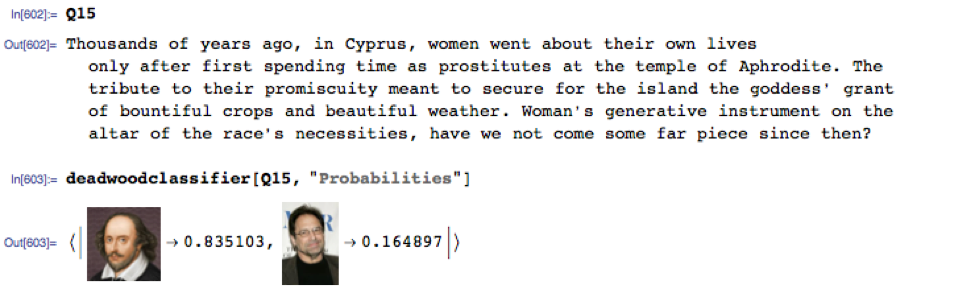
On Quotation no. 15 the algorithm was just as mistaken, but in the other direction (I got this one right, but only because I recalled the monologue from the episode):
ML14


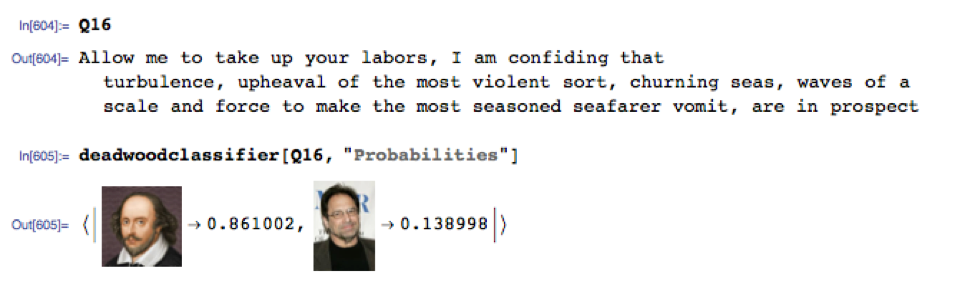
Quotation no.16 strikes me as entirely Shakespearian in form and expression and the classifier thought so too, favoring the Bard by 86% to only 14% for Milch:
 

ML15


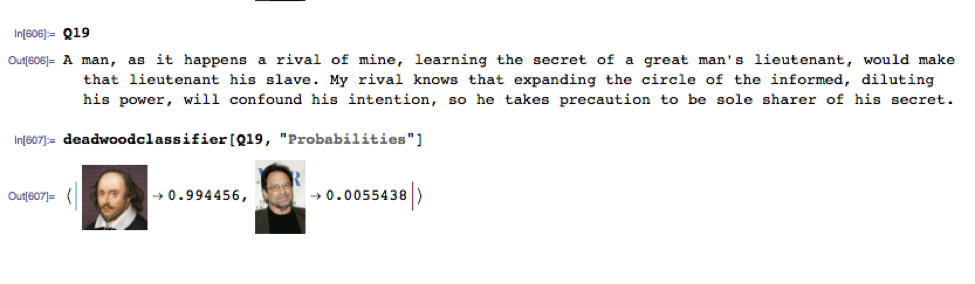
Quotation no. 19 had the algorithm fooled completely.  It’s a perfect illustration of a typical kind of circumlocution favored by Shakespeare that is imitated so well by Milch’s Deadwood characters:
ML16


Conclusion

The model clearly picked up distinguishing characteristics of the two authors’ writings that enabled it to correctly classify 82% of the quotations, quite a high percentage and much better than we would expect to do by tossing a coin, for example.  It’s a respectable performance, but I might have hoped for greater accuracy from the model, which scored about the same as I did.

I guess those who see parallels in the writing of William Shakespeare and David Milch may be onto something.


Postscript

The Hollywood Reporter recently published a story entitled

“How the $100 Million ‘NYPD Blue’ Creator Gambled Away His Fortune”.

It’s a fascinating account of the trials and tribulations of this great author, one worthy of Deadwood itself.

A silver lining to this tragic tale, perhaps, is that Milch’s difficulties may prompt him into writing the much-desired Series 4.

One can hope.

david_milch_2


A Primer on Genetic Programming

Posted by androidMarvin:

Genetic programming is an approach to letting the computer generate its own program code, rather than have a person write the program. It doesn’t specifically “find patterns” or rules within data structures. It starts with a number of randomly-constructed (as long as they are mathematically valid) sample programs, evaluates how close each one is to achieving what the desired result program should achieve, then steadily modifies the best matches to the desired target program in order to improve their match to the desired target; the original random attempts “evolve” towards a better match by natural selection, the best ones being selected to act as the basis for the next generation of attempts.

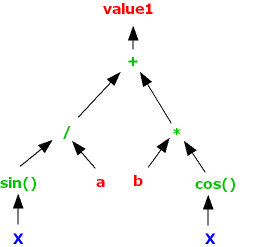
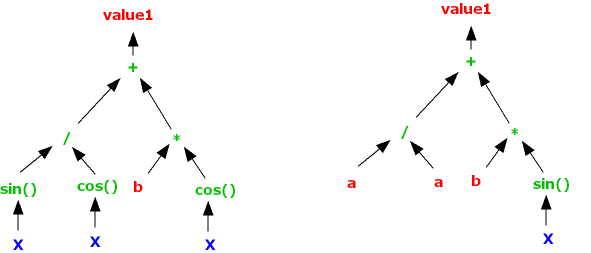
A tree representing a candidate formula could be represented as follows:

Genetic programming

It basically shows the mathematical operations that will be used in the formula, the order in which they are applied, and what values they act on. When the EL Verifier is analysing a statement like

value1 = sin( X ) / a + b * cos( X )

it has to see work out what order the parts of the statement should be evaluated in, which a person sees immediately; effectively, the Verifier constructs the tree diagram above, so that it knows that it has to generate code to make the computer :

  1. take the value of variable X and pass it through a call to the sin() functio
  2. take that result, and divide it by the value of a
  3. take the value of variable X and pass it through a call to the cos() functio
  4. take that result and multiply it by the value of variable
  5. take the result of step 2 and the result of step 4 and add the
  6. that result is the value of Y for the input value of X

SSALGOTRADING AD

Tradestation optimiser would take a single such tree, defining a fixed formula, and attempt to fit it to the data by varying the values of variables a and b. A Genetic Programming optimiser could do the same, but it also has the freedom to change the mathematical operators and the merge points in the tree, and change the shape of the tree to make the formula more or less complex as well; it can adjust both the parameters to the equation and the equation itself in order to evolve it to a better result.

For a mathematical curve fit, a GP optimiser would evaluate each individual tree by applying all the measured X values to the tree’s inputs, compare each output to the measured Y values, and sum a measure of the error over all the data; that sum would be the measure of how well the current tree matches the measure data. The “genetic” part of the name derives from the way it tries to evolve the population of trees its using to find the best.

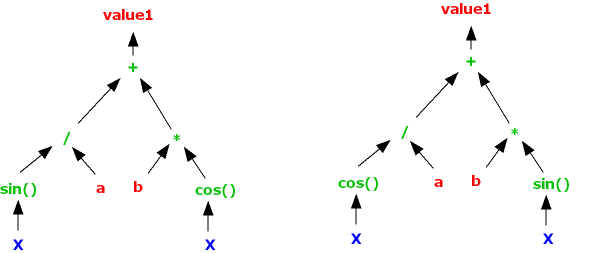
The main evolution technique is “crossover”. When two parent animals create offspring, each offspring will get part of its DNA from one parent and part from the other; improvement of the species happens if some of the offspring get DNA component combinations that suit the environment better than their parents are suited. The GP optimiser emulates this process by selecting two parent trees, and swapping a section of one of those trees with a section of tree from the other parent, to create two offspring. Eg given parent trees

GP

representing equations

value1 = sin( X )/a + b * cos( X )

and

value1 = cos( X ) / a + b * sin( X )

the offspring might be

GP

representing equations

value1 = sin( X )/cos( X ) + b * cos( X )

and

value1 = a / a + b * sin( X )

Those specific changes are unlikely to both be an improvement, but that’s the way with random processes; the changes made aren’t guided by any sort of principle, its just a case of “change something, anything, and see if its any better”.

A secondary change process that can be used is “mutation”, in which something about a single tree is simply changed, not swapped. This is intended to introduce diversity, so that if none of the current trees is a particularly good performer, there’s a chance that something radically better might be brought into the pool.

The push trying to steer the evolution towards a better result comes from deciding which parents are allowed to create offspring. The original idea was that all the current trees were ranked in sorted order of their fitness, the worst ones were removed from the population to be replaced by new offspring, amd the trees that were the best performing are selected to be parents – so the weak die, and the strongest breed, hoping their offspring will be at least as good as the parents.

One reservation I have about a product like Adaptrade Builder is that it doesn’t follow this original pattern. It chooses “a few” (2 by default) trees to be considered as parents, by entering a “tournament” and the best tree in the tournament is selected as a parent. This seems to me to reduce the bias towards breeding strength with strength, but I’m no expert.

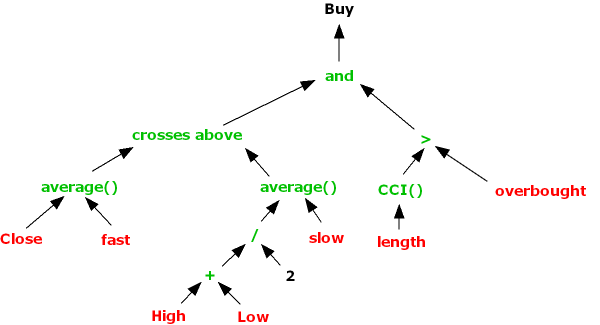
Rather than being simply mathematical, Builder seems to generate tests for entry and exit orders. It takes arithmetic and comparison operators for granted, and allows trees to be built from technical indicators rather than mathematical functions like sin() and cos(). So where an EL programmer might write

if average( Close, fast ) crosses above Average( ( High + Low )/2, slow ) and CCI( length ) > overbought then buy

Builder would have a tree

Genetic programming

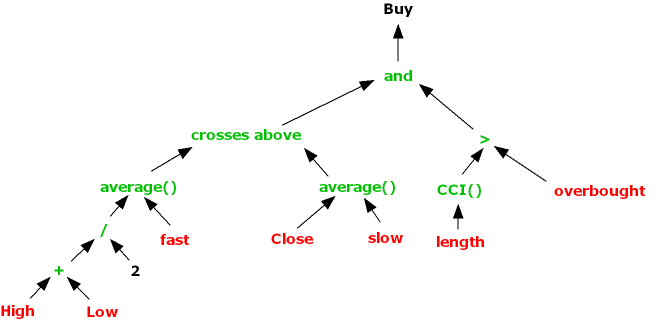
from which an offspring might be generated as :

Genetic programming

to use a Buy test

if average( ( High + Low )/2, fast ) crosses above Average( Close, slow ) and CCI( length ) > overbought then buy

The structure of the test to go long has changed, but in a random rather than the guided way a human might do when trying to develop a strategy.