
A Study in Gold

I want to take a look at a trading strategy in the GDX Gold ETF that has attracted quite a lot of attention, stemming from Jay Kaeppel’s article: The Greatest Gold Stock System You’ll Probably Never Use .

The essence of the approach is that GDX has reliably tended to trade off during the day session, after making gains in the overnight session. One possible explanation for the phenomenon is offer by Adrian Douglas in his article Gold Market is not “Fixed”, it’s Rigged in which he takes issue with the London Fixing mechanism used to set the daily price of gold

In any event there has been a long-term opportunity to exploit what appears to be a market inefficiency using an extremely simple trading rule, as described by Oddmund Grotte (see http://www.quantifiedstrategies.com/the-greatest-gold-stock-system-you-should-trade/):

1) If GDX rises from the open to the close more than 0.1%, buy on the close and exit on the opening next day.
2) If GDX rises from the open to the close more than 0.1% the day before, sell short on the opening and exit on the close (you have to both sell your position from number 1 but also short some more).

SSALGOTRADING AD

Unfortunately this simple strategy has recently begun to fail, producing (substantial) negative returns since June 2013. So I have been experimenting with a number of closely-related strategies and have created a simple Excel workbook to evaluate them. First, a little notation:
RCO = Return from prior close to market open
ROC = return from open to close
RCC = Return from close to close

I also use the suffix “m1” to denote the prior period’s return. So, for example, ROCm1 is yesterday’s return, measured from open to close. And I use the slash symbol “/” to denote dependency. So, for instance, RCO/ROCm1 means the return from today’s open to close, given the return from open to close yesterday.

In the accompanying workbook I look at several possible, closely related trading rules, and evaluate their performance over time. The basic daily data spans the period from May 2006 to July 2013 and in shown in columns A-H of the workbook. Columns I-K show the daily RCO, ROC and RCC returns. The returns for three different strategies are shown in columns L, N and P, and the cumulative returns for each are shown in columns M, N and Q, respectively.

The trading rules for each of the strategies are as follows:

COL L: RCO/ROCm1>0.5%. Which means: buy GDX at the close if the intra-day return from open to close exceeds 0.5%, and hold overnight until the following morning.

COL N: ROC/ROCm1>1%. Which means: sell GDX at today’s open if the intra-day return from open to close on the preceding day exceeds 1% and buy at today’s close.

COL P: ROC/RCCm1>1%. Which means: sell GDX at today’s open if the return from close to close on the preceding day exceeds 1% and buy at today’s close.

COL R shows returns from a blended strategy which combines the returns from the strategies in columns N and P on Mondays, Tuesdays and Thursdays only (i.e. assuming no trading on Wednesdays or Fridays). The cumulative returns from this hybrid strategy are shown in column S.

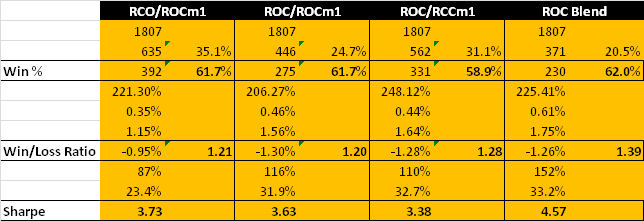
We can now present the results from the four strategies, over the 7 year period from May 2006 to July 2013, as shown in the chart and table below. On their face, the results are impressive: all four strategies have Sharpe ratios in excess of 3, with the blended strategy having a Sharpe of 4.57, while the daily win rates average around 60%.

Cumulative Returns

Performance Stats

How well do these strategies hold up over time? You can monitor their performance as you move through time by clicking on the scrollbar control in COL U of the workbook. As you do so, the start date of the strategies is rolled forward, and the table of performance results is updated to include results from the new start date, ignoring any prior data.

As you can see, all of the strategies continue to perform well into the latter part of 2010. At that point, the performance of the first strategy begins to decline precipitously, although the remaining three strategies continue to do well. By mid-2012, the first strategy is showing negative performance, while the Sharpe ratios of the remaining strategies begin to decline. As we reach the end of Q1, 2013, only the Sharpe ratio of the ROC/RCCm1 strategy remains above 2 for the period Apr 2013 to July 2013.

The conclusion appears to be that there is evidence for the possibility of generating abnormal returns in GDX lasting well into the current decade. However these have declined considerably in recent years, to a point where the effects are likely no longer important.

Strategy Backtesting in Mathematica

This is a snippet from a strategy backtesting system that I am currently building in Mathematica.

One of the challenges when building systems in WL is to avoid looping wherever possible. This can usually be accomplished with some thought, and the efficiency gains can be significant. But it can be challenging to get one’s head around the appropriate construct using functions like FoldList, etc, especially as there are often edge cases to be taken into consideration.

A case in point is the issue of calculating the profit and loss from individual trades in a trading strategy. The starting point is to come up with a FoldList compatible function that does the necessary calculations:

CalculateRealizedTradePL[{totalQty_, totalValue_, avgPrice_, PL_,
totalPL_}, {qprice_, qty_}] :=
Module[{newTotalPL = totalPL, price = QuantityMagnitude[qprice],
newTotalQty, tradeValue, newavgPrice, newTotalValue, newPL},
newTotalQty = totalQty + qty;
tradeValue =
If[Sign[qty] == Sign[totalQty] || avgPrice == 0, priceqty, If[Sign[totalQty + qty] == Sign[totalQty], avgPriceqty,
price(totalQty + qty)]]; newTotalValue = If[Sign[totalQty] == Sign[newTotalQty], totalValue + tradeValue, newTotalQtyprice];
newavgPrice =
If[Sign[totalQty + qty] ==
Sign[totalQty], (totalQtyavgPrice + tradeValue)/newTotalQty, price]; newPL = If[(Sign[qty] == Sign[totalQty] ) || totalQty == 0, 0, qty(avgPrice - price)];
newTotalPL = newTotalPL + newPL;
{newTotalQty, newTotalValue, newavgPrice, newPL, newTotalPL}]

Trade P&L is calculated on an average cost basis, as opposed to FIFO or LIFO.

Note that the functions handle both regular long-only trading strategies and short-sale strategies, in which (in the case of equities), we have to borrow the underlying stock to sell it short. Also, the pointValue argument enables us to apply the functions to trades in instruments such as futures for which, unlike stocks, the value of a 1 point move is typically larger than 1(e.g.50 for the ES S&P 500 mini futures contract).

We then apply the function in two flavors, to accommodate both standard numerical arrays and timeseries (associations would be another good alternative):

CalculateRealizedPLFromTrades[tradeList_?ArrayQ, pointValue_ : 1] :=
Module[{tradePL =
Rest@FoldList[CalculateRealizedTradePL, {0, 0, 0, 0, 0},
tradeList]},
tradePL[[All, 4 ;; 5]] = tradePL[[All, 4 ;; 5]]pointValue; tradePL] CalculateRealizedPLFromTrades[tsTradeList_, pointValue_ : 1] := Module[{tsTradePL = Rest@FoldList[CalculateRealizedTradePL, {0, 0, 0, 0, 0}, QuantityMagnitude@tsTradeList["Values"]]}, tsTradePL[[All, 4 ;; 5]] = tsTradePL[[All, 4 ;; 5]]pointValue;
tsTradePL[[All, 2 ;;]] =
Quantity[tsTradePL[[All, 2 ;;]], "US Dollars"];
tsTradePL =
TimeSeries[
Transpose@
Join[Transpose@tsTradeList["Values"], Transpose@tsTradePL],
tsTradeList["DateList"]]]

These functions run around 10x faster that the equivalent functions that use Do loops (without parallelization or compilation, admittedly).

Let’s see how they work with an example:

Trade Simulation

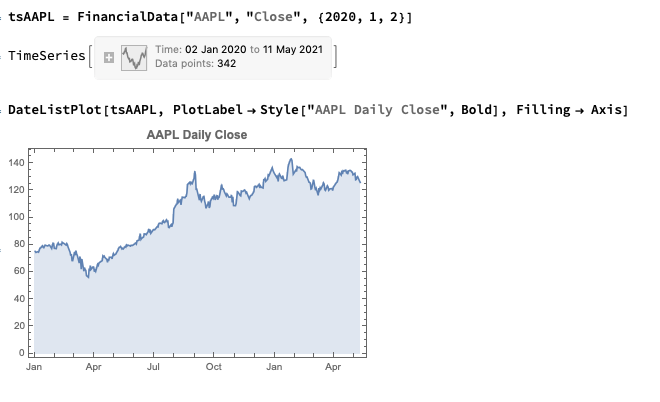
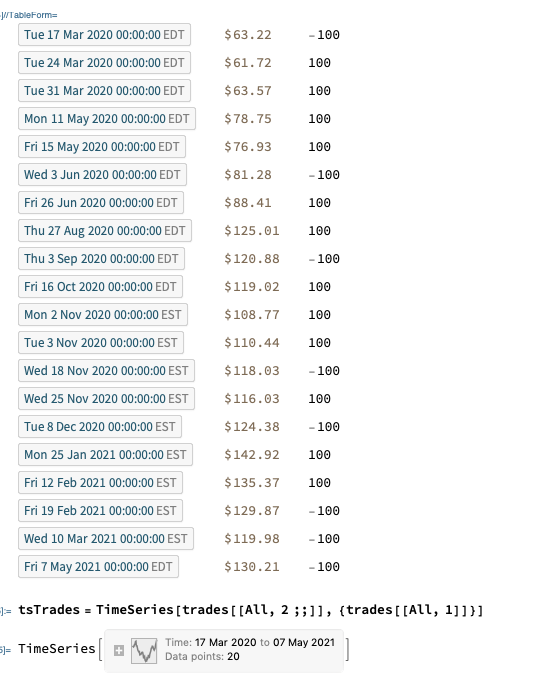
Next, we’ll generate a series of random trades using the AAPL time series, as follows (we also take the opportunity to convert the list of trades into a time series, tsTrades):

trades = Transpose@
Join[Transpose[
tsAAPL["DatePath"][[
Sort@RandomSample[Range[tsAAPL["PathLength"]],
20]]]], {RandomChoice[{-100, 100}, 20]}];
trades // TableForm

Trade P&L Calculation

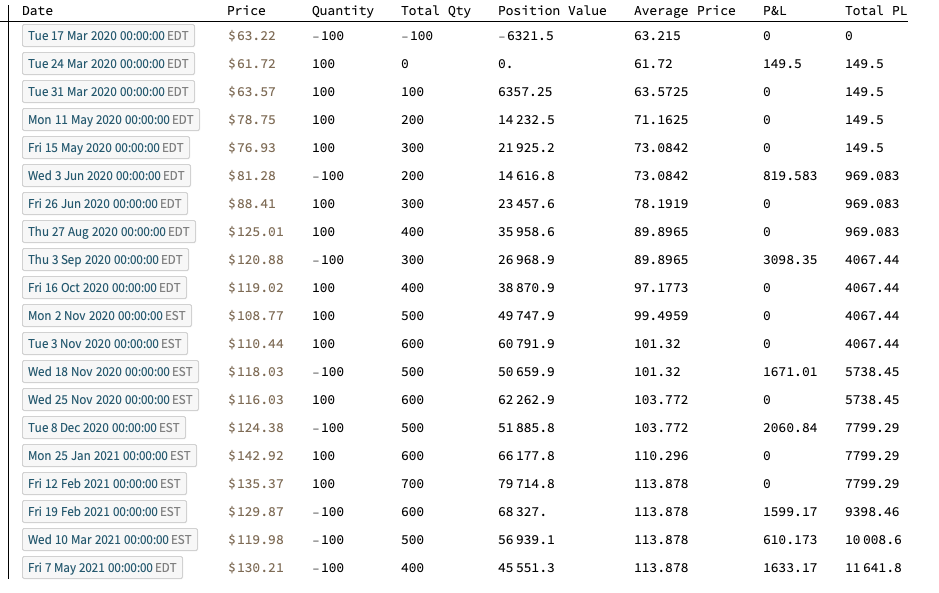
We are now ready to apply our Trade P&L calculation function, first to the list of trades in array form:

TableForm[
Flatten[#] & /@ 
Partition[
Riffle[trades, 
CalculateRealizedPLFromTrades[trades[[All, 2 ;; 3]]]], 2], 
TableHeadings -> {{}, {"Date", "Price", "Quantity", "Total Qty", 
"Position Value", "Average Price", "P&L", "Total PL"}}]

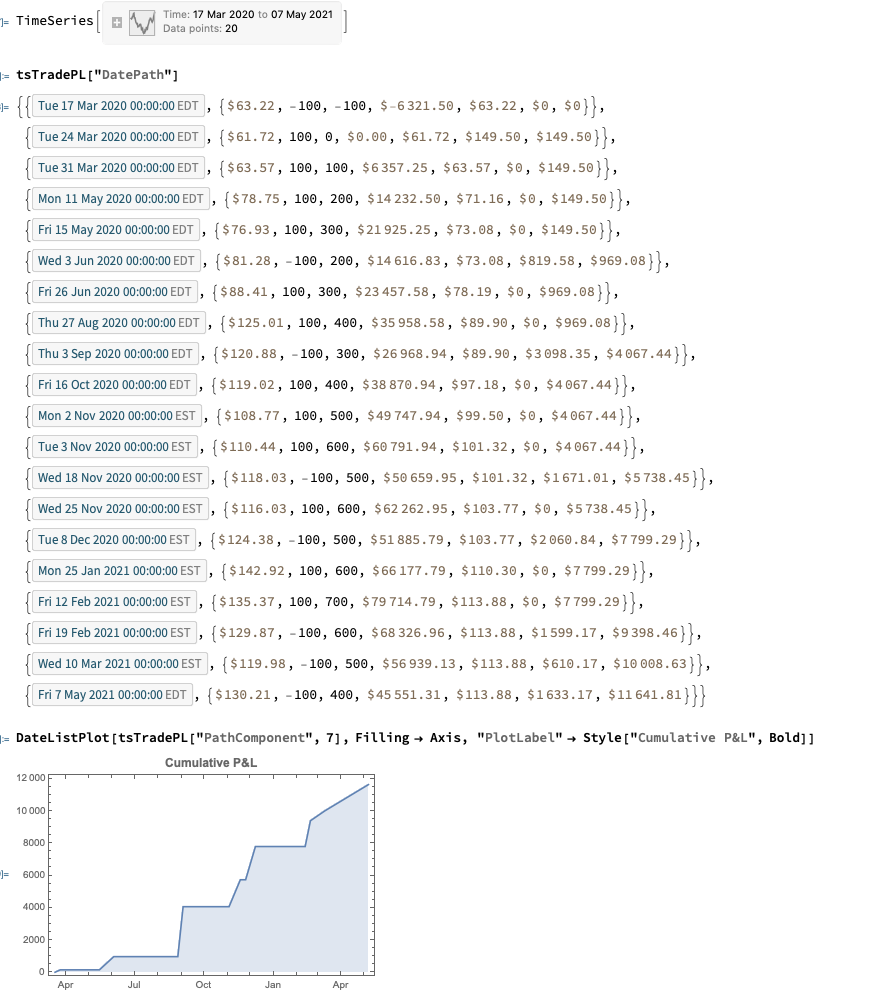
The timeseries version of the function provides the output as a timeseries object in Quantity[“US Dollars”] format and, of course, can be plotted immediately with DateListPlot (it is also convenient for other reasons, as the complete backtest system is built around timeseries objects):

tsTradePL = CalculateRealizedPLFromTrades[tsTrades]

Measuring Toxic Flow for Trading & Risk Management

A common theme of microstructure modeling is that trade flow is often predictive of market direction.  One concept in particular that has gained traction is flow toxicity, i.e. flow where resting orders tend to be filled more quickly than expected, while aggressive orders rarely get filled at all, due to the participation of informed traders trading against uninformed traders.  The fundamental insight from microstructure research is that the order arrival process is informative of subsequent price moves in general and toxic flow in particular.  This is turn has led researchers to try to measure the probability of informed trading  (PIN).  One recent attempt to model flow toxicity, the Volume-Synchronized Probability of Informed Trading (VPIN)metric, seeks to estimate PIN based on volume imbalance and trade intensity.  A major advantage of this approach is that it does not require the estimation of unobservable parameters and, additionally, updating VPIN in trade time rather than clock time improves its predictive power.  VPIN has potential applications both in high frequency trading strategies, but also in risk management, since highly toxic flow is likely to lead to the withdrawal of liquidity providers, setting up the conditions for a flash-crash” type of market breakdown.

The procedure for estimating VPIN is as follows.  We begin by grouping sequential trades into equal volume buckets of size V.  If the last trade needed to complete a bucket was for a size greater than needed, the excess size is given to the next bucket.  Then we classify trades within each bucket into two volume groups:  Buys (V(t)B) and Sells (V(t)S), with V = V(t)B + V(t)S
The Volume-Synchronized Probability of Informed Trading is then derived as:

risk management

Typically one might choose to estimate VPIN using a moving average over n buckets, with n being in the range of 50 to 100.

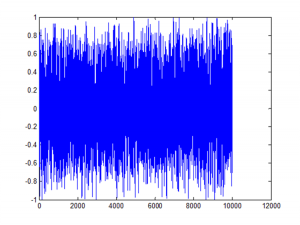
Another related statistic of interest is the single-period signed VPIN. This will take a value of between -1 and =1, depending on the proportion of buying to selling during a single period t.

Toxic Flow

Fig 1. Single-Period Signed VPIN for the ES Futures Contract

It turns out that quote revisions condition strongly on the signed VPIN. For example, in tests of the ES futures contract, we found that the change in the midprice from one volume bucket the next  was highly correlated to the prior bucket’s signed VPIN, with a coefficient of 0.5.  In other words, market participants offering liquidity will adjust their quotes in a way that directly reflects the direction and intensity of toxic flow, which is perhaps hardly surprising.

Of greater interest is the finding that there is a small but statistically significant dependency of price changes, as measured by first buy (sell) trade price to last sell (buy) trade price, on the prior period’s signed VPIN.  The correlation is positive, meaning that strongly toxic flow in one direction has a tendency  to push prices in the same direction during the subsequent period. Moreover, the single period signed VPIN turns out to be somewhat predictable, since its autocorrelations are statistically significant at two or more lags.  A simple linear auto-regression ARMMA(2,1) model produces an R-square of around 7%, which is small, but statistically significant.

A more useful model, however , can be constructed by introducing the idea of Markov states and allowing the regression model to assume different parameter values (and error variances) in each state.  In the Markov-state framework, the system transitions from one state to another with conditional probabilities that are estimated in the model.

SSALGOTRADING AD

An example of such a model  for the signed VPIN in ES is shown below. Note that the model R-square is over 27%, around 4x larger than for a standard linear ARMA model.

We can describe the regime-switching model in the following terms.  In the regime 1 state  the model has two significant autoregressive terms and one significant moving average term (ARMA(2,1)).  The AR1 term is large and positive, suggesting that trends in VPIN tend to be reinforced from one period to the next. In other words, this is a momentum state. In the regime 2 state the AR2 term is not significant and the AR1 term is large and negative, suggesting that changes in VPIN in one period tend to be reversed in the following period, i.e. this is a mean-reversion state.

The state transition probabilities indicate that the system is in mean-reversion mode for the majority of the time, approximately around 2 periods out of 3.  During these periods, excessive flow in one direction during one period tends to be corrected in the
ensuring period.  But in the less frequently occurring state 1, excess flow in one direction tends to produce even more flow in the same direction in the following period.  This first state, then, may be regarded as the regime characterized by toxic flow.

Markov State Regime-Switching Model

Markov Transition Probabilities

P(.|1)       P(.|2)

P(1|.)        0.54916      0.27782

P(2|.)       0.45084      0.7221

Regime 1:

AR1           1.35502    0.02657   50.998        0

AR2         -0.33687    0.02354   -14.311        0

MA1          0.83662    0.01679   49.828        0

Error Variance^(1/2)           0.36294     0.0058

Regime 2:

AR1      -0.68268    0.08479    -8.051        0

AR2       0.00548    0.01854    0.296    0.767

MA1     -0.70513    0.08436    -8.359        0

Error Variance^(1/2)           0.42281     0.0016

Log Likelihood = -33390.6

Schwarz Criterion = -33445.7

Hannan-Quinn Criterion = -33414.6

Akaike Criterion = -33400.6

Sum of Squares = 8955.38

R-Squared =  0.2753

R-Bar-Squared =  0.2752

Residual SD =  0.3847

Residual Skewness = -0.0194

Residual Kurtosis =  2.5332

Jarque-Bera Test = 553.472     {0}

Box-Pierce (residuals):         Q(9) = 13.9395 {0.124}

Box-Pierce (squared residuals): Q(12) = 743.161     {0}


A Simple Trading Strategy

One way to try to monetize the predictability of the VPIN model is to use the forecasts to take directional positions in the ES
contract.  In this simple simulation we assume that we enter a long (short) position at the first buy (sell) price if the forecast VPIN exceeds some threshold value 0.1  (-0.1).  The simulation assumes that we exit the position at the end of the current volume bucket, at the last sell (buy) trade price in the bucket.

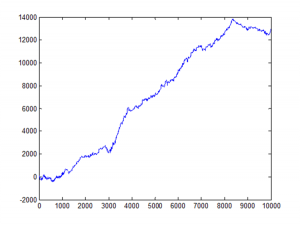
This simple strategy made 1024 trades over a 5-day period from 8/8 to 8/14, 90% of which were profitable, for a total of $7,675 – i.e. around ½ tick per trade.

The simulation is, of course, unrealistically simplistic, but it does give an indication of the prospects for  more realistic version of the strategy in which, for example, we might rest an order on one side of the book, depending on our VPIN forecast.

informed trading

Figure 2 – Cumulative Trade PL

References

Easley, D., Lopez de Prado, M., O’Hara, M., Flow Toxicity and Volatility in a High frequency World, Johnson School Research paper Series # 09-2011, 2011

Easley, D. and M. O‟Hara (1987), “Price, Trade Size, and Information in Securities Markets”, Journal of Financial Economics, 19.

Easley, D. and M. O‟Hara (1992a), “Adverse Selection and Large Trade Volume: The Implications for Market Efficiency”,
Journal of Financial and Quantitative Analysis, 27(2), June, 185-208.

Easley, D. and M. O‟Hara (1992b), “Time and the process of security price adjustment”, Journal of Finance, 47, 576-605.


Long/Short Stock Trading Strategy

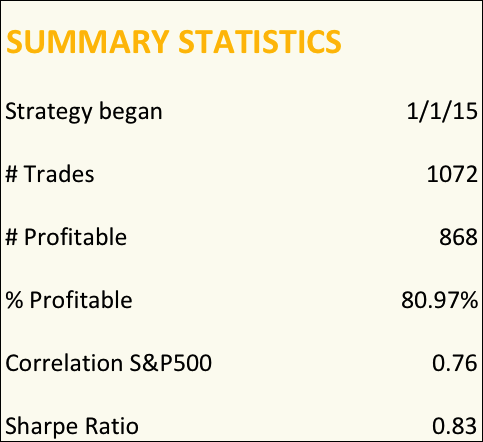
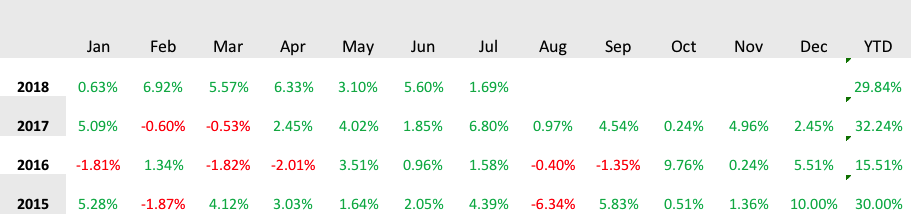
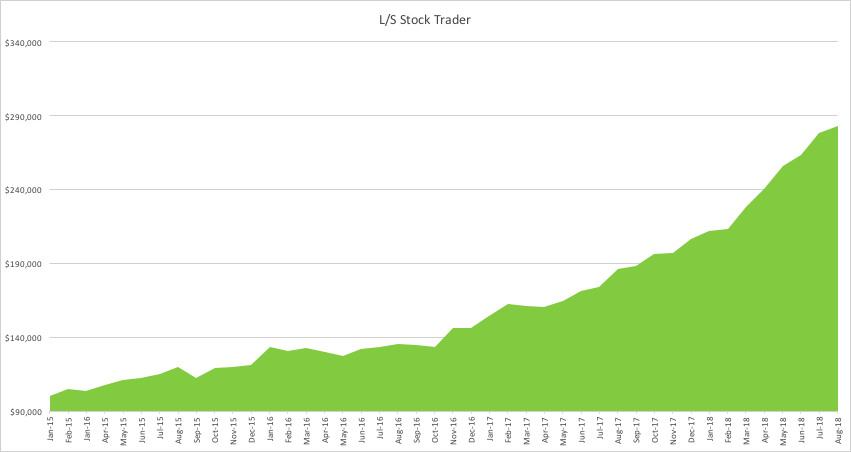
The Long-Short Stock Trader strategy uses a quantitative model to introduce market orders, both entry and exits. The model looks for divergencies between stock price and its current volatility, closing the position when the Price-volatility gap is closed.  The strategy is designed to obtain a better return on risk than S&P500 index and the risk management is focused on obtaining a lower drawdown and volatility than index.
The model trades only Large Cap stocks, with high liquidity and without scalability problems. Thanks to the high liquidity, market orders are filled without market impact and at the best market prices.

For more information and back-test results go here.

The Long-Short Trader is the first strategy launched on the Systematic Algotrading Platform under our new Strategy Manager Program.

Performance Summary


Monthly Returns


Value of $100,000 Portfolio


Master’s in High Frequency Finance

I have been discussing with some potential academic partners the concept for a new graduate program in High Frequency Finance.  The idea is to take the concept of the Computational Finance program developed in the 1990s and update it to meet the needs of students in the 2010s.

The program will offer a thorough grounding in the modeling concepts, trading strategies and risk management procedures currently in use by leading investment banks, proprietary trading firms and hedge funds in US and international financial markets.  Students will also learn the necessary programming and systems design skills to enable them to make an effective contribution as quantitative analysts, traders, risk managers and developers.

I would be interested in feedback and suggestions as to the proposed content of the program.

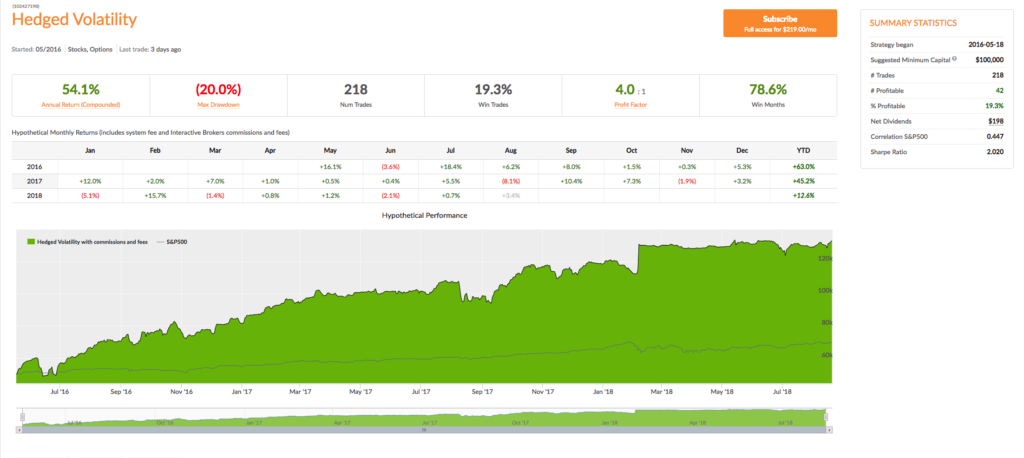
The Hedged Volatility Strategy

Being short regular Volatility ETFs or long Inverse Volatility ETFs are winning strategies…most of the time. The challenge is that when the VIX spikes or when the VIX futures curve is downward sloping instead of upward sloping, very significant losses can occur. Many people have built and back-tested models that attempt to move from long to short to neutral positions in the various Volatility ETFs, but almost all of them have one or both of these very significant flaws: 1) Failure to use “out of sample” back-testing and 2) Failure to protect against “black swan” events.

In this strategy a position and weighting in the appropriate Volatility ETFs are established based on a multi-factor model which always uses out of sample back-testing to determine effectiveness. Volatility Options are always used to protect against significant short-term moves which left unchecked could result in the total loss of one’s portfolio value; these options will usually lose money, but that is a small price to pay for the protection they provide. (Strategies should be scaled at a minimum of 20% to ensure options protection.)

This is a good strategy for IRA accounts in which short selling is not allowed. Long positions in Inverse Volatility ETFs are typically held. Suggested minimum capital: $26,000 (using 20% scaling).

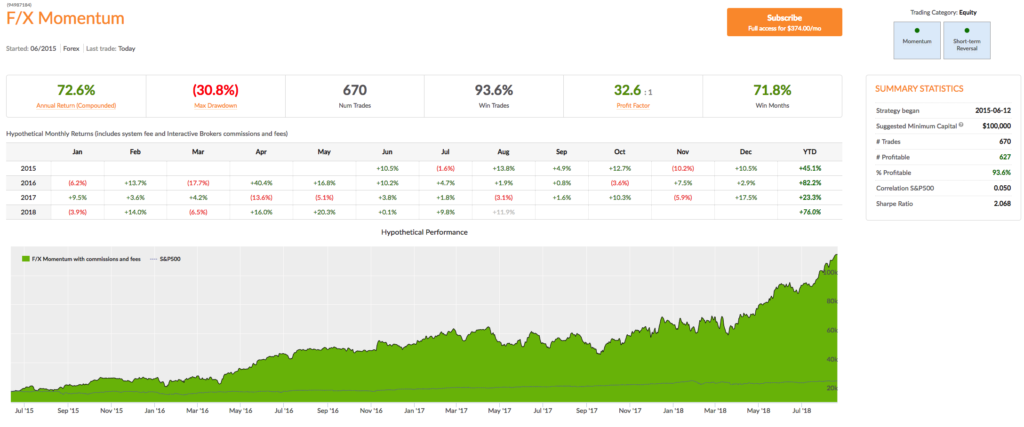
The F/X Momentum Strategy

Our approach is based upon the idea that currencies tend to be range bound, that momentum ultimately exhausts itself and that prices tend to fall faster than they rise. The strategy seeks to exploit these characteristics with short trades that may be closed within a few hours, or continue over several days when the exhaustion pattern emerges more slowly.
FXMomentum Aug 20 2018

A Meta-Strategy in S&P 500 E-Mini Futures

In earlier posts I have described the idea of a meta-strategy as a strategies that trades strategies.  It is an algorithm, or set of rules, that is used to decide when to trade an underlying strategy.  In some cases a meta-strategy may influence the size in which the underlying strategy is traded, or may even amend the base code.  In other word, a meta-strategy actively “trades” an underlying strategy, or group of strategies, much as in the same way a regular strategy may actively trade stocks, going long or short from time to time.  One distinction is that a meta-strategy will rarely, if ever, actually “short” an underlying strategy – at most it will simply turn the strategy off (reduce the position size to zero) for a period.

For a more detailed description, see this post:

Improving Trading System Performance Using a Meta-Strategy

In this post I look at a meta-strategy that developed for a client’s strategy in S&P E-Mini futures.  What is extraordinary is that the underlying strategy was so badly designed (not by me!) and performs so poorly that no rational systematic trader would likely give it  a second look –  instead he would toss it into the large heap of failed ideas that all quantitative researchers accumulate over the course of their careers.  So this is a textbook example that illustrates the power of meta-strategies to improve, or in this case transform, the performance of an underlying strategy.

1. The Strategy

The Target Trader Strategy (“TTS”) is a futures strategy applied to S&P 500 E-Mini futures that produces a very high win rate, but which occasionally experiences very large losses. The purpose of the analysis if to find methods that will:

1) Decrease the max loss / drawdown
2) Increase the win rate / profitability

For longs the standard setting is entry 40 ticks below the target, stop loss 1000 ticks below the target, and then 2 re-entries 100 ticks below entry 1 and 100 ticks below entry 2

For shorts the standard is entry 80 ticks above the target. stop loss 1000 ticks above the target, and then 2 re-entries 100 ticks above entry 1 and 100 ticks above entry 2

For both directions its 80 ticks above/below for entry 1, 1000 tick stop, and then 1 re entry 100 ticks above/below, and then re-entry 2 100 ticks above/below entry 2


2. Strategy Performance

2.1 Overall Performance

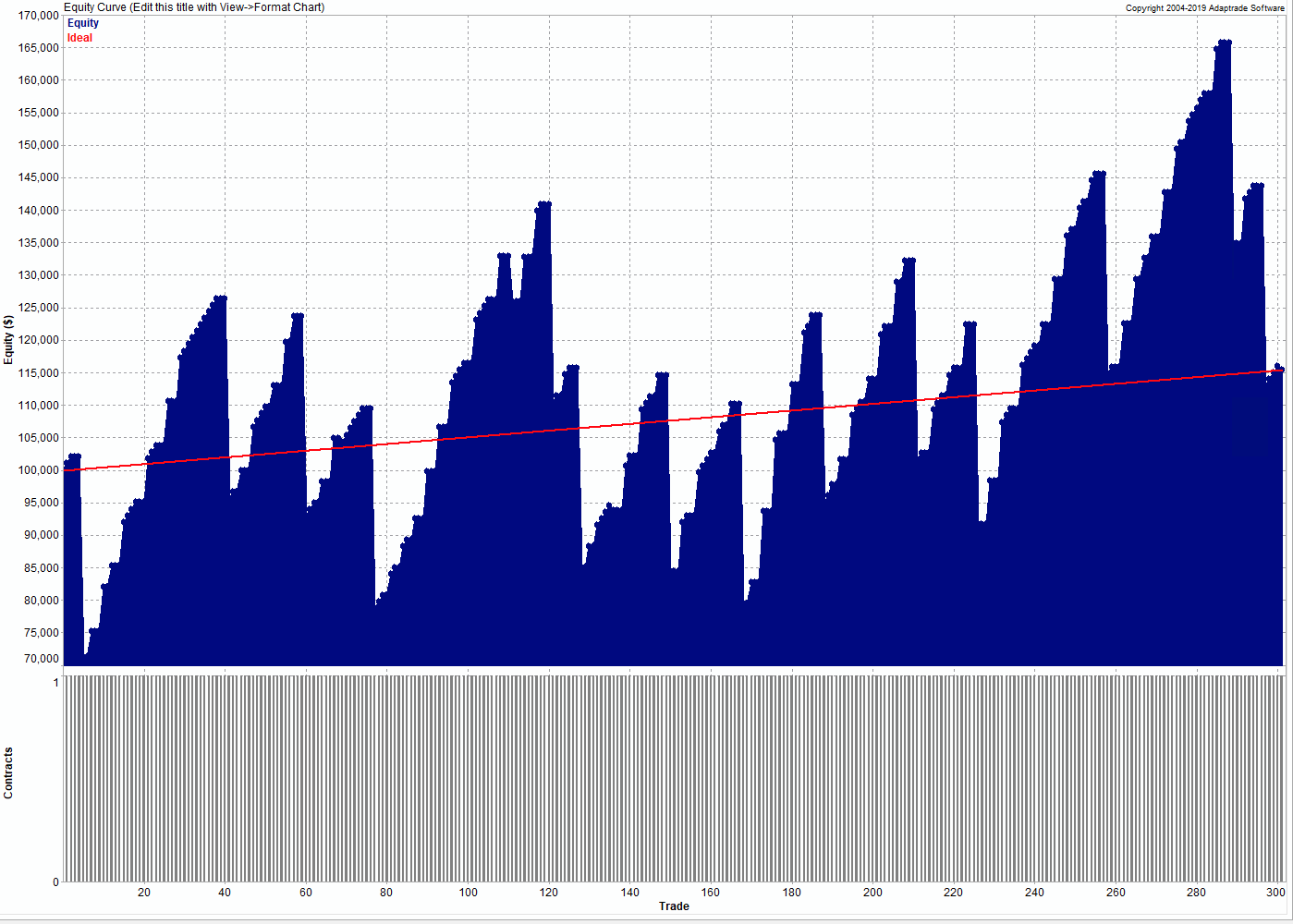
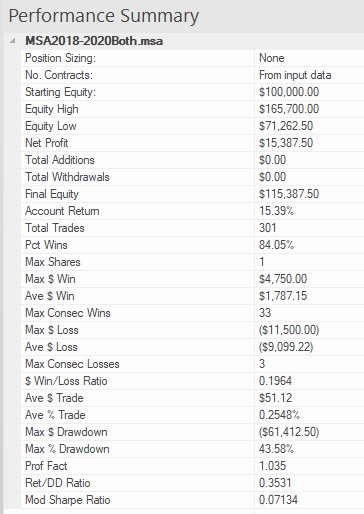
The overall performance of the strategy over the period from 2018 to 2020 is summarized in the chart of the strategy equity curve and table of performance statistics below.
These confirm that, while the win rate if very high (over 84%) there strategy experiences many significant drawdowns, including a drawdown of -$61,412.50 (-43.58%). The total return is of the order of 5% per year, the strategy profit factor is fractionally above 1 and the Sharpe Ratio is negligibly small. Many traders would consider the performance to be highly unattractive.


2.2 Long Trades

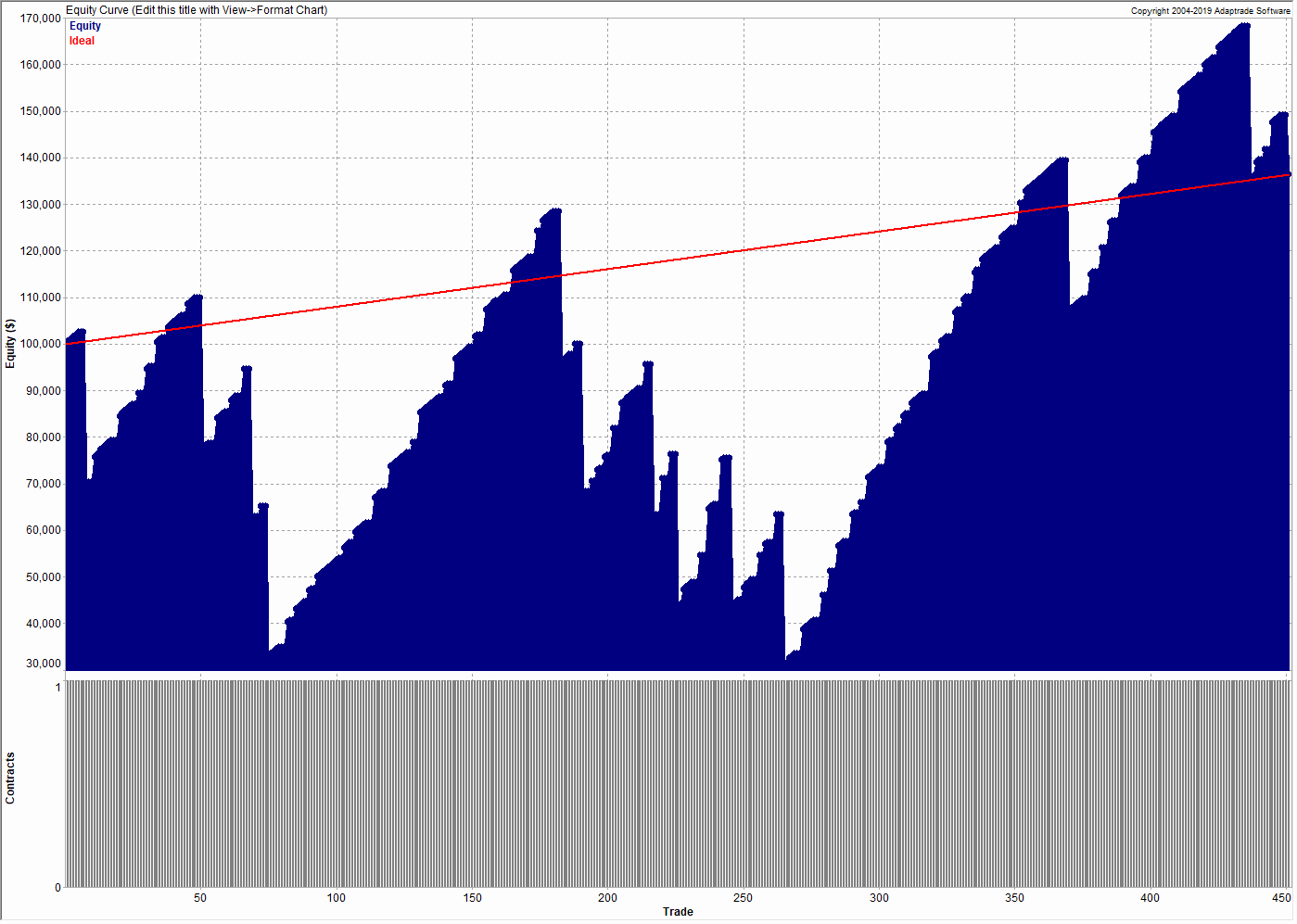
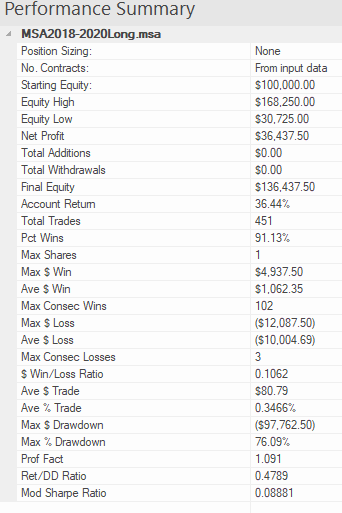
We break the strategy performance down into long and short trades, and consider them separately. On the long side, the strategy has been profitable, producing a gain of over 36% during the period 2018-2020. It also suffered catastrophic drawdown of over -$97,000 during that period:


2.3 Short Trades

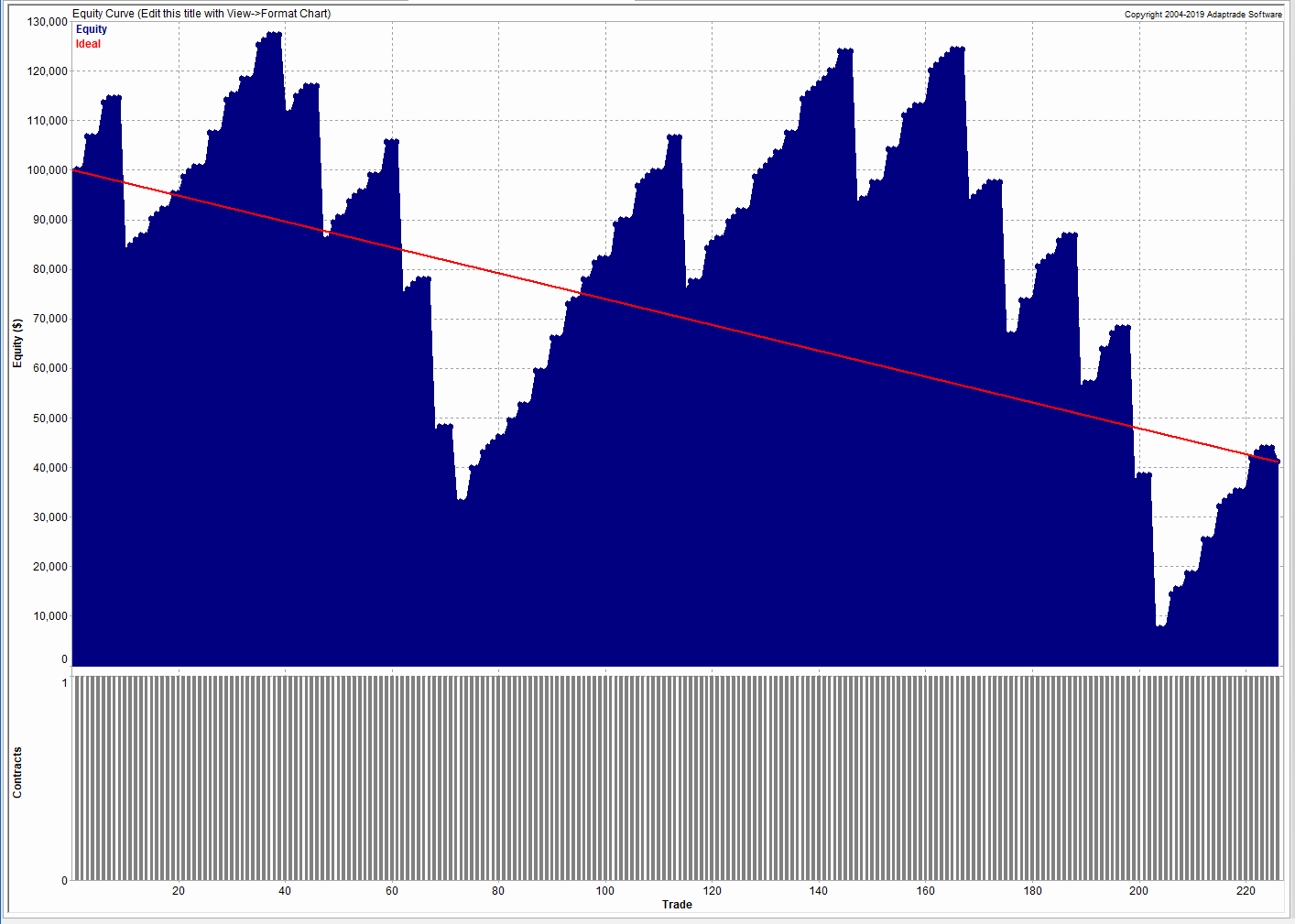
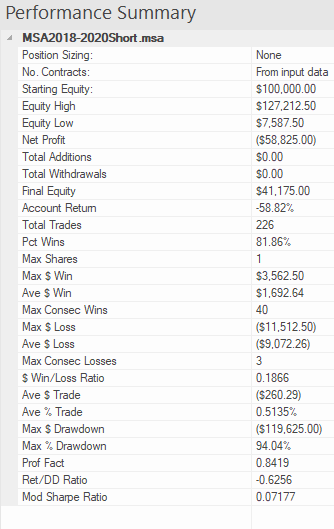
On the short side, the story is even worse, producing an overall loss of nearly -$59,000:


3. Improving Strategy Performance with a Meta-Strategy

We considered two possible methods to improve strategy performance. The first method attempts to apply technical indicators and other data series to improve trading performance. Here we evaluated price series such as the VIX index and a wide selection of technical indicators, including RSI, ADX, Moving Averages, MACD, ATR and others. However, any improvement in strategy performance proved to be temporary in nature and highly variable, in many cases amplifying the problems with the strategy performance rather than improving them.

The second approach proved much more effective, however. In this method we create a meta-strategy which effectively “trades the strategy”, turning it on and off depending on its recent performance. The meta-strategy consists of a set of rules that determines whether or not to continue trading the strategy after a series of wins or losses. In some cases the meta-strategy may increase the trade size for a sequence of trades, at times when it considers the conditions for the underlying strategy to be favorable.

The result of applying the meta-strategy are described in the following sections.

3.1 Long & Short Strategies with Meta-Strategy Overlay

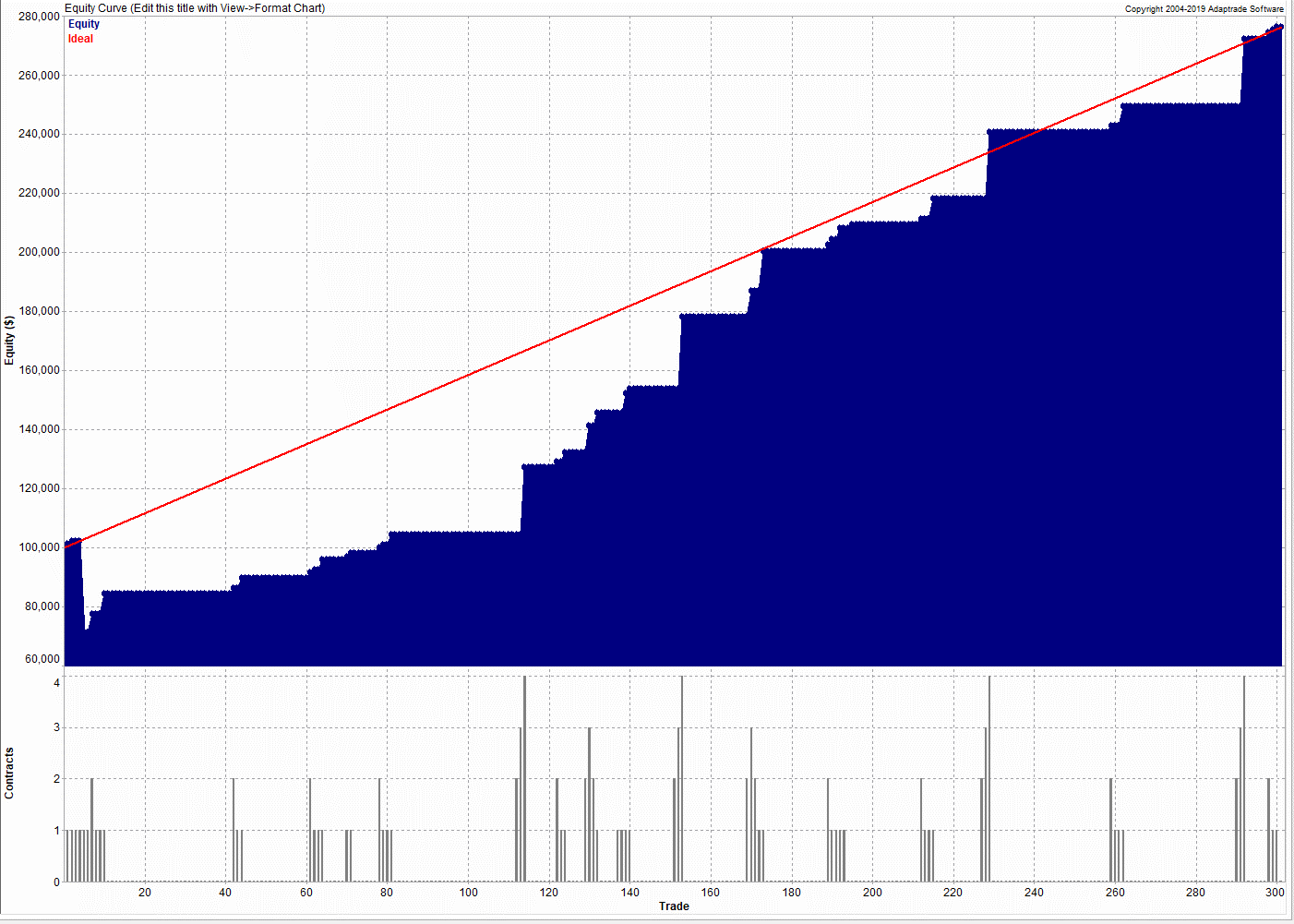
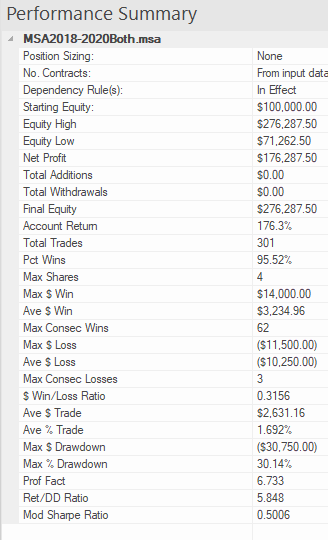
The performance of the long/short strategies combined with the meta-strategy overlay are set out in the chart and table below.
The overall improvements can be summarized as follows:

  • Net profit increases from $15,387 to $176,287
  • Account return rises from 15% to 176%
  • Percentage win rate rises from 84% to 95%
  • Profit factor increases from 1.0 to 6.7
  • Average trade rises from $51 to $2,631
  • Max $ Drawdown falls from -$61,412 to -$30,750
  • Return/Max Drawdown ratio rises from 0.35 to 5.85
  •  The modified Sharpe ratio increases from 0.07 to 0.5

Taken together, these are dramatic improvements to every important aspect of strategy performance.

There are two key rules in the meta-strategy, applicable to winning and losing trades:

Rule for winning trades:
After 3 wins in a row, skip the next trade.

Rule for losing trades:
After 3 losses in a row, add 1 contract until the first win. Subtract 1 contract after each win until the next loss, or back to 1 contract.


3.2 Long Trades with Meta-Strategy

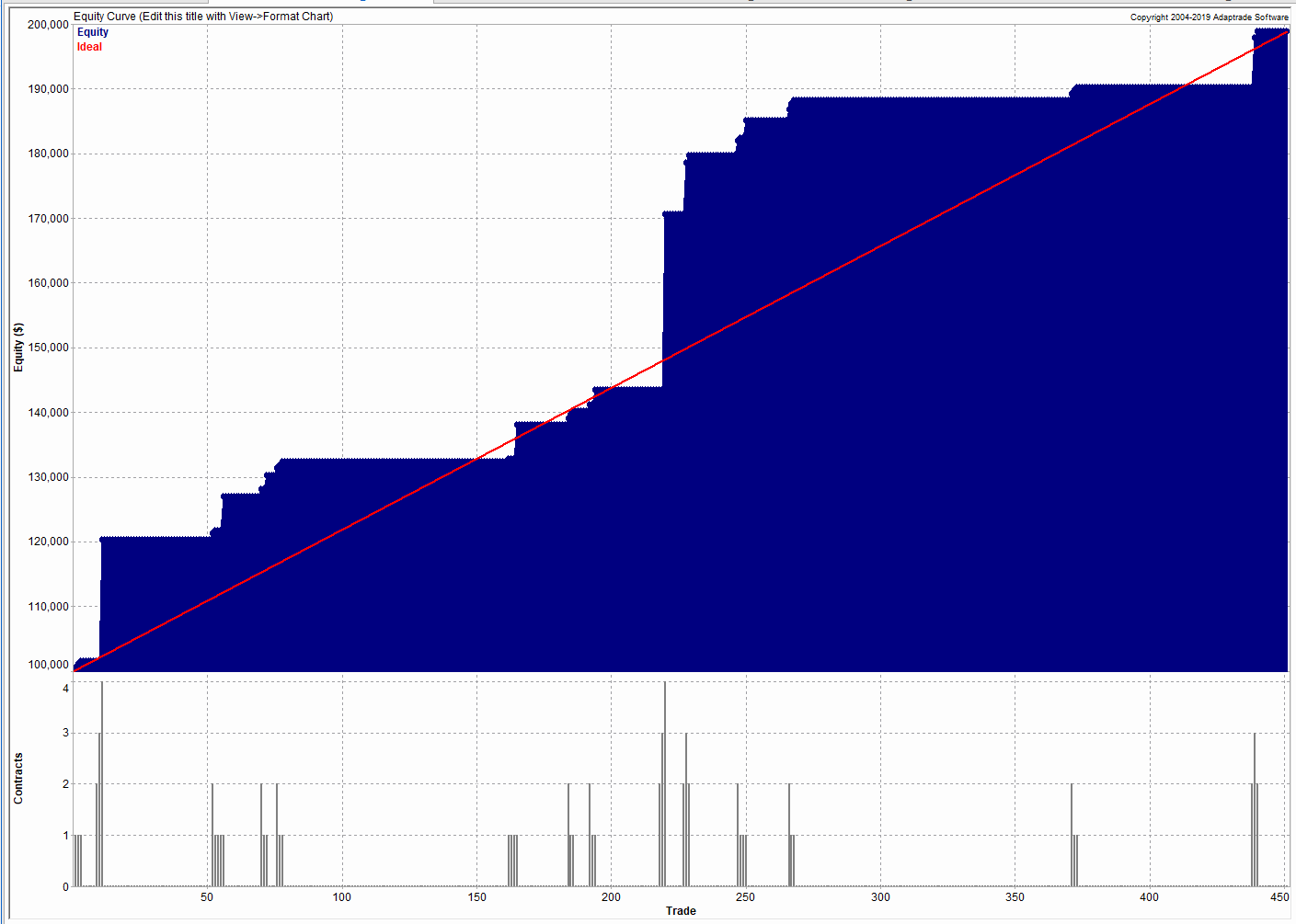
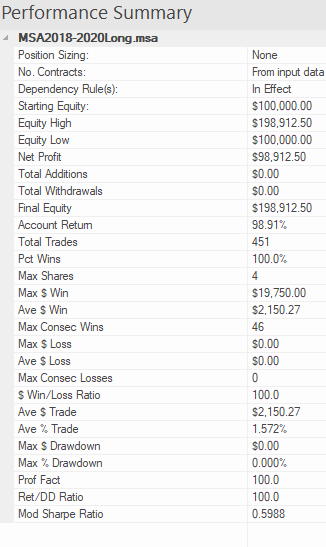
The meta-strategy rules produce significant improvements in the performance of both the long and short components of the strategy. On the long side the percentage win rate is increased to 100% and the max % drawdown is reduced to 0%:


3.3 Short Trades with Meta-Strategy

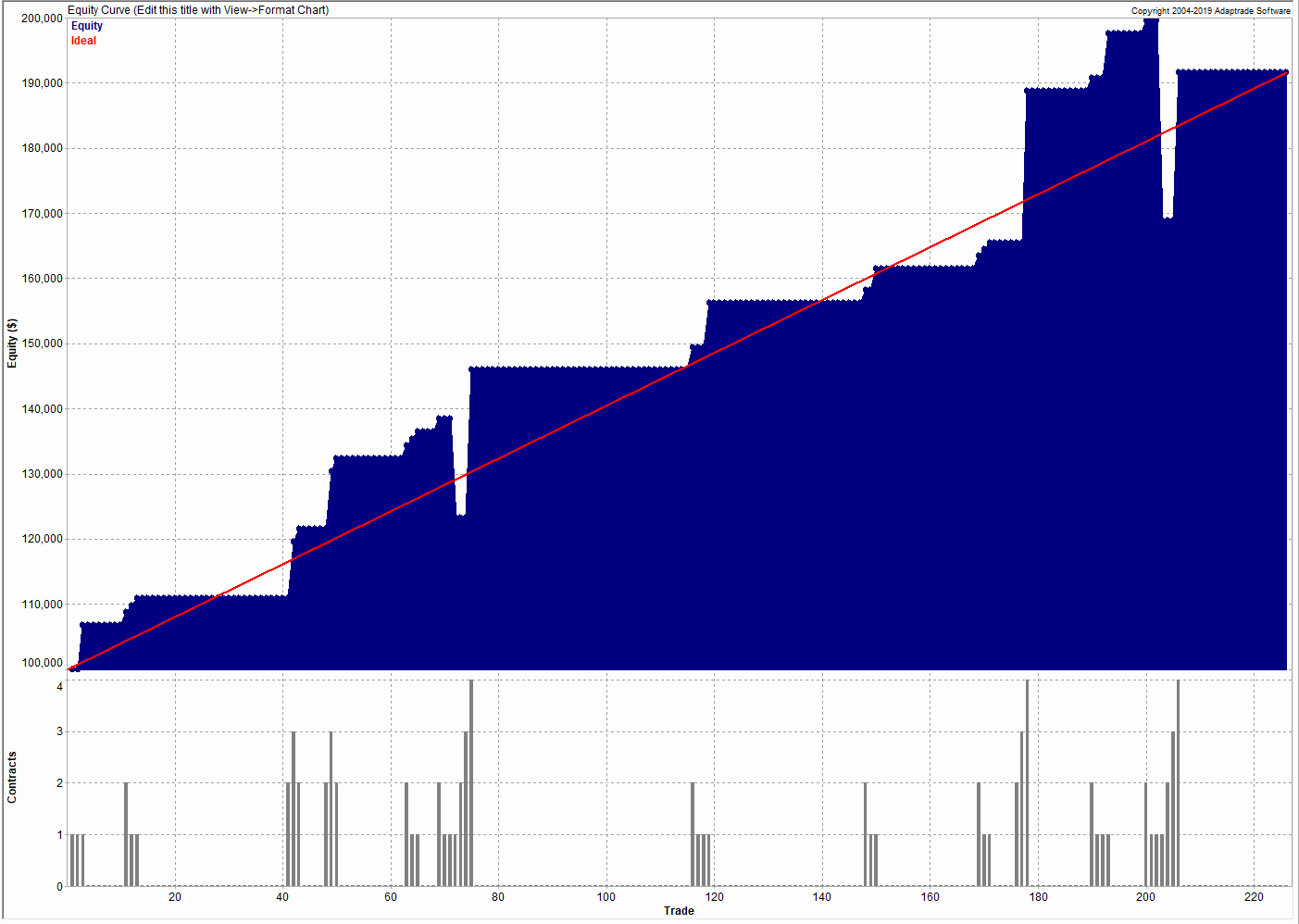
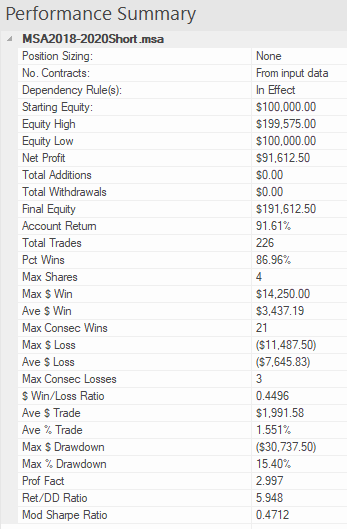
Improvements to the strategy on the short side are even more significant, transforming a loss of -$59,000 into a profit of $91,600:


4. Conclusion

A meta-strategy is a simple, yet powerful technique that can transform the performance of an underlying strategy.  The rules are often simple, although they can be challenging to implement.  Meta strategies can be applied to almost any underlying strategy, whether in futures, equities, or forex. Worthwhile improvements in strategy performance are often achievable, although not often as spectacular as in this case.

If any reader is interested in designing a meta-strategy for their own use, please get in contact.

Career Opportunity for Quant Traders

Career Opportunity for Quant Traders as Strategy Managers

We are looking for 3-4 traders (or trading teams) to showcase as Strategy Managers on our Algorithmic Trading Platform.  Ideally these would be systematic quant traders, since that is the focus of our fund (although they don’t have to be).  So far the platform offers a total of 10 strategies in equities, options, futures and f/x.  Five of these are run by external Strategy Managers and five are run internally.

The goal is to help Strategy Managers build a track record and gain traction with a potential audience of over 100,000 members.  After a period of 6-12 months we will offer successful managers a position as a PM at Systematic Strategies and offer their strategies in our quantitative hedge fund.  Alternatively, we will assist the manager is raising external capital in order to establish their own fund.

If you are interested in the possibility (or know a talented rising star who might be), details are given below.

Manager Platform

Daytrading Index Futures Arbitrage

Trading with Indices

I have always been an advocate of incorporating index data into one’s trading strategies.  Since they are not tradable, the “market” in index products if often highly inefficient and displays easily identifiable patterns that can be exploited by a trader, or a trading system.  In fact, it is almost trivially easy to design “profitable” index trading systems and I gave a couple of examples in the post below, including a system producing stellar results in the S&P 500 Index.


http://jonathankinlay.com/2016/05/trading-with-indices/

Of course such systems are not directly useful.  But traders often use signals from such a system as a filter for an actual trading system.  So, for example, one might look for a correlated signal in the S&P 500 index as a means of filtering trades in the E-Mini futures market or theSPDR S&P 500 ETF (SPY).

Multi-Strategy Trading Systems

This is often as far as traders will take the idea, since it quickly gets a lot more complicated and challenging to build signals generated from an index series into the logic of a strategy designed for related, tradable market. And for that reason, there is a great deal of unexplored potential in using index data in this way.  So, for instance, in the post below I discuss a swing trading system in the S&P500 E-mini futures (ticker: ES) that comprises several sub-systems build on prime-valued time intervals.  This has the benefit of minimizing the overlap between signals from multiple sub-systems, thereby increasing temporal diversification.

http://jonathankinlay.com/2018/07/trading-prime-market-cycles/

A critical point about this system is that each of sub-systems trades the futures market based on data from both the E-mini contract and the S&P 500 cash index.  A signal is generated when the system finds particular types of discrepancy between the cash index and corresponding futures, in a quasi risk-arbitrage.

SSALGOTRADING AD

Arbing the NASDAQ 100 Index Futures

Developing trading systems for the S&P500 E-mini futures market is not that hard.  A much tougher challenge, at least in my experience, is presented by the E-mini NASDAQ-100 futures (ticker: NQ).  This is partly to do with the much smaller tick size and different market microstructure of the NASDAQ futures market. Additionally, the upward drift in equity related products typically favors strategies that are long-only.  Where a system trades both long and short sides of the market, the performance on the latter is usually much inferior.  This can mean that the strategy performs poorly in bear markets such as 2008/09 and, for the tech sector especially, the crash of 2000/2001.  Our goal was to develop a daytrading system that might trade 1-2 times a week, and which would perform as well or better on short trades as on the long side.  This is where NASDAQ 100 index data proved to be especially helpful.  We found that discrepancies between the cash index and futures market gave particularly powerful signals when markets seemed likely to decline.  Using this we were able to create a system that performed exceptionally well during the most challenging market conditions. It is notable that, in the performance results below (for a single futures contract, net of commissions and slippage), short trades contributed the greater proportion of total profits, with a higher overall profit factor and average trade size.

EC

Annual PL

PL

Conclusion: Using Index Data, Or Other Correlated Signals, Often Improves Performance

It is well worthwhile investigating how non-tradable index data can be used in a trading strategy, either as a qualifying signal or, more directly, within the logic of the algorithm itself.  The greater challenge of building such systems means that there are opportunities to be found, even in well-mined areas like index futures markets.  A parallel idea that likewise offers plentiful opportunity is in designing systems that make use of data on multiple time frames, and in correlated markets, for instance in the energy sector.Here one can identify situations in which, under certain conditions, one market has a tendency to lead another, a phenomenon referred to as Granger Causality.