Pairs Trading in Practice

Part 1 – Methodologies

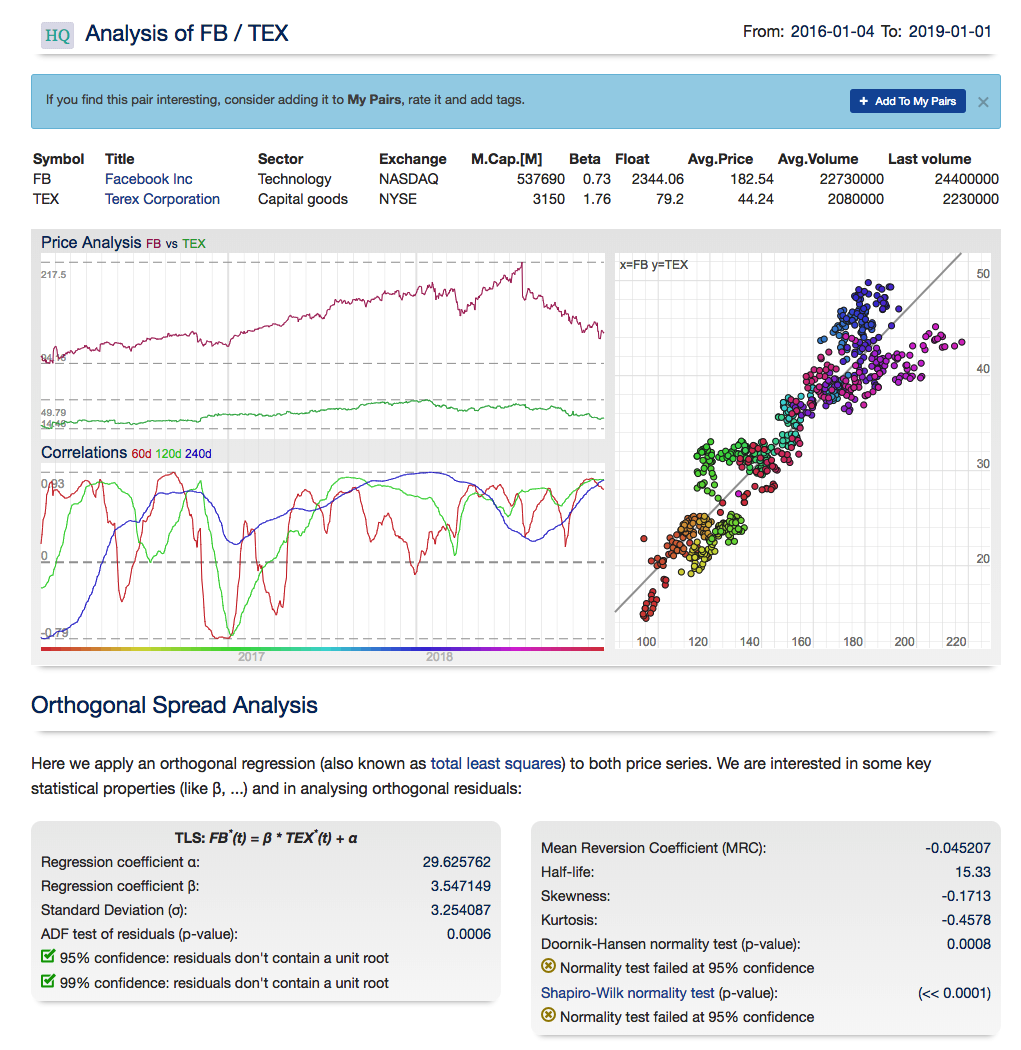
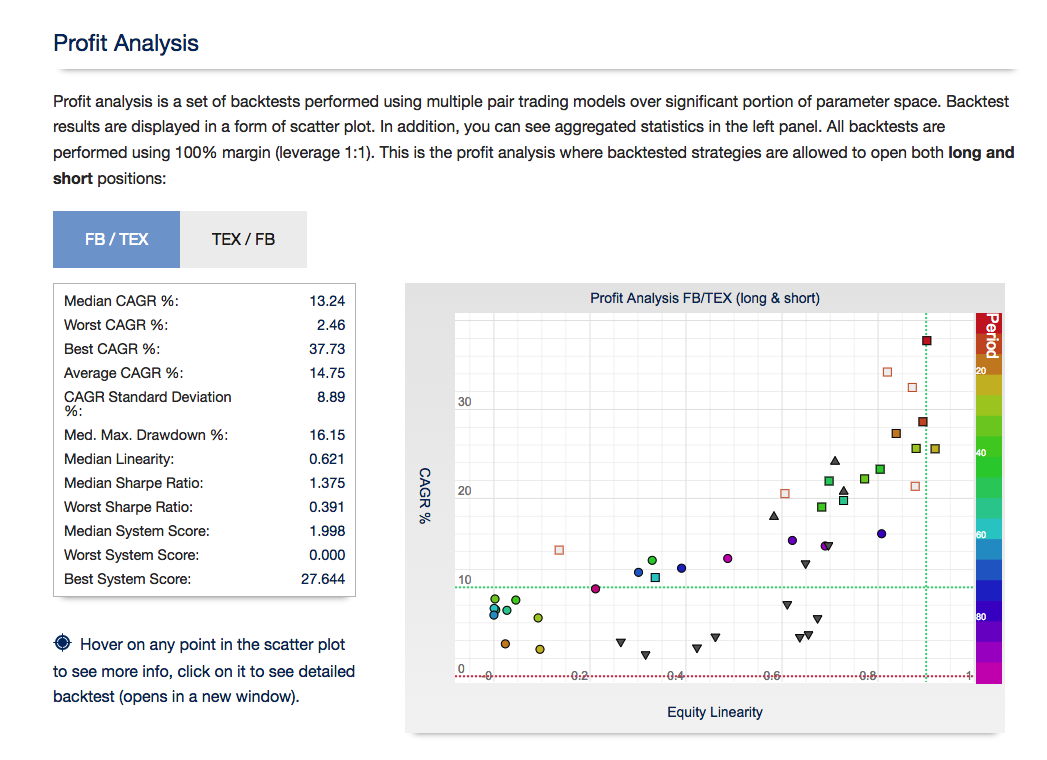
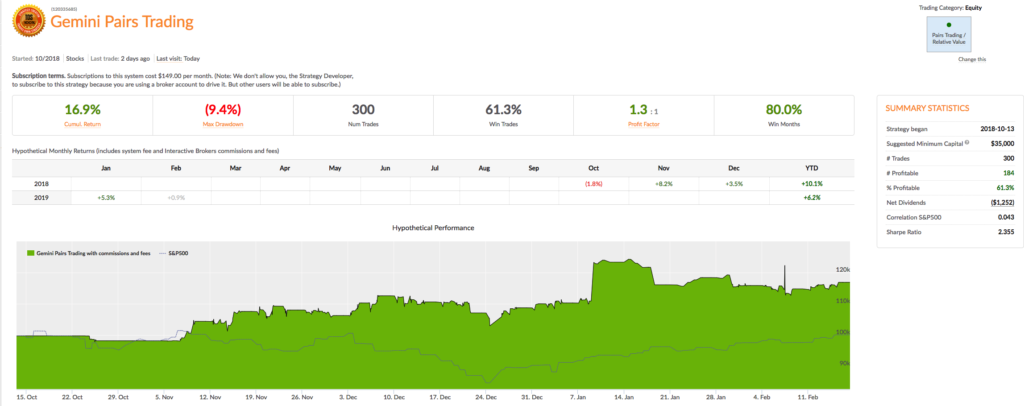
It is perhaps a little premature for a deep dive into the Gemini Pairs Trading strategy which trades on our Systematic Algotrading platform.  At this stage all one can say for sure is that the strategy has made a pretty decent start – up around 17% from October 2018.  The strategy does trade multiple times intraday, so the record in terms of completed trades – numbering over 580 – is appreciable (the web site gives a complete list of live trades).  And despite the turmoil through the end of last year the Sharpe Ratio has ranged consistently around 2.5.

One of the theoretical advantages of pairs trading is, of course, that the coupling of long and short positions in a relative value trade is supposed to provide a hedge against market downdrafts, such as we saw in Q4 2018.  In that sense pairs trading is the quintessential hedge fund strategy, embodying the central concept on which the entire edifice of hedge fund strategies is premised.
In practice, however, things often don’t work out as they should. In this thread I want to spend a little time reviewing why that is and to offer some thoughts based on my own experience of working with statistical arbitrage strategies over many years.

Methodology

There is no “secret recipe” for pairs trading:  the standard methodologies are as well known as the strategy concept.  But there are some important practical considerations that I would like to delve into in this post.  Before doing that, let me quickly review the tried and tested approaches used by statistical arbitrageurs.

The Ratio Model is one of the standard pair trading models described in literature. It is based in ratio of instrument prices, moving average and standard deviation. In other words, it is based on Bollinger Bands indicator.

  • we trade pair of stocks A, B, having price series A(t)B(t)
  • we need to calculate ratio time series R(t) = A(t) / B(t)
  • we apply a moving average of type T with period Pm on R(t) to get time series M(t)
  • Next we apply the standard deviation with period Ps on R(t) to get time series S(t)
  • now we can create Z-score series Z(t) as Z(t) = (R(t) – M(t)) / S(t), this time series can give us z-score to signal trading decision directly (in reality we have two Z-scores: Z-scoreask and Z-scorebid as they are calculated using different prices, but for the sake of simplicity let’s now pretend we don’t pay bid-ask spread and we have just one Z-score)

Another common way to visualize  this approach is to think in terms of bands around the moving average M(t):

  • upper entry band Un(t) = M(t) + S(t) * En
  • lower entry band Ln(t) = M(t) – S(t) * En
  • upper exit band Ux(t) = M(t) + S(t) * Ex
  • lower exit band Lx(t) = M(t) – S(t) * Ex

These bands are actually the same bands as in Bollinger Bands indicator and we can use crossing of R(t) and bands as trade signals.

  • We open short pair position, if the Z-score Z(t) >= En (equivalent to R(t) >= Un(t))
  • We open long pair position if the Z-score Z(t) <= -En (equivalent to R(t) <= Ln(t))

In the Regression, Residual or Cointegration approach we construct a linear regression between A(t)B(t) using OLS, where A(t) = β * B(t) + α + R(t)

Because we use a moving window of period P (we calculate new regression each day), we actually get new series β(t)α(t)R(t), where β(t)α(t) are series of regression coefficients and R(t) are residuals (prediction errors)

  • We look at the residuals series  R(t) = A(t) – (β(t) * B(t) + α(t))
  • We next calculate the standard deviation of the residuals R(t), which we designate S(t)
  • Now we can create Z-score series Z(t) as Z(t) = R(t) / S(t) – the time series that is used to generate trade signals, just as in the Ratio model.

The Kalman Filter model provides superior estimates of the current hedge ratio compared to the Regression method.  For a detailed explanation of the techniques, see the following posts (the post on ETF trading contains complete Matlab code).


Finally,  the rather complex Copula methodology models the joint and margin distributions of the returns process in each stock as described in the following post

Portfolio Improvement for the Equity Investor

Portfolio

Equity investors and long-only portfolio managers are constantly on the lookout for ways to improve their portfolios, either by yield enhancement, or risk reduction.  In the case of yield enhancement, the principal focus is on adding alpha to the portfolio through stock selection and active management, while risk reduction tends to be accomplished through diversification.

Another approach is to seek improvement by adding investments outside the chosen universe of stocks, while remaining within the scope of the investment mandate (which, for instance, may include equity-related products, but not futures or options).  The advent of volatility products in the mid-2000’s offered new opportunities for risk reduction; but this benefit was typically achieved at the cost of several hundred basis points in yield.  Over the last decade, however, a significant evolution has taken place in volatility strategies, such that they can now not only provide insurance for the equity portfolio, but, in addition, serve as an orthogonal source of alpha to enhance portfolio yields.

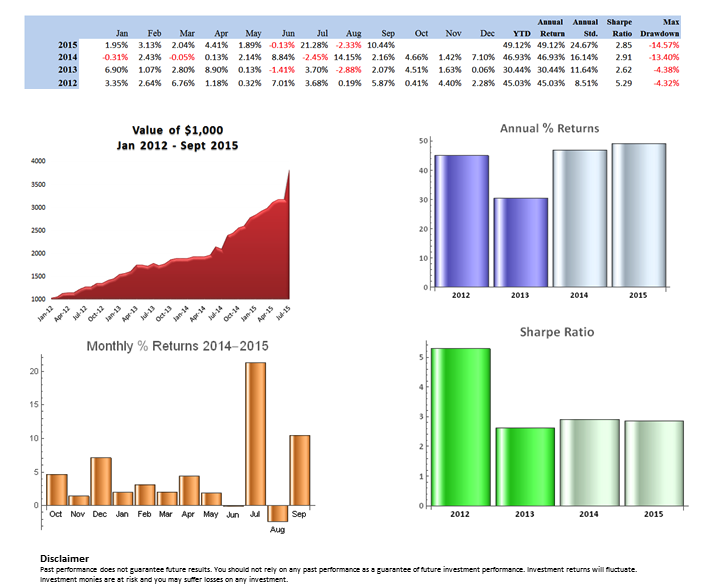
An example of one such product is our volatility strategy, a quantitative approach to trading VIX-related ETF products traded on ARCA. A summary of the performance of the strategy is given below.

Vol Strategy perf Sept 2015

The mechanics of the strategy are unlikely to be of great interest to the typical equity investor and so need not detain us here.  Rather, I want to focus on how an investor can use such products to enhance their equity portfolio.

Performance of the Equity Market and Individual Sectors

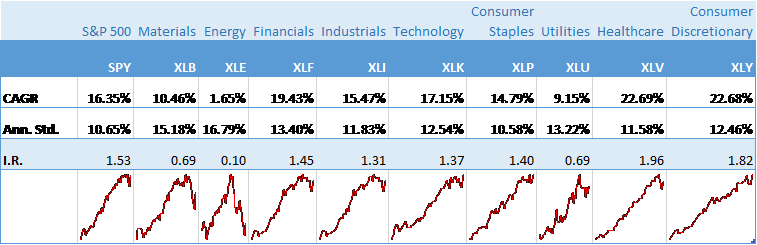
The last five years have been extremely benign for the equity market, not only for the broad market, as evidenced by the performance of the SPDR S&P 500 Trust ETF (SPY), and also by almost every individual sector, with the notable exception of energy.

Sector ETF Performance 2012-2015

The risk-adjusted returns have been exceptional over this period, with information ratios reaching 1.4 or higher for several of the sectors, including Financials, Consumer Staples, Healthcare and Consumer Discretionary.  If the equity investor has been in a position to diversify his portfolio as fully as the SPY ETF, it might reasonably been assumed that he has accomplished the maximum possible level of risk reduction; at the same time, no-one is going to argue with a CAGR of 16.35%.  Yet, even here, portfolio improvement is possible.

Yield Enhancement

The key to improving the portfolio yield lies in the superior risk-adjusted performance of the volatility portfolio compared to the equity portfolio and also due the fact that, while the correlation between the two is significant (at 0.44), it is considerably lower than 1.  Hence there is potential for generating higher rates of return on a risk-adjusted basis by combining the pair of portfolios in some proportion.

SSALGOTRADING AD

To illustrate this we assume, firstly, that the investor is comfortable with the currently level of risk in his broadly diversified equity portfolio, as measured by the annual standard deviation of returns, currently 10.65%.   Holding this level of risk constant, we now introduce an overlay strategy, namely the volatility portfolio, to which we seek to allocate some proportion of the available investment capital.  With this constraint it turns out that we can achieve a substantial improvement in the overall yield by reducing our holding in the equity portfolio to just over 2/3 of the current level (67.2%) and allocating 32.8% of the capital to the volatility portfolio.  Over the period from 2012, the combined equity and volatility portfolio produced a CAGR of 26.83%, but with the same annual standard deviation – a yield enhancement of 10.48% annually.  The portfolio Information Ratio improves from 1.53 to a 2.52, reflecting the much higher returns produced by the combined portfolio, for the same level of risk as before.

Chart

Risk Reduction

The given example may appear impressive, but it isn’t really a practical proposition.  Firstly, no equity investor or portfolio manager is likely to want to allocate 1/3 of their total capital to a strategy operated by a third party, no matter how impressive the returns. Secondly, the capacity in the volatility strategy is, realistically, of the order of $100 million.  A 32.8% allocation of capital from a sizeable equity portfolio would absorb a large proportion of the available capacity in the volatility ETF strategy, or even all of it.

A much more realistic approach would be to cap the allocation to the volatility component at a reasonable level – say, 5%.  Then the allocation from a $100M capital budget would be $5M, well within the capacity constraints of the volatility product.  In fact, operating at this capped allocation percentage, the volatility strategy provides capacity for equity portfolios of up to $2Bn in total capital.

Let’s look at an example of what can be achieved under a 5% allocation constraint.  In this scenario I am going to move along the second axis of portfolio improvement – risk reduction.  Here, we assume that we wish to maintain the current level of performance of the equity portfolio (CAGR 16.35%), while reducing the risk as much as possible.

A legitimate question at this stage would be to ask how it might be possible to reduce risk by introducing a new investment that has a higher annual standard deviation than the existing portfolio?  The answer is simply that we move some of our existing investment into cash (or, rather, Treasury securities).  In fact, by allocating the maximum allowed to the volatility portfolio (5%) and reducing our holding in the equity portfolio to 85.8% of the original level (with the remaining 9.2% in cash), we are able to create a portfolio with the same CAGR but with an annual volatility in single digits: 9.53%, a reduction in risk of  112 basis points annually.  At the same time, the risk adjusted performance of the portfolio improves from 1.53 to 1.71 over the period from 2012.

Of course, the level of portfolio improvement is highly dependent on the performance characteristics of both the equity portfolio and overlay strategy, as well as the correlation between them. To take a further example, if we consider an equity portfolio mirroring the characteristics of the Materials Select Sector SPDR ETF (XLB), we can achieve a reduction of as much as 3.31% in the annual standard deviation, without any loss in expected yield, through an allocation of 5% to the volatility overlay strategy and a much higher allocation of 18% to cash.

Other Considerations

Investors and money managers being what they are, it goes against the grain to consider allocating money to a third party – after all, a professional money manager earns his living from his own investment expertise, rather than relying on others.  Yet no investor can reasonably expect to achieve the same level of success in every field of investment.  If you have built your reputation on your abilities as a fundamental analyst and stock picker, it is unreasonable to expect that you will be able accomplish as much in the arena of quantitative investment strategies.  Secondly, by capping the allocation to an external manager at the level of 5% to 10%, your primary investment approach remains unaltered –  you are maintaining the fidelity of your principal investment thesis and investment mandate.  Thirdly, there is no reason why overlay strategies such as the one discussed here should not provide easy liquidity terms – after all, the underlying investments are liquid, exchange traded products. Finally, if you allocate capital in the form of a managed account you can maintain control over the allocated capital and make adjustments rapidly, as your investment needs change.

Conclusion

Quantitative strategies have a useful role to play for equity investors and portfolio managers as a means to improve existing portfolios, whether by yield enhancement, risk reduction, or a combination of the two.  While the level of improvement is highly dependent on the performance characteristics of the equity portfolio and the overlay strategy, the indications are that yield enhancement, or risk reduction, of the order of hundreds of basis points may be achievable even through very modest allocations of capital.

Daytrading Volatility ETFs

ETFAs we have discussed before, there is no standard definition of high frequency trading.  For some, trading more than once or twice a day constitutes high frequency, while others regard anything less than several hundred times a session as low, or medium frequency trading.  Hence in this post I have referred to “daytrading” since we can at least agree on that description for a strategy that exits all positions by the close of the session.

HFT Trading in ETFs – Challenges and Opportunities

High frequency trading in equities and ETFs offer their own opportunities and challenges compared to futures. Amongst the opportunities we might list:

  • Arbitrage between destinations (exchanges, dark pools) where the stock is traded
  • Earning rebates from the exchanges willing to pay for order flow
  • Arbitraging news flows amongst pairs or baskets of equities

When it comes to ETFs, unfortunately, the set of possibilities is more restricted than for single names and one is often obliged to dig deeply into the basket/replication/cointegration type of approach, which can be very challenging in a high frequency context.  The risk of one leg of a multi-asset trade being left unfilled is such that one has to be willing to cross the spread to get the trade on.  Depending on the trading platform and the quality of the execution algorithms, this can make trading the strategy prohibitively expensive.

In that case you have a number of possibilities to consider.  You can simplify the trade, limit the number of stocks in the basket and hope that there is enough alpha left in the reduced strategy. You can focus on managing the trade execution sufficiently well that aggressive trading becomes necessary on relatively few occasions and you look to minimize the costs of paying the spread when they arise.  You can design strategies with higher profit factors that are able to withstand the performance drag entailed in trading aggressively.  Or you can design slower versions of the strategy where latency, fill rates and execution costs are not such critical factors.

SSALGOTRADING AD

Developing high frequency strategies in the volatility ETFs presents special challenges.  Being fairly new, the products have limited histories, which makes modeling more of a challenge.  One way to address this is to create synthetic series priced from the VIX futures, using the published methodology for constructing the ETFs.  Be warned, though, that these synthetic series are likely to inflate your backtest results since they aren’t traded instruments.

Another practical problem that crops up regularly in products like UVXY and VXX is that the broker has difficulty locating stock for short selling.  So you are limited to taking the strategy offline when that occurs, designing strategies that trade long only, or as we do, switching to other products when the ETF is unavailable to short.

Then there is the capacity issue. Despite their fast-growing popularity, volatility ETF funds are in many cases quite small, totaling perhaps a few hundred millions of dollars in AUM. You are never going to be able to construct a strategy capable of absorbing billions of dollars of investment in the ETF products alone.

Volatility and Alpha

volatilitychartFor these reasons, volatility ETFs are not a natural choice for many investment strategists.  But they do have one great advantage compared to other products:  volatility.  Volatility implies uncertainty about the true value of a security, which means that market participants can have very different views about what it is worth at any moment in time.  So the prospects for achieving competitive advantage through superior analytical methods is much greater than for a stock that hardly moves at all and on whose value everyone concurs.  Furthermore, volatility creates regular opportunities for hitting stops, and creating mini crashes or short squeezes, in which the security is temporarily under- or over-valued.  If ever there was a security offering the potential for generating alpha, it is the volatility ETF.

The volatility of the VIX ETFs is enormous, by the standards of regular stocks.  A typical stock might have an annual volatility of 30% to 60%.  The lowest level ever seen in the VVIX index series so far is 70%. To give you an idea of how extreme it can become, during the latest market swoon in August the VVIX, the volatility-of-volatility for the S&P500 index, reached over 200% a year.

A Daytrading Strategy in the VXX

So, despite the challenges and difficulties, there are very good reasons to make the attempt to develop strategies for the volatility ETF products.  My firm, Systematic Strategies, has developed several such algorithms that are combined to create a strategy that trades the volatility ETFs very successfully.  Until recently, however,  all of the sub-strategies we employ were longer term in nature, and entailed holding positions overnight.  We wanted to develop higher frequency algorithms that could react more quickly to changes in the volatility landscape.  We had to dig pretty deep into the arsenal of trading ideas to get there, but eventually we succeeded.  After six months of live trading we were ready to release the new VXX daytrading algorithm into production for our volatility ETF strategy investors.  Here’s how it looks (results are for a $100,000 account).

Fig 1 Fig 2 Fig 3

As you can see, the strategy trades up to around 10 times a day with a reasonable profit factor (1.53) and win rate of just under 60%. By itself, the strategy has a Sharpe Ratio of around 6, so it is well worth trading on its own.  But its real value (for us) emerges when it is combined in appropriate proportion with the other, lower frequency algorithms in the volatility strategy.  The additional alpha from the VXX strategy reduces the size of the loss in August and produces a substantial gain in September, taking the YTD return to just under 50%.  Returns for Oct MTD are already at 16%.

Vol Strategy perf Sept 2015


Improving Trading System Performance Using a Meta-Strategy

What is a Meta-Strategy?

In my previous post on identifying drivers of strategy performance I mentioned the possibility of developing a meta-strategy.

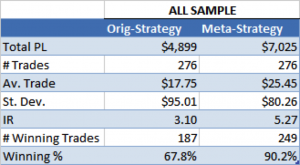
fig0A meta-strategy is a trading system that trades trading systems.  The idea is to develop a strategy that will make sensible decisions about when to trade a specific system, in a way that yields superior performance compared to simply following the underlying trading system.  Put another way, the simplest kind of meta-strategy is a long-only strategy that takes positions in some underlying trading system.  At times, it will follow the underlying system exactly; at other times it is out of the market and ignore the trading system’s recommendations.

More generally, a meta-strategy can determine the size in which one, or several, systems should be traded at any point in time, including periods where the size can be zero (i.e. the system is not currently traded).  Typically, a meta-strategy is long-only:  in theory there is nothing to stop you developing a meta-strategy that shorts your underlying strategy from time to time, but that is a little counter-intuitive to say the least!

A meta-strategy is something that could be very useful for a fund-of-funds, as a way of deciding how to allocate capital amongst managers.

Caissa Capital operated a meta-strategy in its option arbitrage hedge fund back in the early 2000’s.  The meta-strategy (we called it a “model management system”) selected from a half dozen different volatility models to be used for option pricing, depending their performance, as measured by around 30 different criteria.  The criteria included both statistical metrics, such as the mean absolute percentage error in the forward volatility forecasts, as well as trading performance criteria such as the moving average of the trade PNL.  The model management system probably added 100 – 200 basis points per annum to the performance the underlying strategy, so it was a valuable add-on.

Illustration of a Meta-Strategy in US Bond Futures

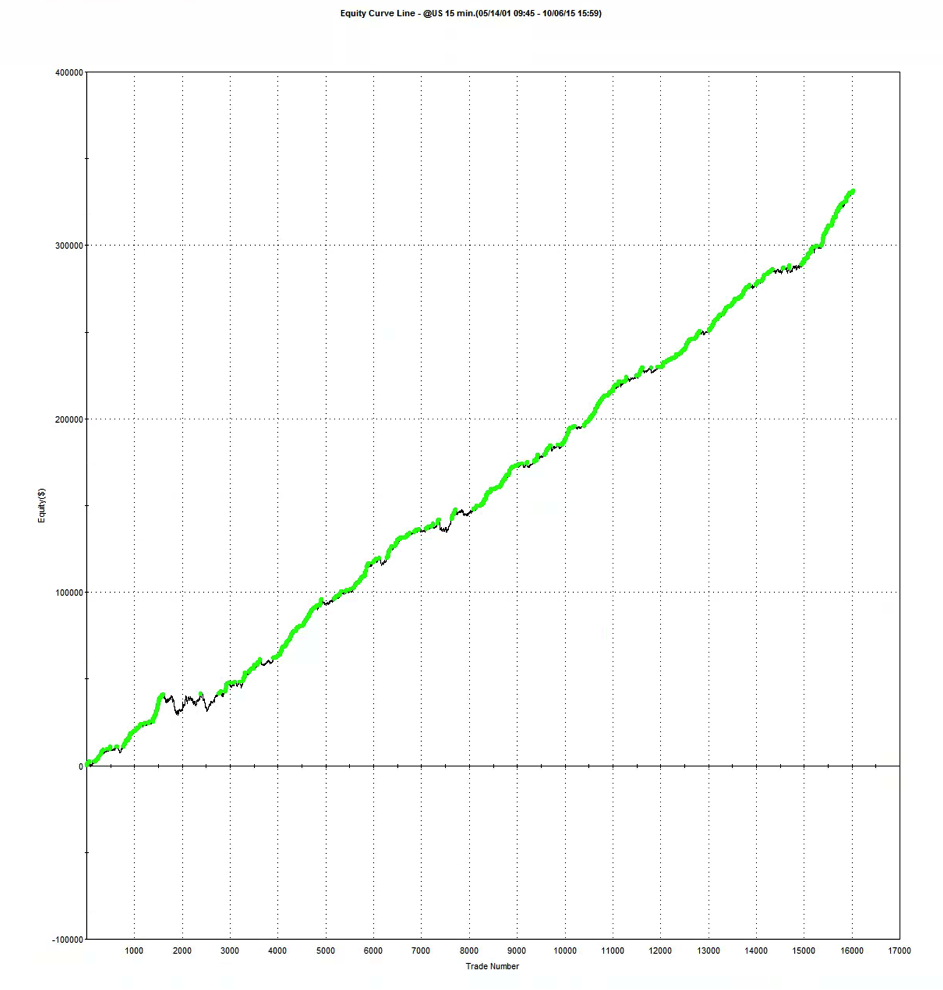
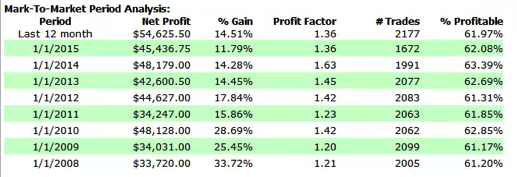
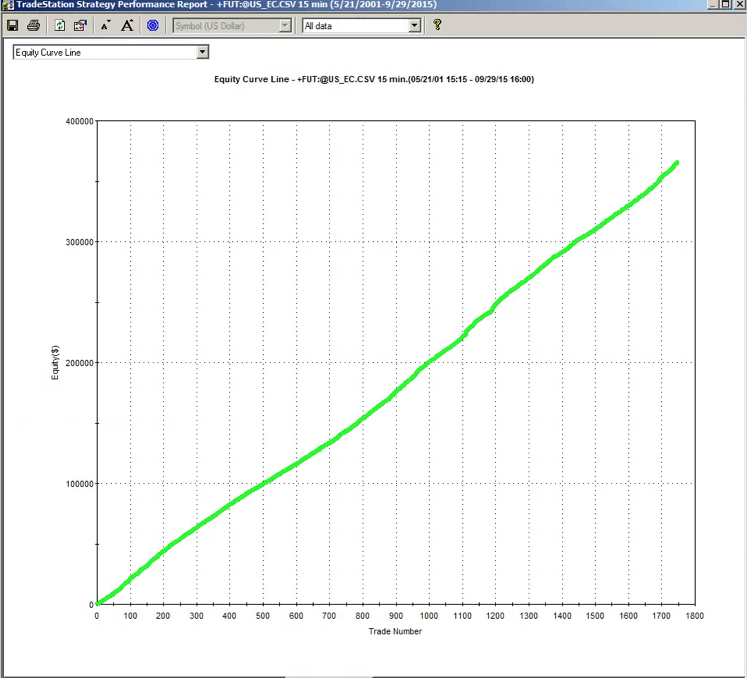
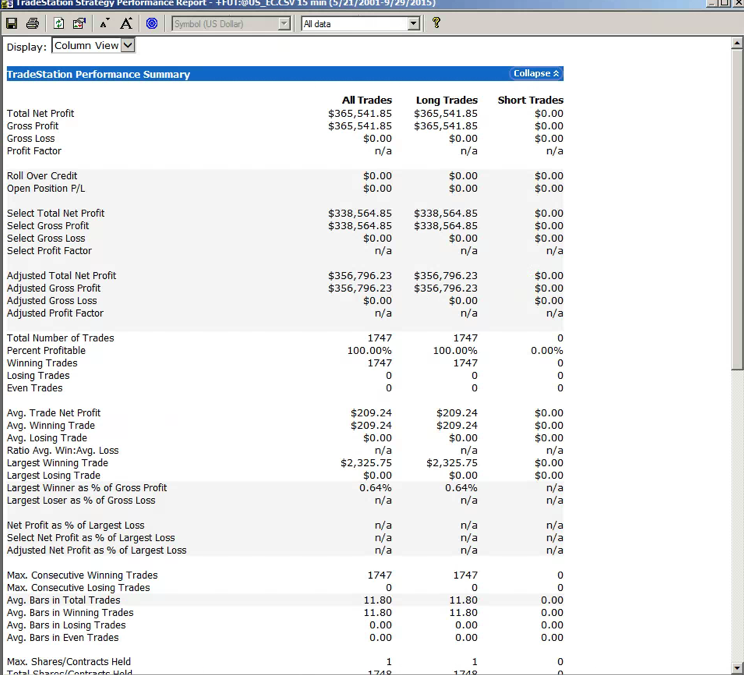
To illustrate the concept we will use an underlying system that trades US Bond futures at 15-minute bar intervals.  The performance of the system is summarized in the chart and table below.

Fig1A


FIG2A


Strategy performance has been very consistent over the last seven years, in terms of the annual returns, number of trades and % win rate.  Can it be improved further?

To assess this possibility we create a new data series comprising the points of the equity curve illustrated above.  More specifically, we form a series comprising the open, high, low and close values of the strategy equity, for each trade.  We will proceed to treat this as a new data series and apply a range of different modeling techniques to see if we can develop a trading strategy, in exactly the same way as we would if the underlying was a price series for a stock.

It is important to note here that, for the meta-strategy at least, we are working in trade-time, not calendar time. The x-axis will measure the trade number of the underlying strategy, rather than the date of entry (or exit) of the underlying trade.  Thus equally spaced points on the x-axis represent different lengths of calendar time, depending on the duration of each trade.

It is necessary to work in trade time rather than calendar time because, unlike a stock, it isn’t possible to trade the underlying strategy whenever we want to – we can only enter or exit the strategy at points in time when it is about to take a trade, by accepting that trade or passing on it (we ignore the other possibility which is sizing the underlying trade, for now).

SSALGOTRADING AD

Another question is what kinds of trading ideas do we want to consider for the meta-strategy?  In principle one could incorporate almost any trading concept, including the usual range of technical indictors such as RSI, or Bollinger bands.  One can go further an use machine learning techniques, including Neural Networks, Random Forest, or SVM.

In practice, one tends to gravitate towards the simpler kinds of trading algorithm, such as moving averages (or MA crossover techniques), although there is nothing to say that more complex trading rules should not be considered.  The development process follows a familiar path:  you create a hypothesis, for example, that the equity curve of the underlying bond futures strategy tends to be mean-reverting, and then proceed to test it using various signals – perhaps a moving average, in this case.  If the signal results in a potential improvement in the performance of the default meta-strategy (which is to take every trade in the underlying system system), one includes it in the library of signals that may ultimately be combined to create the finished meta-strategy.

As with any strategy development you should follows the usual procedure of separating the trade data to create a set used for in-sample modeling and out-of-sample performance testing.

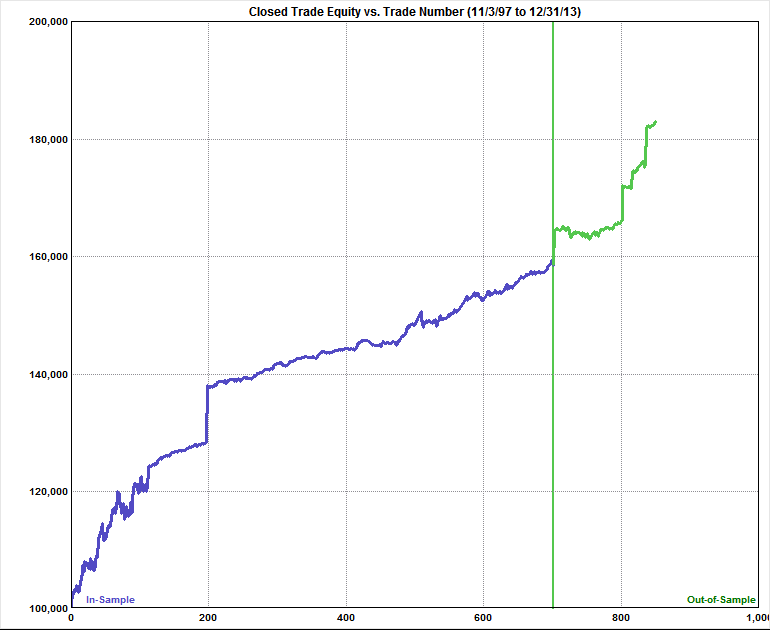
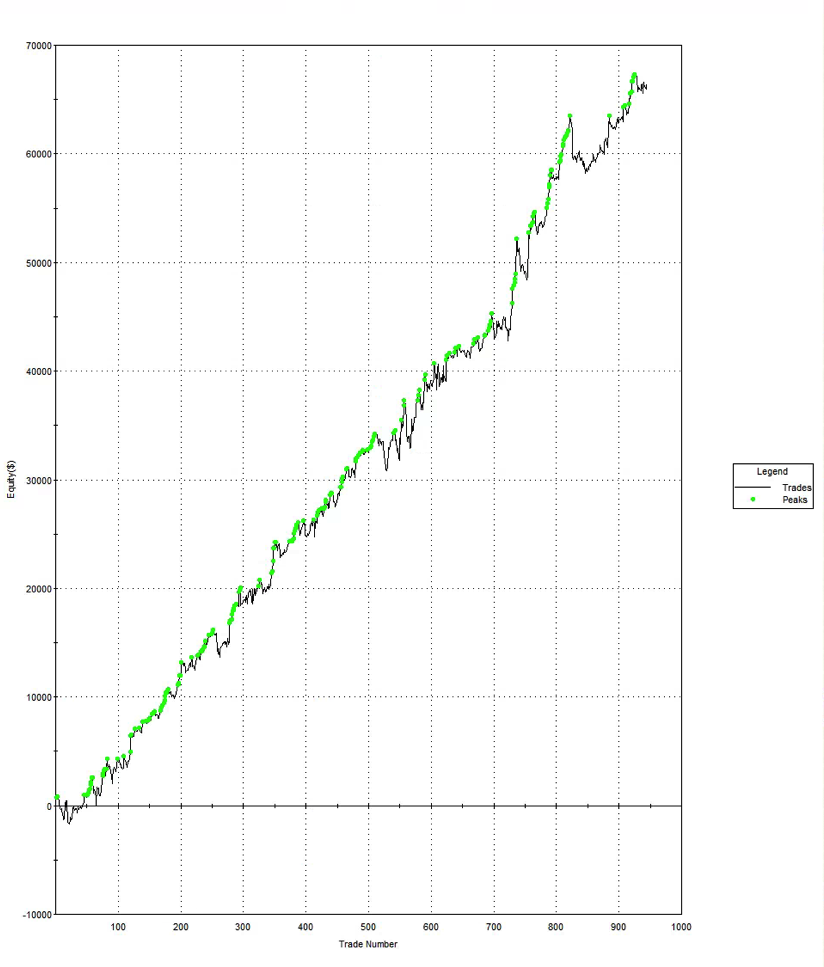
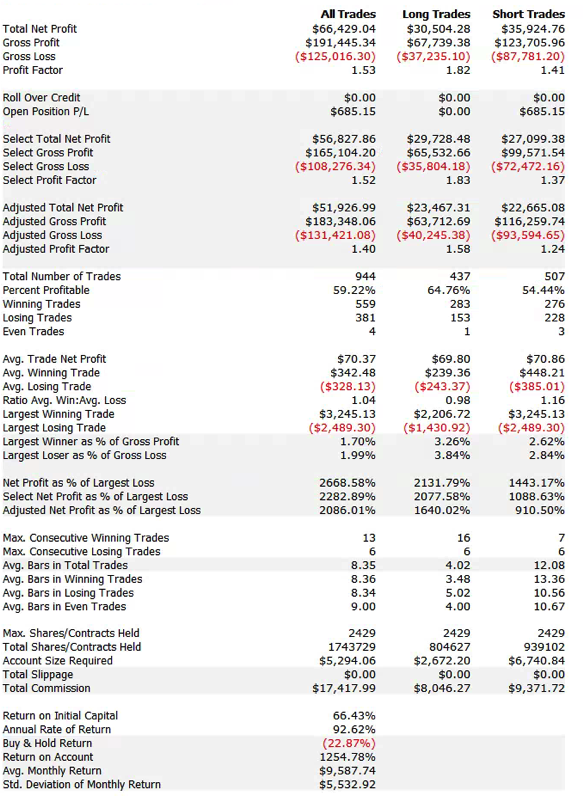
Following this general procedure I arrived at the following meta-strategy for the bond futures trading system.

FigB1

FigB2

The modeling procedure for the meta-strategy has succeeded in eliminating all of the losing trades in the underlying bond futures system, during both in-sample and out-of-sample periods (comprising the most recent 20% of trades).

In general, it is unlikely that one can hope to improve the performance of the underlying strategy quite as much as this, of course.  But it may well be possible to eliminate a sufficient proportion of losing trades to reduce the equity curve drawdown and/or increase the overall Sharpe ratio by a significant amount.

A Challenge / Opportunity

If you like the meta-strategy concept, but are unsure how to proceed, I may be able to help.

Send me the data for your existing strategy (see details below) and I will attempt to model a meta-strategy and send you the results.  We can together evaluate to what extent I have been successful in improving the performance of the underlying strategy.

Here are the details of what you need to do:

1. You must have an existing, profitable strategy, with sufficient performance history (either real, simulated, or a mixture of the two).  I don’t need to know the details of the underlying strategy, or even what it is trading, although it would be helpful to have that information.
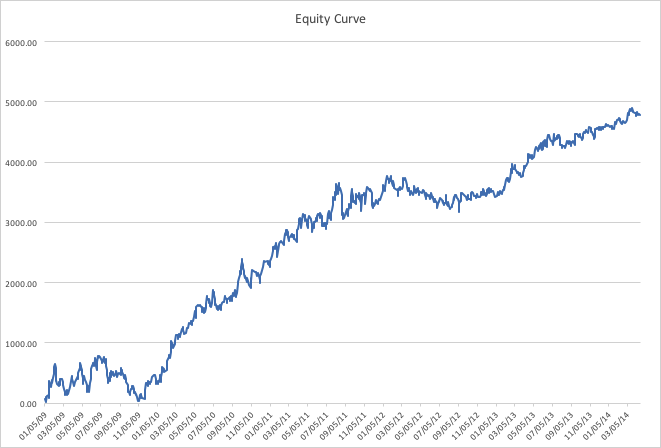
2. You must send  the complete history of the equity curve of the underlying strategy,  in Excel format, with column headings Date, Open, High, Low, Close.  Each row represents consecutive trades of the underlying system and the O/H/L/C refers to the value of the equity curve for each trade.

3.  The history must comprise at least 500 trades as an absolute minimum and preferably 1000 trades, or more.

4. At this stage I can only consider a single underlying strategy (i.e. a single equity curve)

5.  You should not include any software or algorithms of any kind.  Nothing proprietary, in other words.

6.  I will give preference to strategies that have a (partial) live track record.

As my time is very limited these days I will not be able to deal with any submissions that fail to meet these specifications, or to enter into general discussions about the trading strategy with you.

You can reach me at jkinlay@systematic-strategies.com


Identifying Drivers of Trading Strategy Performance

Building a winning strategy, like the one in the e-Mini S&P500 futures described here is only half the challenge:  it remains for the strategy architect to gain an understanding of the sources of strategy alpha, and risk.  This means identifying the factors that drive strategy performance and, ideally, building a model so that their relative importance can be evaluated.  A more advanced step is the construction of a meta-model that will predict strategy performance and provided recommendations as to whether the strategy should be traded over the upcoming period.

Strategy Performance – Case Study

Let’s take a look at how this works in practice.  Our case study makes use of the following daytrading strategy in e-Mini futures.

Fig1

The overall performance of the strategy is quite good.  Average monthly PNL over the period from April to Oct 2015 is almost $8,000 per contract, after fees, with a standard deviation of only $5,500. That equates to an annual Sharpe Ratio in the region of 5.0.  On a decent execution platform the strategy should scale to around 10-15 contracts, with an annual PNL of around $1.0 to $1.5 million.

Looking into the performance more closely we find that the win rate (56%) and profit factor (1.43) are typical for a profitable strategy of medium frequency, trading around 20 times per session (in this case from 9:30AM to 4PM EST).

fig2

Another attractive feature of the strategy risk profile is the Max Adverse Execution, the drawdown experienced in individual trades (rather than the realized drawdown). In the chart below we see that the MAE increases steadily, without major outliers, to a maximum of only around $1,000 per contract.

Fig3

One concern is that the average trade PL is rather small – $20, just over 1.5 ticks. Strategies that enter and exit with limit orders and have small average trade are generally highly dependent on the fill rate – i.e. the proportion of limit orders that are filled.  If the fill rate is too low, the strategy will be left with too many missed trades on entry or exit, or both.  This is likely to damage strategy performance, perhaps to a significant degree – see, for example my post on High Frequency Trading Strategies.

The fill rate is dependent on the number of limit orders posted at the extreme high or low of the bar, known as the extreme hit rate.  In this case the strategy has been designed specifically to operate at an extreme hit rate of only around 10%, which means that, on average, only around one trade in ten occurs at the high or low of the bar.  Consequently, the strategy is not highly fill-rate dependent and should execute satisfactorily even on a retail platform like Tradestation or Interactive Brokers.

Drivers of Strategy Performance

So far so good.  But before we put the strategy into production, let’s try to understand some of the key factors that determine its performance.  Hopefully that way we will be better placed to judge how profitable the strategy is likely to be as market conditions evolve.

In fact, we have already identified one potential key performance driver: the extreme hit rate (required fill rate) and determined that it is not a major concern in this case. However, in cases where the extreme hit rate rises to perhaps 20%, or more, the fill ratio is likely to become a major factor in determining the success of the strategy.  It would be highly inadvisable to attempt implementation of such a strategy on a retail platform.

SSALGOTRADING AD

What other factors might affect strategy performance?  The correct approach here is to apply the scientific method:  develop some theories about the drivers of performance and see if we can find evidence to support them.

For this case study we might conjecture that, since the strategy enters and exits using limit orders, it should exhibit characteristics of a mean reversion strategy, which will tend to do better when the market moves sideways and rather worse in a strongly trending market.

Another hypothesis is that, in common with most day-trading and high frequency strategies, this strategy will produce better results during periods of higher market volatility.  Empirically, HFT firms have always produced higher profits during volatile market conditions  – 2008 was a banner year for many of them, for example.  In broad terms, times when the market is whipsawing around create additional opportunities for strategies that seek to exploit temporary mis-pricings.  We shall attempt to qualify this general understanding shortly.  For now let’s try to gather some evidence that might support the hypotheses we have formulated.

I am going to take a very simple approach to this, using linear regression analysis.  It’s possible to do much more sophisticated analysis using nonlinear methods, including machine learning techniques. In our regression model the dependent variable will be the daily strategy returns.  In the first iteration, let’s use measures of market returns, trading volume and market volatility as the independent variables.

Fig4

The first surprise is the size of the (adjusted) R Square – at 28%, this far exceeds the typical 5% to 10% level achieved in most such regression models, when applied to trading systems.  In other words, this model does a very good job of account for a large proportion of the variation in strategy returns.

Note that the returns in the underlying S&P50o index play no part (the coefficient is not statistically significant). We might expect this: ours is is a trading strategy that is not specifically designed to be directional and has approximately equivalent performance characteristics on both the long and short side, as you can see from the performance report.

Now for the next surprise: the sign of the volatility coefficient.  Our ex-ante hypothesis is that the strategy would benefit from higher levels of market volatility.  In fact, the reverse appears to be true (due to the  negative coefficient).  How can this be?  On further reflection, the reason why most HFT strategies tend to benefit from higher market volatility is that they are momentum strategies.  A momentum strategy typically enters and exits using market orders and hence requires  a major market move to overcome the drag of the bid-offer spread (assuming it calls the market direction correctly!).  This strategy, by contrast, is a mean-reversion strategy, since entry/exits are effected using limit orders.  The strategy wants the S&P500 index to revert to the mean – a large move that continues in the same direction is going to hurt, not help, this strategy.

Note, by contrast, that the coefficient for the volume factor is positive and statistically significant.  Again this makes sense:  as anyone who has traded the e-mini futures overnight can tell you, the market tends to make major moves when volume is light – simply because it is easier to push around.  Conversely, during a heavy trading day there is likely to be significant opposition to a move in any direction.  In other words, the market is more likely to trade sideways on days when trading volume is high, and this is beneficial for our strategy.

The final surprise and perhaps the greatest of all, is that the strategy alpha appears to be negative (and statistically significant)!  How can this be?  What the regression analysis  appears to be telling us is that the strategy’s performance is largely determined by two underlying factors, volume and volatility.

Let’s dig into this a little more deeply with another regression, this time relating the current day’s strategy return to the prior day’s volume, volatility and market return.

Fig5

In this regression model the strategy alpha is effectively zero and statistically insignificant, as is the case for lagged volume.  The strategy returns relate inversely to the prior day’s market return, which again appears to make sense for a mean reversion strategy:  our model anticipates that, in the mean, the market will reverse the prior day’s gain or loss.  The coefficient for the lagged volatility factor is once again negative and statistically significant.  This, too, makes sense:  volatility tends to be highly autocorrelated, so if the strategy performance is dependent on market volatility during the current session, it is likely to show dependency on volatility in the prior day’s session also.

So, in summary, we can provisionally conclude that:

This strategy has no market directional predictive power: rather it is a pure, mean-reversal strategy that looks to make money by betting on a reversal in the prior session’s market direction.  It will do better during periods when trading volume is high, and when market volatility is low.

Conclusion

Now that we have some understanding of where the strategy performance comes from, where do we go from here?  The next steps might include some, or all, of the following:

(i) A more sophisticated econometric model bringing in additional lags of the explanatory variables and allowing for interaction effects between them.

(ii) Introducing additional exogenous variables that may have predictive power. Depending on the nature of the strategy, likely candidates might include related equity indices and futures contracts.

(iii) Constructing a predictive model and meta-strategy that would enable us assess the likely future performance of the strategy, and which could then be used to determine position size.  Machine learning techniques can often be helpful in this content.

I will give an example of the latter approach in my next post.

Signal Processing and Sample Frequency

The Importance of Sample Frequency

Too often we apply a default time horizon for our trading, whether it below (daily, weekly) or higher (hourly, 5 minute) frequency.  Sometimes the choice is dictated by practical considerations, such as a desire to avoid overnight risk, or the (lack of0 availability of low-latency execution platform.

But there is an alternative approach to the trade frequency decision that often yields superior results in terms of trading performance.    The methodology derives from signal processing and the idea essentially is to use Fourier transforms to help identify the cyclical behavior of the strategy alpha and hence determine the best time-frames for sampling and trading.  I wrote about this is a previous blog post, in which I described how to use principal components analysis to investigate the factors driving the returns in various pairs trading strategies.  Here I want to take a simpler approach, in which we use Fourier analysis to select suitable sample frequencies.  The idea is simply to select sample frequencies where the signal strength appears strongest, in the hope that it will lead to superior performance characteristics in what strategy we are trying to develop.

Signal Decomposition for S&P500 eMini Futures

Let’s take as an example the S&P 500 emini futures contract. The chart below shows the continuous ES futures contract plotted at 1-minute intervals from 1998. At the bottom of the chart I have represented the signal analysis as a bar chart (in blue), with each bar representing the amplitude at each frequency. The white dots on the chart identify frequencies that are spaced 10 minutes apart.  It is immediately evident that local maxima in the spectrum occur around 40 mins, 60 mins and 120 mins.  So a starting point for our strategy research might be to look at emini data sampled at these frequencies.  Incidentally, it is worth pointing out that I have restricted the session times to 7AM – 4PM EST, which is where the bulk of the daily volume and liquidity tend to occur.  You may get different results if you include data from the Globex session.

Emini Signal

This is all very intuitive and unsurprising: the clearest signals occur at frequencies that most traders typically tend to trade, using hourly data, for example. Any strategy developer is already quite likely to consider these and other common frequencies as part of their regular research process.  There are many instances of successful trading strategies built on emini data sampled at 60 minute intervals.

SSALGOTRADING AD

Signal Decomposition for US Bond Futures

Let’s look at a rather more interesting example:  US (30 year) Bond futures. Unlike the emini contract, the spectral analysis of the US futures contract indicates that the strongest signal by far occurs at a frequency of around 47 minutes.  This is decidedly an unintuitive outcome – I can’t think of any reason why such a strong signal should appear at this cycle length, but, statistically it does. 

US Bond futures

Does it work?  Readers can judge for themselves:  below is an example of an equity curve for a strategy on US futures sampled at 47 minute frequency over the period from 2002.  The strategy has performed very consistently, producing around $25,000 per contract per year, after commissions and slippage.

US futures EC

Conclusion

While I have had similar success with products as diverse as Corn and VIX futures, the frequency domain approach is by no means a panacea:  there are plenty of examples where I have been unable to construct profitable strategies for data sampled at the frequencies with very strong signals. Conversely, I have developed successful strategies using data at frequencies that hardly registered at all on the spectrum, but which I selected for other reasons.  Nonetheless, spectral analysis (and signal processing in general) can be recommended as a useful tool in the arsenal of any quantitative analyst.

Trading Strategy Design

In this post I want to share some thoughts on how to design great automated trading strategies – what to look for, and what to avoid.

For illustrative purposes I am going to use a strategy I designed for the ever-popular S&P500 e-mini futures contract.

The overall equity curve for the strategy is show below.

@ES Equity Curve

This is often the best place to start.  What you want to see, of course, is a smooth, upward-sloping curve, without too many sizable drawdowns, and one in which the strategy continues to make new highs.  This is especially important in the out-of-sample test period (Jan 2014- Jul 2015 in this case).  You will notice a flat period around 2013, which we will need to explore later.  Overall, however, this equity curve appears to fit the stereotypical pattern we hope to see when developing a new strategy.

Let’s move on look at the overall strategy performance numbers.

STRATEGY PERFORMANCE CHARACTERISTICS

@ES Perf Summary(click to enlarge)

 1. Net Profit
Clearly, the most important consideration.  Over the 17 year test period the strategy has produced a net profit  averaging around $23,000 per annum, per contract.  As a rough guide, you would want to see a net profit per contract around 10x the maintenance margin, or higher.
2. Profit Factor
The gross profit divided by the gross loss.  You want this to be as high as possible. Too low, as the strategy will be difficult to trade, because you will see sustained periods of substantial losses.  I would suggest a minimum acceptable PF in the region of 1.25.  Many strategy developers aim for a PF of 1.5, or higher.

3. Number of Trades
Generally, the more trades the better, at least from the point of view of building confidence in the robustness of strategy performance.  A strategy may show a great P&L, but if it only trades once a month it is going to take many many years of performance data to ensure statistical significance.  This strategy, on the other hand, is designed to trade 2-3 times a day.  Given that, and the length of the test period, there is little doubt that the results are statistically significant.

SSALGOTRADING AD

Profit Factor and number of trades are opposing design criteria – increasing the # trades tends to reduce the PF.  That consideration sets an upper bound on the # trades that can be accommodated, before the profit factor deteriorates to unacceptably low levels.  Typically, 4-5 trades a day is about the maximum trading frequency one can expect to achieve.

4. Win Rate
Novice system designers tend to assume that you want this to be as high as possible, but that isn’t typically the case.  It is perfectly feasible to design systems that have a 90% win rate, or higher, but which produce highly undesirable performance characteristics, such as frequent, large drawdowns.  For a typical trading system the optimal range for the win rate is in the region of 40% to 66%.  Below this range, it becomes difficult to tolerate the long sequences of losses that will result, without losing faith in the system.

5. Average Trade
This is the average net profit per trade.  A typical range would be $10 to $100.  Many designers will only consider strategies that have a higher average trade than this one, perhaps $50-$75, or more.  The issue with systems that have a very small average trade is that the profits can quickly be eaten up by commissions. Even though, in this case, the results are net of commissions, one can see a significant deterioration in profits if the average trade is low and trade frequency is high, because of the risk of low fill rates (i.e. the % of limit orders that get filled).  To assess this risk one looks at the number of fills assumed to take place at the high or low of the bar.  If this exceeds 10% of the total # trades, one can expect to see some slippage in the P&L when the strategy is put into production.
6. Average Bars
The number of bars required to complete a trade, on average.  There is no hard limit one can suggest here – it depends entirely on the size of the bars.  Here we are working in 60 minute bars, so a typical trade is held for around 4.5 hours, on average.   That’s a time-frame that I am comfortable with.  Others may be prepared to hold positions for much longer – days, or even weeks.

Perhaps more important is the average length of losing trades. What you don’t want to see is the strategy taking far longer to exit losing trades than winning trades. Again, this is a matter of trader psychology – it is hard to sit there hour after hour, or day after day, in a losing position – the temptation to cut the position becomes hard to ignore.  But, in doing that you are changing the strategy characteristics in a fundamental way, one that rarely produces a performance improvement.

What the strategy designer needs to do is to figure out in advance what the limits are of the investor’s tolerance for pain, in terms of maximum drawdown, average losing trade, etc, and design the strategy to meet those specifications, rather than trying to fix the strategy afterwards.

7. Required Account Size
It’s good to know exactly how large an account you need per contract, so you can figure out how to scale the strategy.  In this case one could hope to scale the strategy up to a 10-lot in a $100,000 account.  That may or may not fit the trader’s requirements and again, this needs to be considered at the outset.  For example, for a trader looking to utilize, say, $1,000,000 of capital, it is doubtful whether this strategy would fit his requirements without considerable work on the implementations issues that arise when trying to trade in anything approaching a 100 contract clip rate.

8. Commission
Always check to ensure that the strategy designer has made reasonable assumptions about slippage and commission.  Here we are assuming $5 per round turn.  There is no slippage, because the strategy executes using limit orders.
9. Drawdown
Drawdowns are, of course, every investor’s bugbear.  No-one likes drawdowns that are either large, or lengthy in relation to the annual profitability of the strategy, or the average trade duration.  A $10,000 max drawdown on a strategy producing over $23,000 a year is actually quite decent – I have seen many e-mini strategies with drawdowns at 2x – 3x that level, or larger.  Again, this is one of the key criteria that needs to be baked into the strategy design at the outset, rather than trying to fix later.
 ANNUAL PROFITABILITY

Let’s now take a look at how the strategy performs year-by-year, and some of the considerations and concerns that often arise.

@ES Annual1. Performance During Downturns
One aspect I always pay attention to is how well the strategy performs during periods of high market stress, because I expect similar conditions to arise in the fairly near future, e.g. as the Fed begins to raise rates.

Here, as you can see, the strategy performed admirably during both the dot com bust of 1999/2000 and the financial crisis of 2008/09.

2. Consistency in the # Trades and % Win Rate
It is not uncommon with low frequency strategies to see periods of substantial variation in the # trades or win rate.  Regardless how good the overall performance statistics are, this makes me uncomfortable.  It could be, for instance, that the overall results are influenced by one or two exceptional years that are unlikely to be repeated.  Significant variation in the trading or win rate raise questions about the robustness of the strategy, going forward.  On the other hand, as here, it is a comfort to see the strategy maintaining a very steady trading rate and % win rate, year after year.

3. Down Years
Every strategy shows variation in year to year performance and one expects to see years in which the strategy performs less well, or even loses money. For me, it rather depends on when such losses arise, as much as the size of the loss.  If a loss occurs in the out-of-sample period it raises serious questions about strategy robustness and, as a result, I am very unlikely to want to put such a strategy into production. If, as here, the period of poor performance occurs during the in-sample period I am less concerned – the strategy has other, favorable characteristics that make it attractive and I am willing to tolerate the risk of one modestly down-year in over 17 years of testing.

INTRA-TRADE DRAWDOWNS

Many trades that end up being profitable go through a period of being under-water.  What matters here is how high those intra-trade losses may climb, before the trade is closed.  To take an extreme example, would you be willing to risk $10,000 to make an average profit of only $10 per trade?  How about $20,000? $50,000? Your entire equity?

The Maximum Average Excursion chart below shows the drawdowns on a trade by trade basis.  Here we can see that, over the 17 year test period, no trade has suffered a drawdown of much more than $5,000.  I am comfortable with that level. Others may prefer a lower limit, or be tolerant of a higher MAE.

MAE

Again, the point is that the problem of a too-high MAE is not something one can fix after the event.  Sure, a stop loss will prevent any losses above a specified size.  But a stop loss also has the unwanted effect of terminating trades that would have turned into money-makers. While psychologically comfortable, the effect of a stop loss is almost always negative  in terms of strategy profitability and other performance characteristics, including drawdown, the very thing that investors are looking to control.

 CONCLUSION
I have tried to give some general guidelines for factors that are of critical importance in strategy design.  There are, of course, no absolutes:  the “right” characteristics depend entirely on the risk preferences of the investor.

One point that strategy designers do need to take on board is the need to factor in all of the important design criteria at the outset, rather than trying (and usually failing) to repair the strategy shortcomings after the event.


My Big Fat Greek Vacation

LEARNING TO TRUST A TRADING SYSTEM

One of the most difficult decisions to make when running a systematic trading program is SystemTradingknowing when to override the system.  During the early 2000’s when I was running the Caissa Capital fund, the models would regularly make predictions on volatility that I and our head Trader, Ron Henley, a former option trader from the AMEX, disagreed with.  Most times, the system proved to have made the correct decision. My take-away from that experience was that, as human beings, even as traders, we are not very good at pricing risk.

My second take-away was that, by and large, you are better off trusting the system, rather than second-guessing its every decision.  Of course, markets can change and systems break down; but the right approach to assessing this possibility is to use statistical control procedures to determine formally whether or not the system has broken down, rather than going through a routine period of under-performance (see:  is your strategy still working?)

GREEK LESSONS

So when the Greek crisis blew up in June my first instinct was not to start looking grexit jisawimmediately for the escape hatch.  However, as time wore on I became increasingly concerned that the risk of a Grexit or default had not abated.  Moreover, I realized that there was really nothing comparable in the data used in the development of the trading models that was in any way comparable to the scenario facing Greece, the EU and, by a process of contagion, US markets.  Very reluctantly, therefore, I came to the decision that the smart way to play the crises was from the sidelines.  So we made the decisions to go 100% to cash and waited for the crisis to subside.

A week went by. Then another.  Of course, I had written to our investors explaining what we intended to do, and why, so there were no surprises.  Nonetheless, I felt uncomfortable not making money for them.  I did my best to console myself with the principal rule of money management: first, do not lose money.  Of course we didn’t – but neither did we make much money, and ended June more or less flat.

COMEBACK

After the worst of the crisis was behind us, I was relieved to see that the models appeared almost as anxious as I was to make up for lost time.  One of the features of the system is

poker2that it makes aggressive use of leverage. Rather like an expert poker player, when it judges the odds to be in its favor, the system will increase its bet size considerably; at other times it will hunker down, play conservatively, or even exit altogether.  Consequently, the turnover in the portfolio can be large at times.  The cost of trading high volume can substantial, especially in some of the less liquid ETF products, where the bid/ask spread can amount to several cents.  So we typically aim to execute passively, looking to buy on the bid and sell on the offer, using execution algos to split our orders up and randomize them. That also makes it tougher for HFT algos to pick us off as we move into and out of our positions.

So, in July, our Greek “vacation” at an end, the system came roaring back, all guns blazing. It quickly moved into some aggressive short volatility positions to take advantage of the elevated levels in the VIX, before reversing and gong long as the index collapsed to the bottom of the monthly range.

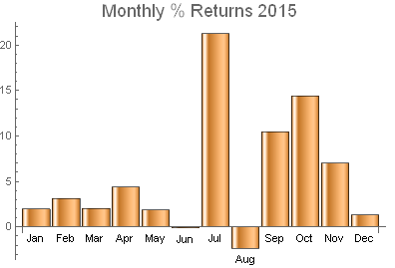
A DOUBLE-DIGIT MONTHLY RETURN: +21.28%

The results were rather spectacular:  a return of +21.28% for the month, bringing the totalMonthly Pct Returns return to 38.25% for 2015 YTD.

In the current low rate environment, this rate of return is extraordinary, but not entirely unprecedented: the strategy has produced double-digit monthly returns several times in the past, most recently in August last year, which saw a return of +14.1%.  Prior, to that, the record had been +8.90% in April 2013.

Such outsized returns come at a price – they have the effect of increasing strategy volatility and hence reducing the Sharpe Ratio.   Of course, investors worry far less about upside volatility than downside volatility (or simi-variance), which is why the Sortino Ratio is in some ways a more appropriate measure of risk-adjusted performance, especially for strategies like ours which has very large kurtosis.

VALUE OF $1000Since inception the compound annual growth rate (CAGR) of the strategy has been 45.60%, while the Sharpe Ratio has maintained a level of around 3 since that time.

Most of the drawdowns we have seen in the strategy have been in single digits, both in back-test and in live trading.  The only exception was in 2013, where we experienced a very short term decline of -13.40%, from which the strategy recovered with a couple of days.

In the great majority of cases, drawdowns in VIX-related strategies result from bad end-of-day “marks” in the VIX index.  These can arise for legitimate reasons, but are often

Sharpecaused by traders manipulating the index, especially around option expiration. Because of the methodology used to compute the VIX, it is very easy to move the index by 5bp to 10bp, or more, by quoting prices for deep OTM put options as expiration nears.  This can be critically important to holders of large VIX option positions and hence the temptation to engage in such manipulation may be irresistible.

For us, such market machinations are simply an annoyance, a cost of doing business in the VIX.  Sure, they inflate drawdowns and strategy volatility, but there is not much we can do about them, other wait patiently for bad “marks” to be corrected the following day, which they almost always are.

Looking ahead over the remainder of the year, we are optimistic about the strategy’s opportunities to make money in August, but, like many traders, we are apprehensive about Ann Returnsthe consequences if the Fed should decide to take action to raise rates in September.  We are likely to want to take in smaller size through the ensuing volatility, since either a long- or short-vol positions carries considerable risk in such a situation.  As and when a rate rise does occur, we anticipate a market correction of perhaps 20% or more, accompanied by surge in market volatility.  We are likely to see the VIX index reach the 20’s or 30’s, before it subsides.  However, under this scenario, opportunities to make money on the short side will likely prove highly attractive going into the final quarter of the year.  We remain hopeful of achieving a total return in the region of 40% to 50%, or more in 2015.

STRATEGY PERFORMANCE REPORT Jan 2012 – Jul 2015

Monthly Returns


Making Money with High Frequency Trading

There is no standard definition of high frequency trading, nor a single type of strategy associated with it. Some strategies generate returns, not by taking any kind of view on market direction, but simply by earning Exchange rebates. In other cases the strategy might try to trade ahead of the news as it flows through the market, from stock to stock (or market to market).  Perhaps the most common and successful approach to HFT is market making, where one tries to earn (some fraction of) the spread by constantly quoting both sides of the market.  In the latter approach, which involves processing vast numbers of order messages and other market data in order to decide whether to quote (or pull a quote), latency is of utmost importance.  I would tend to argue that HFT market making owes its success as much, or more, to computer science than it does to trading or microstructure theory.

By contrast, Systematic Strategies’s approach to HFT has always been model-driven.  We are unable to outgun firms like Citadel or Getco in terms of their speed of execution; so, instead, we focus on developing theoretical models of market behavior, on the assumption that we are more likely to identify a source of true competitive advantage that way.  This leads to slower, less latency-sensitive strategies (the models have to be re-estimated or recomputed in real time), but which may nonetheless trade hundreds of times a day.

A good example is provided by our high frequency scalping strategy in Corn futures, which trades around 100-200 times a day, with a win rate of over 80%.

Corn Monthly PNL EC


One of the most important considerations in engineering a HFT strategy of this kind is to identify a suitable bar frequency.  We find that our approach works best using data at frequencies of 1-5 minutes, trading at latencies of around 1 millisec, whereas other firms are reacting to data tick-by-tick, with latencies measured in microseconds.

Often strategies are built using only data derived from with a single market, based on indicators involving price action, pattern trading rules, volume or volatility signals.  In other cases, however, signals are derived from other, related markets: the VXX-ES-TY complex would be a typical example of this kind of inter-market approach.

SSALGOTRADING AD

When we build strategies we often start by using a simple retail platform like TradeStation or MultiCharts.  We know that if the strategy can make money on a platform with retail levels of order and market data latency (and commission rates), then it should perform well when we transfer it to a production environment, with much lower latencies and costs.  We might be able to trade only 1-2 contracts in TradeStation, but in production we might aim to scale that up to 10-15 contract per trade, or more, depending on liquidity.  For that reason we prefer to trade only intraday, when market liquidity is deepest; but we often find sufficient levels of liquidity to make trading worthwhile 1-2 hours before the open of the day session.

Generally, while we look for outside money for our lower frequency hedge fund strategies, we tend not to do so for our HFT strategies.  After all, what’s the point?  Each strategy has limited capacity and typically requires no more than a $100,000 account, at most.  And besides, with Sharpe Ratios that are typically in double-digits, it’s usually in our economic interest to use all of the capacity ourselves.  Nor do we tend to license strategies to other trading firms.  Again, why would we?  If the strategies work, we can earn far more from trading rather than licensing them.

We have, occasionally, developed strategies for other firms for markets in which we have no interest (the KOSPI springs to mind).  But these cases tend to be the exception, rather than the rule.